
How an ancient empire’s most effective tool of cultural erasure has found a disturbing echo in modern Ukraine
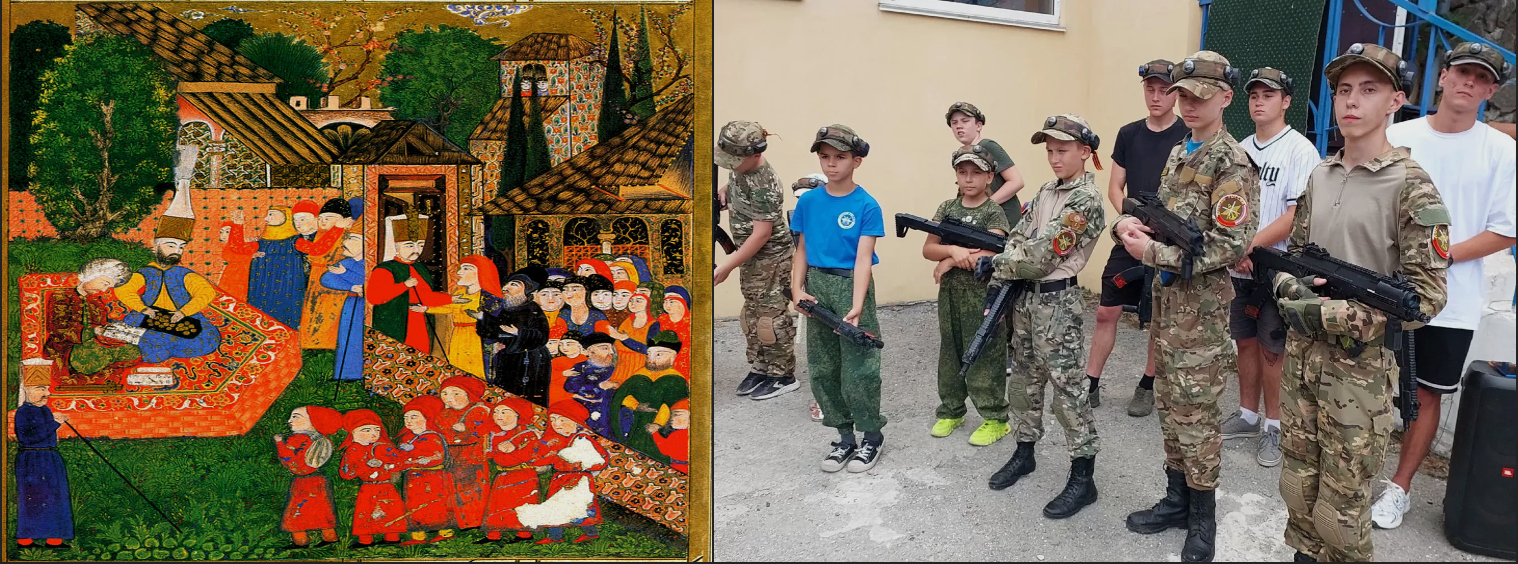
Left: The devşirme—Christian boys presented to Ottoman officials for induction into the Janissary system. Miniature from the Süleymanname, c. 1558, Topkapı Palace Museum. Right: Ukrainian children undergoing “re-education” at Russian military camps. Photo: Bring Kids Back UA
For hundreds of years, the Ottoman Empire ran one of history’s most sophisticated systems of forced assimilation: the devşirme, literally ”the gathering”. Christian boys from the Balkans and Anatolia were taken from their families, converted to Islam, given new names, and trained to serve the sultan. The best of them became the Janissaries, the empire’s elite infantry. Some rose to become grand viziers. Many never saw their families again.
Today, as documented by Ukrainian officials, international investigators, and the International Criminal Court, Russia is engaged in what critics and legal scholars are calling a systematic programme of relocating Ukrainian children to Russian territory, stripping them of their nationality, enrolling them in Russian schools, exposing them to state-directed ideological curricula, and, in many cases, placing them with Russian families for adoption. Russian officials have, at various points, spoken openly and approvingly of this process.
The parallel is not perfect. No historical parallel ever is. But it is close enough to be worth examining seriously, because the devşirme tells us something important about what such programmes are for, how they work on the children subjected to them, and what they mean for the societies from which those children are taken.
The Gathering
The devşirme operated on a rough cycle, typically every few years, in which Ottoman officials would arrive in Christian villages and select boys between the ages of roughly eight and eighteen. The criteria were specific: healthy, intelligent, good-looking, and neither too tall nor too short. Sons of craftsmen were preferred, sturdy, capable, and with practical intelligence. They had to be Christian, not Muslim (the logic being that converting them was the point). They could not be only sons, because wiping out a family line entirely would have caused too much local unrest.
The boys were marched to Constantinople. Their heads were shaved. They were circumcised. Their Christian names were replaced with Muslim ones. They were assigned to Turkish families in Anatolia first, to learn the language and customs, and then brought back for training in the palace schools, an education system that was, by the standards of its era, remarkably rigorous. Languages, theology, horsemanship, archery, administration. The brightest were channelled towards statecraft. The strongest support is towards the military.
The Janissaries who emerged from this process were, by most historical accounts, extraordinary soldiers. They were also, by design, men without a homeland to return to. They were barred from marrying for much of the corps’ early history. Their loyalty was to the Sultan and the empire because the empire had become everything: mother, father, faith, and identity.
The Filtration
Russia’s deportation of Ukrainian children has been documented most extensively by the Yale School of Public Health’s Humanitarian Research Lab and by Ukrainian government records. As of mid-2023, Ukrainian officials estimated that over 19,000 children had been confirmed deported, with the real figure potentially running into the hundreds of thousands. The ICC issued arrest warrants in March 2023 for Vladimir Putin and Maria Lvova-Belova, Russia’s Children’s Rights Commissioner, specifically for the unlawful deportation of children.
The mechanism, like the devşirme, is layered and somewhat varied. Some children were evacuated from active conflict zones, a process that has a surface plausibility as humanitarian. Others were taken from orphanages and state care institutions in occupied territories. Some were separated from parents during filtration processes. Once inside Russia, the children enter a system that is difficult to exit.
They are enrolled in Russian schools, where Ukrainian history is not taught or is taught as the history of a country that does not really exist or that was always properly part of Russia. They are instructed in Russian civic identity and, frequently, Russian Orthodox religious practice. Some are sent to camps, not labour camps, but the kind of ideological summer camps that have been a feature of Russian state youth programmes for decades and which have intensified significantly since 2022. They are, in many documented cases, formally adopted by Russian families, who are given state incentives to take them.
Russia disputes the characterisation of these as deportations. Their official stance is that these are humanitarian rescues of children orphaned or endangered by the conflict, which Russia claims Ukraine initiated, provoked, or is not losing.
What It Does to a Child
Here is where the comparison becomes most psychologically acute.
Ottoman sources, and later European accounts of encounters with Janissaries, suggest that most of the devşirme boys did not remain in anguish about their origins. Some did; there are records of Janissaries who maintained quiet contact with Christian relatives or who retained some private attachment to their birth communities. But the system worked. The conversion was generally real. The identity was genuinely transformed. Men who had been born Jovan or Georgios became Ibrahim and Mehmed, and they were Ibrahim and Mehmed. They served, often brilliantly, and they identified with their service.
This is the disturbing genius of beginning with children. Adult prisoners of war can be broken, but they rarely truly convert. A child of ten, placed in an immersive new environment with a new name, new language, new religion, and new social bonds and deprived of the old ones, that child’s identity is genuinely plastic. The new self is not a mask over the old one. In many cases, it simply becomes the self.
Child psychologists who have worked with conflict-affected children and researchers who have studied programs of forced assimilation from residential schools in Canada and Australia to the Nazi Lebensborn program consistently find the same thing: the younger the child, the more total the separation, and the more immersive the new environment, the more complete the identity transformation tends to be.
This is what makes Russia’s programme, if the worst accounts of it are accurate, so much more serious than simple propaganda exposure. Propaganda can be later unlearned. A childhood, the language of childhood, the religion of childhood, and the names and faces of the people who raised you are far harder to revise.
The Political Logic
The devşirme served the Ottomans in two ways simultaneously. First, obviously, it produced soldiers and administrators of exceptional loyalty and capability. Men who owed everything to the empire had every incentive to serve it faithfully. There was no rival clan, no ancestral land, no old religion pulling them in a different direction.
Second, and perhaps more importantly for the long run, it was a tool of cultural and demographic management. The Balkans remained restive under Ottoman rule. The devşirme did not stop Greek or Serbian or Bulgarian culture from surviving, but it systematically removed from those communities their most capable young men generation after generation. It was, in effect, a recurring brain drain imposed by force on conquered peoples, a slow, steady extraction of human capital that weakened the capacity of those communities to produce future resistance.
From an outsider’s perspective, Russia’s apparent logic operates similarly at both levels. Children raised in Russia, fluent in the language, deeply connected to Russian culture and heritage, and with Russian families, are unlikely to fight for Ukraine. Should they be returned or find their way back, they might even serve Russian interests within Ukrainian society. Furthermore, removing a generation of children from Ukrainian communities, especially those in occupied territories, has significant material and cultural repercussions that extend far beyond the individual children.
It is, in this sense, a policy aimed not just at the children but at Ukrainian identity itself. The goal, to put it plainly, is to make there be fewer Ukrainians in the world, not by killing them, but by transforming them into something else.
The Difference That Matters
The devşirme was, for most of its history, institutionalised and regularised, an accepted feature of Ottoman imperial administration. The boys taken knew, and their families knew, that this was how the empire worked. There was grief, but there was also, in some communities, a complicated ambivalence: a devşirme boy who rose high could sometimes protect his home village, and some families are recorded as having tried to get their sons selected.
There is no such ambivalence in occupied Ukraine. The children taken are taken from a society that is actively resisting the power taking them. Their removal is not a tax paid to an accepted sovereign but an act committed against people who contest Russian authority over their land entirely. And it is happening in the context of a war, which means that many of the children’s parents are dead, displaced, imprisoned, or simply unable to reach them.
There is also the matter of international law, which has evolved considerably since the fifteenth century. The forcible transfer of children from one national group to another is defined in the 1948 Genocide Convention as one of the acts constituting genocide, when committed with intent to destroy a national group in whole or in part. The ICC warrants reflect exactly this legal framework.
The Janissaries were a prominent feature of their era. What Russia is allegedly doing constitutes a crime under our laws.
The Children
In the end, what connects the devşirme and the Donbas most viscerally is the simplest thing: individual children, removed from everything they knew, asked to become something different.
Some Janissaries rose to greatness by their own standards, while others became administrators who built lasting legacies. A few even achieved historical significance. To us, the system that created them appeared monstrous, yet the men themselves were complex, much like people.
We don’t yet know who the Ukrainian children will become. Many are young, some are even infants. Currently, they’re learning Russian and being gently, perhaps even lovingly, introduced to their new identities by their adoptive families, without mentioning “Ukraine”.
Whether they’ll ever find their way back to themselves, if they choose to, is one of the quieter tragedies unfolding in this war. History suggests it’s incredibly difficult, yet it’s not entirely impossible. Some Janissaries managed to remember.
The question remains: will anyone be there to help them remember when the time comes?
