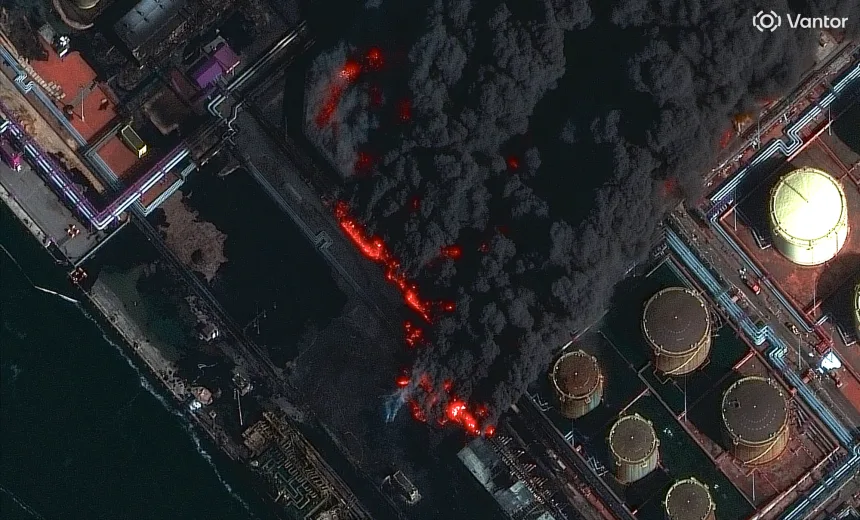

In less than 60 days, Kyiv has knocked out nearly half of Russia’s oil export capacity — not by attacking oil fields, but by targeting the pipes, ports, and refineries that everything flows through. Here’s why that distinction is the whole story.
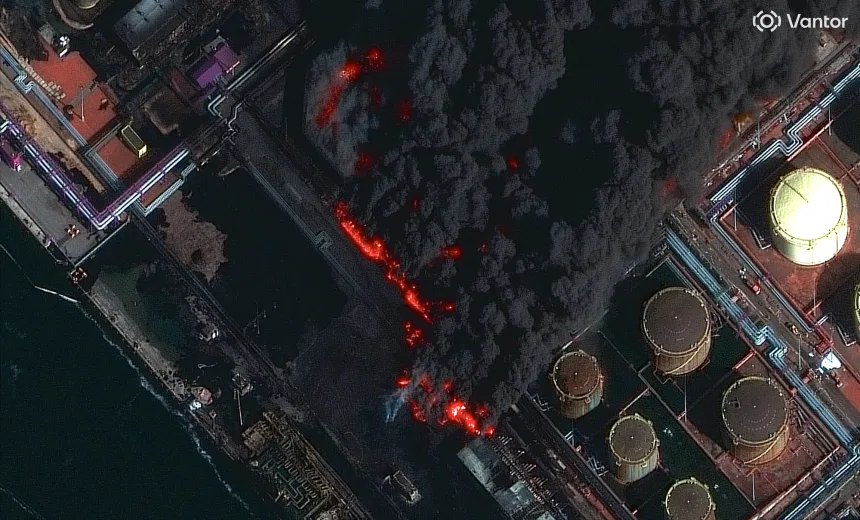
Russia doesn’t lose money when its oil stays in the ground. It loses money when its oil can’t get to market. That’s the insight driving Ukraine’s most strategically coherent offensive of the war — and it may be doing more damage to the Kremlin’s war chest than anything that’s happened on the front line.
Between March 2 and March 28, 2026, Ukraine struck six Russian energy facilities in rapid succession. The targets weren’t symbolic. They were chosen with a logic that is almost surgical: hit the export chokepoints, not the production assets that are scattered across thousands of miles of Siberian terrain and impossible to reach by drone.
The result, according to Ukrainian military sources and Reuters, is a roughly 40% reduction in Russia’s oil export capacity — the most severe disruption to Russian energy exports in modern history.
| The thesis | Infrastructure destruction creates supply bottlenecks that cannot be quickly cured. Attacking the pipes and ports is more effective than attacking the wells. |
What got hit, and why it matters
The six facilities targeted represent a cross-section of Russia’s entire export supply chain — from Baltic loading terminals to Black Sea crude ports to inland refineries. The strikes weren’t random. They targeted nodes where damage multiplies.
| Facility | Capacity lost / impact |
| Primorsk (Baltic) | 1,000,000+ bpd — completely halted. Russia’s primary Baltic export hub. High recovery complexity due to specialised loading equipment. |
| Ust-Luga (Baltic) | 800,000 bpd — suspended. Multiple berths hit. Processes condensate into jet fuel, naphtha, and gasoil. No spare Baltic capacity nearby. |
| Novorossiysk (Black Sea) | 700,000 bpd normal capacity, now reduced. Russia’s only Black Sea crude facility. Bottlenecks Mediterranean supply routes. |
| Druzhba Pipeline | 500,000 bpd offline since January 2026. Struck near Brody. 4,000 km of distributed infrastructure — extremely difficult to secure. |
| Yaroslavl Refinery | ~11.3 million tons/year output. Struck March 28. Significant diesel and fuel oil production hit. |
| KINEF, Kirishi | 20 million tons/year capacity — Russia’s second-largest refinery. Struck March 25–26. Produces approximately 80 product types. |
2% of global supply — but that’s not the right number to watch
You’ll see the figure 2 million barrels per day reported as the scale of the disruption. And you’ll see commentary pointing out that this is only about 2% of global crude production — a number designed to sound manageable.
It’s the wrong frame. Oil markets don’t price on total global supply. They price on the margin — on the difference between supply and demand at any given moment. Two million barrels per day is not a rounding error. It is, depending on the week, the entire buffer between a balanced market and a tight one.
More importantly: these barrels didn’t disappear cleanly. They disappeared from specific routes, serving specific buyers. Southern European refiners accessing Black Sea crude via Novorossiysk cannot simply switch to Baltic supply that has also been reduced. The geographic bottlenecks compound each other.
| Key dynamic | Russia’s oil producers have warned buyers they may declare force majeure on Baltic supplies. Force majeure isn’t just a supply disruption — it’s a legal signal that begins unwinding long-term contracts. |
The sanctions problem Ukraine is exploiting
Here’s what makes the infrastructure strategy particularly clever: Russia cannot easily fix what’s broken.
Many of the refineries and loading systems rely on specialised Western equipment — equipment that is now sanctioned. The loading arms at Primorsk, the processing units at Ust-Luga, the control systems at KINEF — these are not components you source from a domestic supplier in a few weeks. Lead times were long even before the war. Now, the suppliers are legally prohibited from selling.
This is the structural asymmetry Ukraine is betting on: it takes days to damage the infrastructure, and potentially months or years to restore it. Every strike extends Russia’s recovery timeline and deepens the revenue gap.
The Kremlin’s timing problem
There’s a painful irony in the timing. The conflict in the Middle East and the associated surge in crude prices should have delivered a windfall to Moscow — higher prices, same volumes, filling the war budget. Ukraine’s campaign has moved to neutralise that windfall before it can be banked.
If Russia was expecting its energy revenues to fund the next phase of the war, the strategic picture has shifted considerably. The question is no longer whether Russia can afford a prolonged conflict. It’s whether it can afford one while simultaneously managing an energy infrastructure crisis at home.
The bottom line
Ukraine has identified something that pure battlefield analysis tends to miss: a country’s ability to fight is bounded by its ability to pay. By targeting the infrastructure that converts oil in the ground into money in the budget, Kyiv has opened a second front — one that plays out in energy markets and balance sheets rather than trenches.
The strikes may not end the war. But they’ve made it considerably more expensive to continue it.
Sources: Ukrainian military briefings, Reuters, satellite imagery analysis. All capacity figures reflect pre-strike operational baselines.
