The War the World Forgot to Finish
The Crimean War, 1853 to 1856
AUG 10, 2026
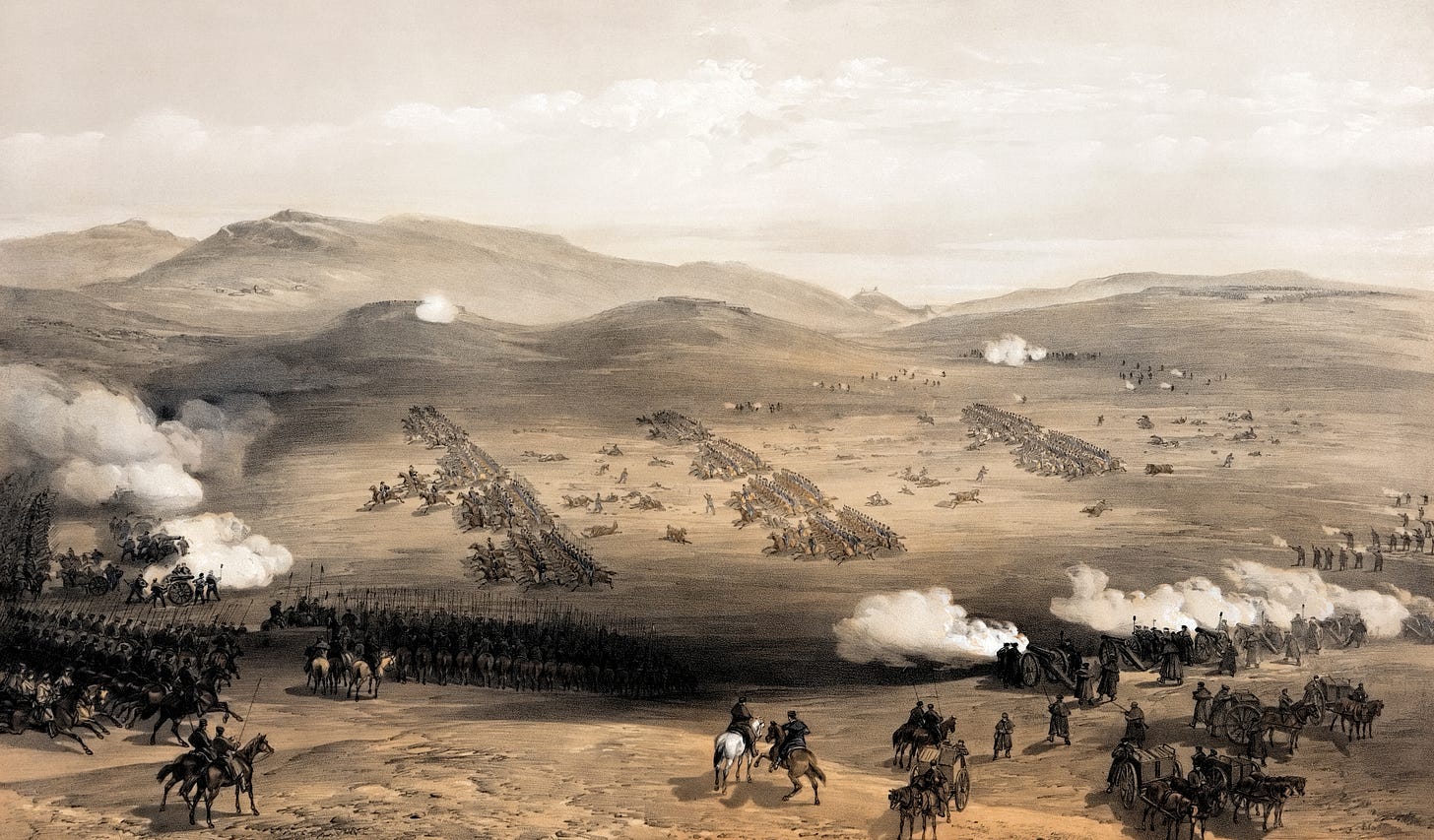
The Charge of the Light Brigade, 25 October 1854. William Simpson, 1855. Wikimedia Commons. Public domain.
Russia had Crimea. It had the Black Sea Fleet. It had Sevastopol. It wanted more. The rest of the world said no. What followed was one of the most catastrophic, most consequential, and most forgotten wars in modern history.
Part 1 ended with Russia in control of Crimea, its Tatar population driven out, its place names erased, and a brand new naval base at Sevastopol projecting Russian power into the Black Sea. That was 1783. For the next seventy years Russia pushed further, testing how much it could take before someone pushed back.
In 1853, someone finally did.
THE EXCUSE, AND WHAT IT WAS HIDING
Russia picked its fight the same way it always picks its fights. It found a pretext that sounded righteous and used it to cover an ambition that was not.
The pretext in 1853 was religion. Russia declared itself the protector of Orthodox Christians living under Ottoman rule. It was the same language Catherine had used in 1783: protection, rescue, reluctant intervention on behalf of people who had not asked for help. Tsar Nicholas I sent troops into Ottoman-controlled territory and moved his Black Sea Fleet to attack Ottoman ships.
What he actually wanted was straightforward. The Ottoman Empire was weakening. Nicholas called it “the sick man of Europe.” He wanted access to the Turkish Straits, the narrow channel connecting the Black Sea to the Mediterranean. Control that, and Russia could project naval power anywhere in the world.
Britain and France looked at that and said no.
Not for noble reasons. Britain had trade routes to protect. France had a new emperor who needed a war to prove himself. Russia had moved against the Ottomans in 1853. Britain and France declared war in March 1854. It was the first time the major European powers had gone to war with each other in nearly forty years. The battlefield they chose was Crimea.
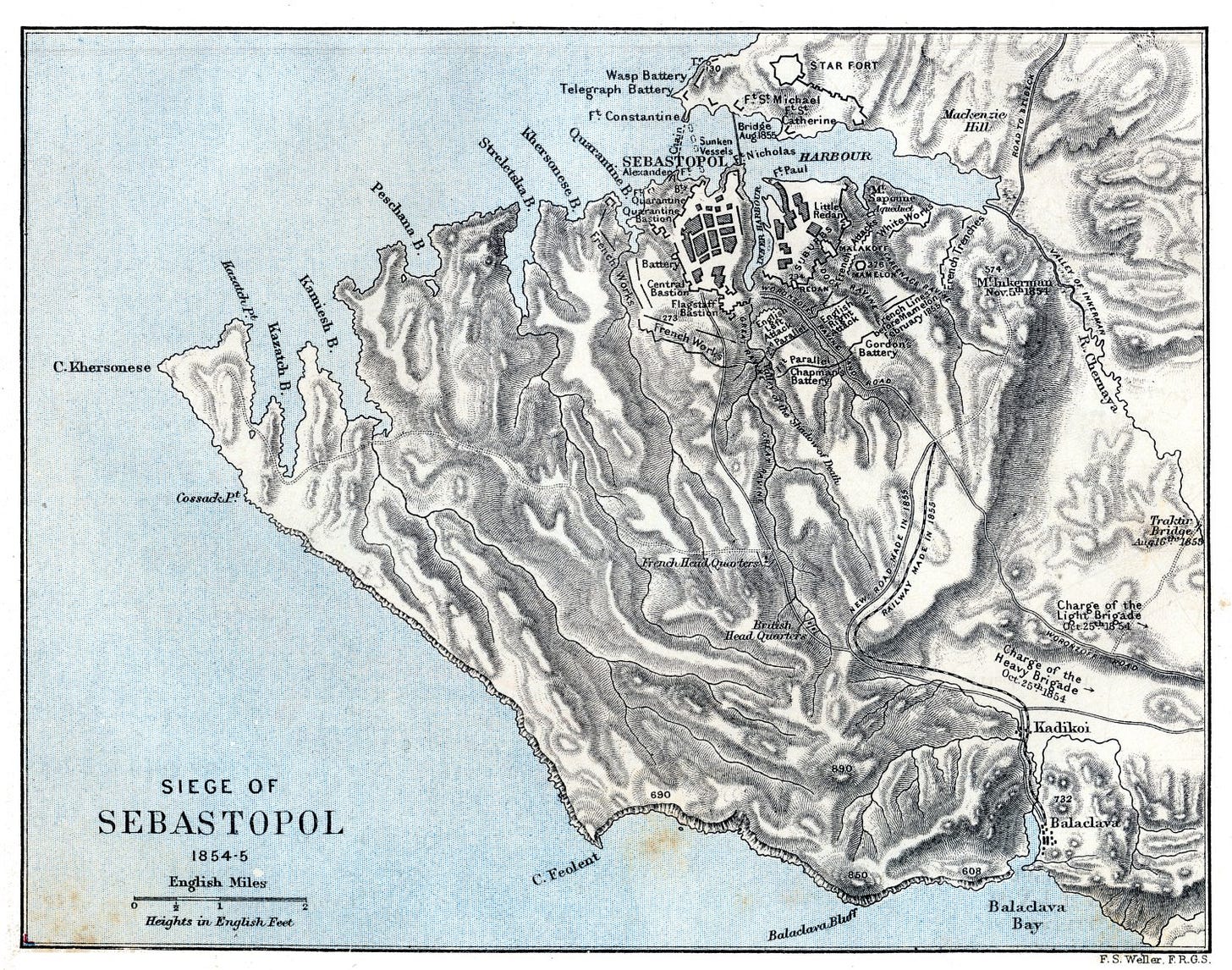
Siege of Sebastopol, 1854 to 1855. F.S. Weller. Wikimedia Commons. Public domain. A note on spelling: you will see it written as Sebastopol in older maps and histories, including the map above. That was the anglicised version used throughout the 19th century. Sevastopol is the modern spelling, and the one you will have seen in news coverage of 2014 and 2022. Same city. Same harbour. Same story.
SEVASTOPOL
The plan was simple. Take Sevastopol. Destroy the Black Sea Fleet inside it. Remove Russia’s ability to threaten the region from the south. The whole siege, in theory, could be over in weeks.
It took almost a year.
Allied forces landed on the Crimean coast in September 1854, about thirty miles north of Sevastopol. They won the first battle. They pushed south. They surrounded the city and began a siege that would last three hundred and forty nine days.
Sevastopol in 1854 was not a large city. Its population was smaller than a modern English market town. But it sat on one of the finest natural harbours in the world, heavily fortified, defended by soldiers who understood exactly what losing it would mean. They held on through winter conditions that killed as many men as the fighting did.
The trenches outside Sevastopol in the winter of 1854 to 1855 were among the worst places on earth. Soldiers on both sides froze. Supply lines collapsed. Men died of cholera, dysentery and frostbite in numbers that dwarfed the battlefield casualties. Of the roughly 21,000 British soldiers who died in the entire war, two thirds never saw combat.
Britain was not alone in its losses. France lost nearly 95,000 men. Russia lost an estimated 450,000. Across all sides, roughly half a million people died in a war fought over a peninsula most of them had never heard of. The majority on every side never died in battle. The Crimean War was not a war of great cavalry charges and heroic last stands. It was a war of catastrophic military incompetence, of officers who had bought their commissions rather than earned them, of a supply system so broken that soldiers starved while ships full of food sat in harbour with nobody to unload them. It was a war that exposed, in front of the world’s first war correspondents, just how badly the whole operation was being run.
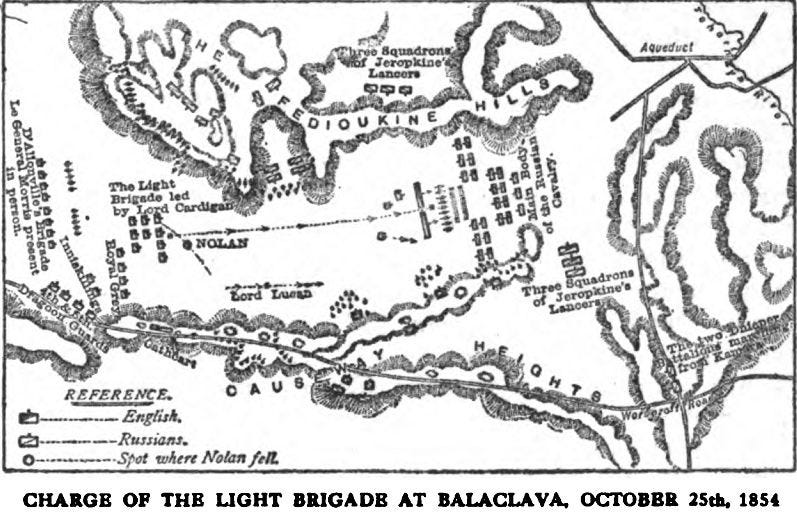
Tactical map of the Charge of the Light Brigade at Balaclava, 25 October 1854. The dotted line shows the route of the charge directly into the valley, with Russian artillery positioned on the hills on both sides. The circle marks the spot where Captain Nolan, who delivered the order to charge, was killed in the first minutes. From “Our Fighting Services” by Evelyn Wood. Wikimedia Commons. Public domain.
THE CHARGE
On 25 October 1854, a miscommunication between British commanders sent the Light Brigade, around 670 cavalrymen, directly into a valley flanked on three sides by Russian artillery. They charged anyway. In twenty minutes, roughly 120 men were dead and another 200 wounded or captured. They had taken the wrong objective entirely and achieved nothing.
A French general watching from the hillside said simply: it is magnificent, but it is not war.
Alfred Lord Tennyson wrote a poem about it that made it sound heroic. The poem is the reason most people have heard of it. The reality was a catastrophic failure of command that sent men to die because two generals could not agree on what a written order meant.
THE WOMAN IN THE HOSPITAL
There is one name from the Crimean War that almost everyone knows. And almost no one connects it to this war specifically.
Florence Nightingale.
When reports from the front began appearing in British newspapers, the public was horrified. Not by the fighting. But the hospitals. The wounded were lying in their own filth. There were no bandages. There was no system. Men who survived the battlefield were dying of infections that should have been treatable.
Nightingale arrived at the British military hospital at Scutari, across the water from Istanbul, in November 1854, with a team of 38 nurses. She found four miles of beds, most of them full, almost none of them properly supplied. She organised, lobbied and fought the military bureaucracy until the mortality rate collapsed. When she arrived, roughly 40 in every 100 patients were dying. By the time she left, it was closer to 2.
Modern nursing, as a profession, as a discipline, as something governments and medical institutions took seriously, was born in a war most people cannot place on a map.
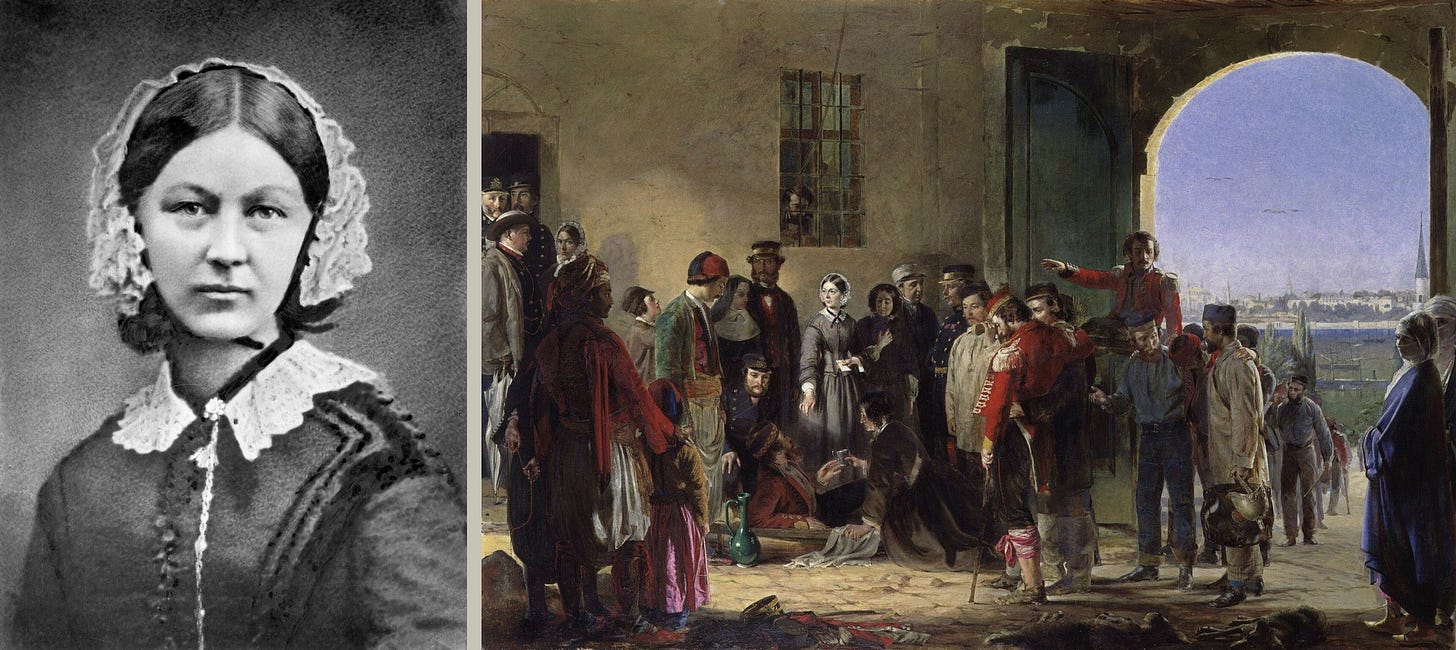
Left: Florence Nightingale, photographed circa 1860. Right: Florence Nightingale receiving the wounded at Scutari, painted by Jerry Barrett, 1856. Wikimedia Commons. Public domain.
THE FIRST WAR CORRESPONDENTS
This is the part of the story that connects most directly to why Caolan Reports exists.
The Crimean War was the first conflict in history to be covered by war correspondents in real time. Not officers writing memoirs after the fact. Not government dispatches carefully edited before publication. Journalists, in the field, sending reports home while the war was still happening.
The man who started it was William Howard Russell, an Irishman working for The Times of London. He had no military training and no official permission from the army to be there in any meaningful sense. He went anyway. What he sent back was not the war the British government wanted the public to see.
He described the trenches. He described the hospitals. He described soldiers dying of cold and disease because the supply system had broken down so completely that men were going without boots in a Crimean winter while warehouses full of supplies sat unorganised in the harbour. He named the failures. He named the people responsible.
The British establishment was furious. The commander of British forces blamed Russell’s reporting for giving information to the enemy and undermining the morale of his troops. There were serious attempts to have him removed from the front entirely.
The public read every word.
“The wretched beggar who wanders the streets of London leads the life of a prince compared with the British soldier.” William Howard Russell, dispatches to The Times, December 1854.
“The commonest accessories of a hospital are wanting; there is not the least attention paid to decency or clean linen; the stench is appalling… these men die without the least effort being made to save them.” William Howard Russell, dispatches to The Times, 1854.
Russell’s dispatches sold newspapers in numbers The Times had never seen. They were read in parliament. The outrage they produced brought down the British government in January 1855, the first time in history that a sitting government fell directly because of press reporting from a war zone. It is also the reason Florence Nightingale was sent to Scutari. Public pressure, generated by Russell’s reporting, forced the government’s hand.
He did not just report the war. He changed it.
Then there was Roger Fenton. Fenton was a photographer, sent to Crimea partly because the British government hoped positive images might counter the damage Russell was doing. Give the public something to look at, something orderly and composed, and perhaps they would stop reading those dispatches with quite so much horror.
Fenton took around 360 photographs. He worked with equipment that required him to prepare glass plates in a converted wagon and expose them within minutes in unpredictable temperatures. Every photograph was a physical ordeal.
But one image cut through everything else. A rutted dirt road running through a shallow valley, with cannonballs scattered across it and piled in the ditch alongside. No soldiers. No bodies. Just the road, the hills, and the evidence of what had passed through. He called it The Valley of the Shadow of Death. It is one of the most reproduced war photographs ever made, and it achieved the opposite of what the government had hoped. It made the war feel real in a way that words alone had not quite managed.
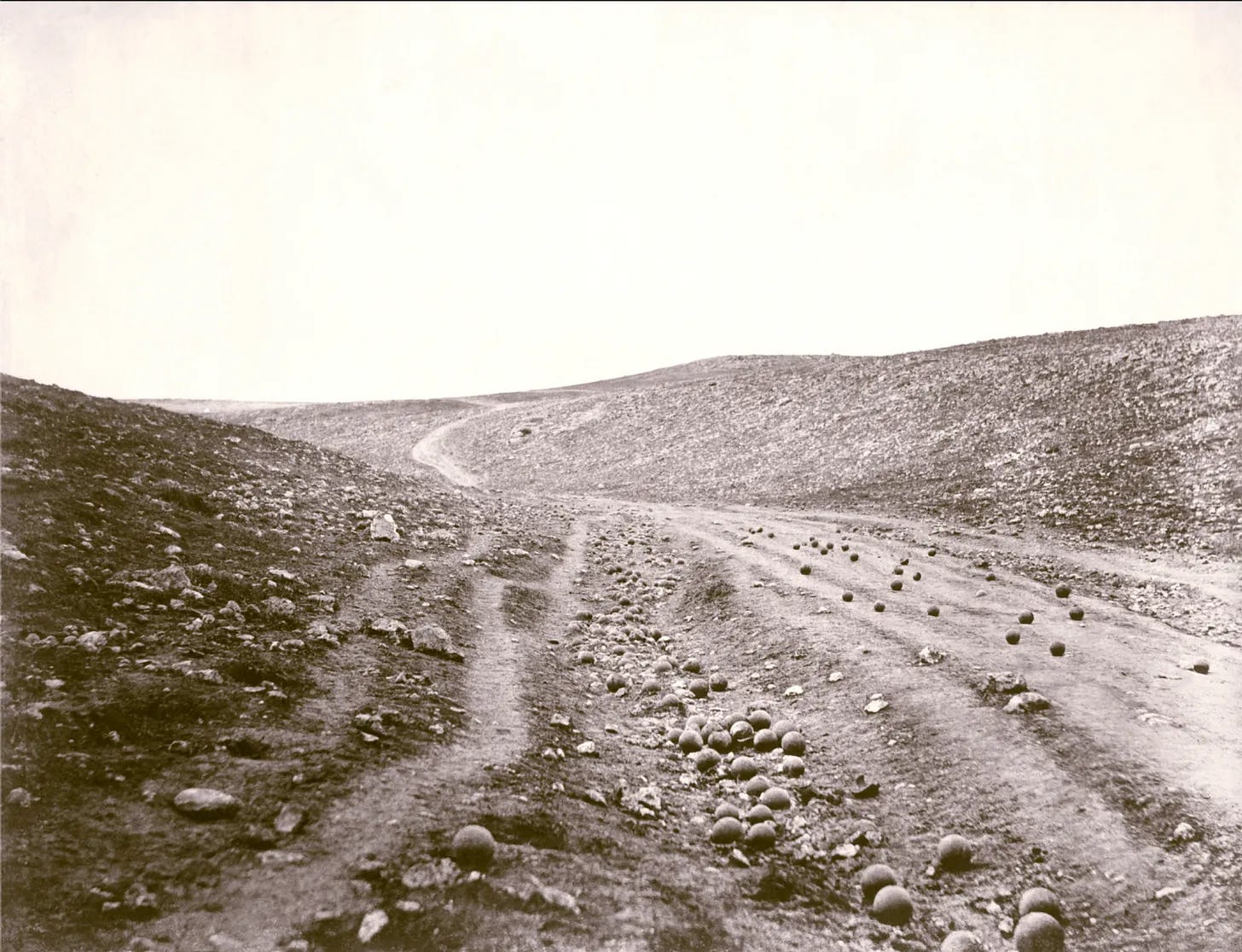
The Valley of the Shadow of Death, Crimea, 1855. Photograph by Roger Fenton. The road the Light Brigade charged down. Wikimedia Commons. Public domain.
The argument the army made against Russell in 1854 is the same argument made against war journalists today. That reporting from the front gives comfort to the enemy. That graphic coverage undermines public support for necessary military action. That journalists who show the reality of war cause more harm than good.
What Russell’s reporting did was force accountability. What Fenton’s photographs did was make the cost of war visible to people who would never come close to it. That is not undermining a war effort. That is the public’s right to know what is being done in their name.
The world’s first war correspondent went to Crimea in 1854. One hundred and seventy years later, Caolan Reports is in Kyiv. The technology is different. The argument about whether the work matters has not changed at all.
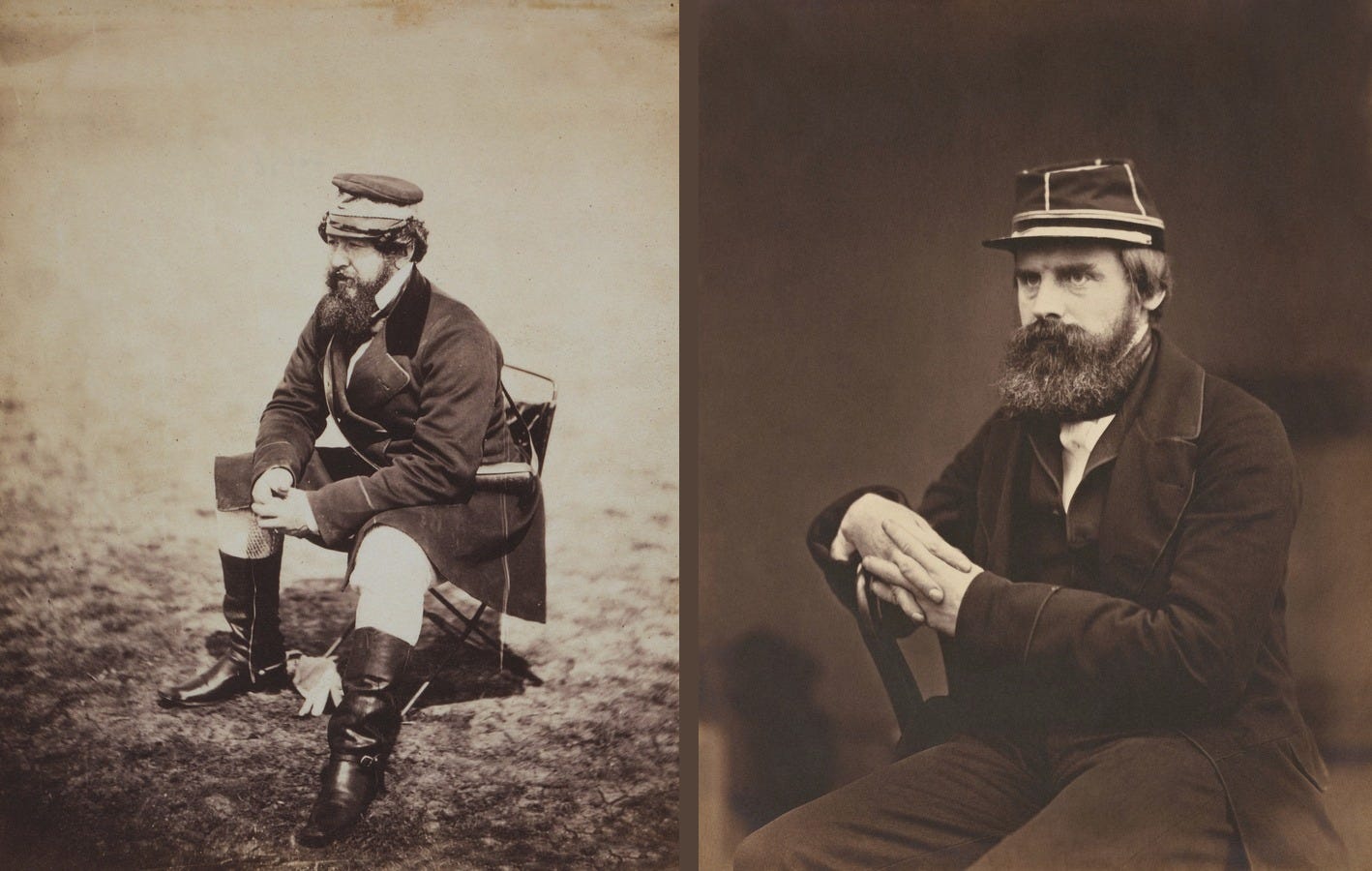
Left: William Howard Russell, war correspondent for The Times of London. Right: Roger Fenton, the first war photographer. Both in Crimea, 1855. Wikimedia Commons. Public domain.
RUSSIA LOSES
Sevastopol fell in September 1855 after nearly a year of siege. Russian forces blew up their own naval base rather than surrender it intact and retreated. The war was over.
The Treaty of Paris, signed in March 1856, stripped Russia of almost everything it had gone to war to protect. It was barred from keeping a naval fleet in the Black Sea. Sevastopol, the port Russia had spent a year defending, was to be demilitarised. The gains of a century of southern expansion were, on paper, reversed.
Russia signed. It had no choice.
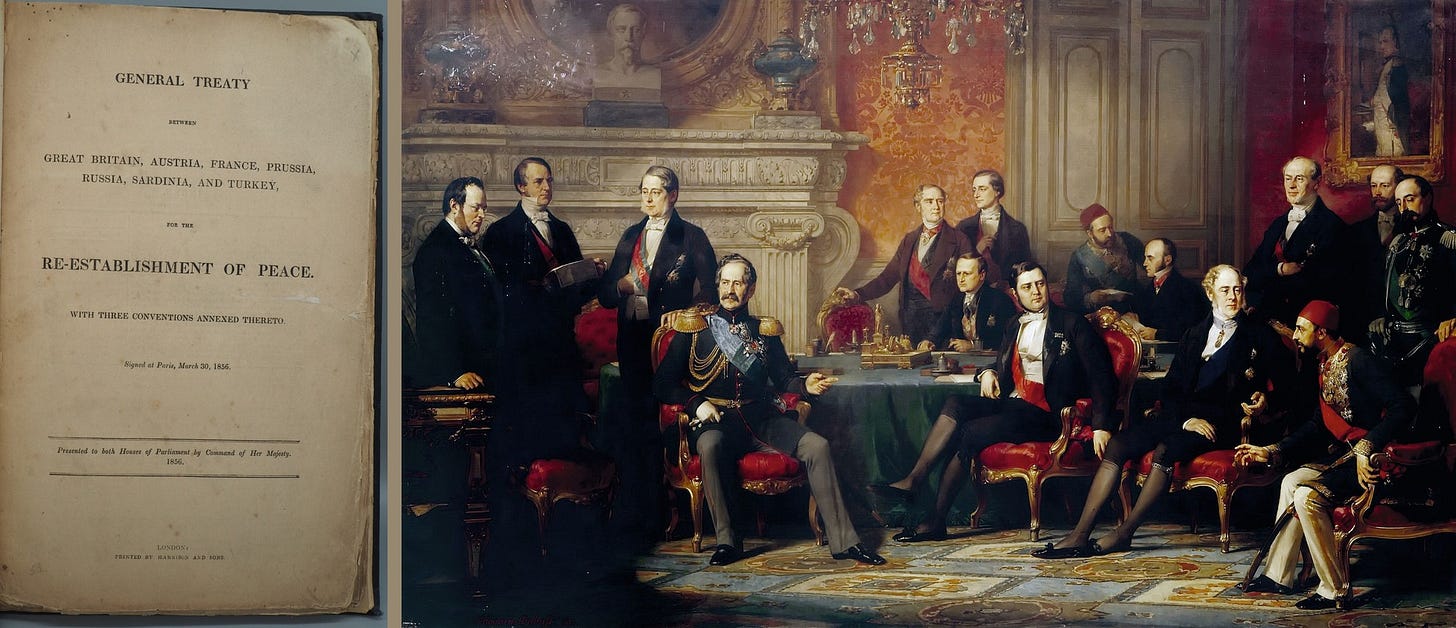
Left: The Treaty of Paris, signed 30 March 1856, presented to both Houses of Parliament by command of Her Majesty. Right: The Congress of Paris, painted by Edouard Dubufe, 1856. The men in that room drew the lines Russia would spend the next century and a half trying to erase. Wikimedia Commons. Public domain.
It did not forget.
The humiliation of the Crimean War sat at the centre of Russian strategic thinking for the next century and a half. It drove military reform, industrialisation, and a deep institutional obsession with the Black Sea and the warm water ports that gave access to it. Sevastopol was not just a city to Russia. It was a wound.
In 1871, fifteen years after the treaty, Russia tore up the clause banning its Black Sea fleet the moment it judged it could get away with it. By the Soviet period, Sevastopol had become a near-mythologised symbol of Russian sacrifice and resistance, celebrated in films, monuments and school curricula across the USSR.
And in February 2014, when Russian soldiers in unmarked uniforms appeared on the streets of Crimea, the first thing they secured was not a government building.
It was the naval base at Sevastopol.
One hundred and fifty eight years after the Treaty of Paris stripped it away, Russia took back what it had never stopped believing was its own.
NEXT
Russia lost the Crimean War. It signed the treaty. It accepted the terms. And then, slowly and deliberately, it undid every single one of them.
By 1944, Stalin had absolute control of Crimea, an unassailable Black Sea Fleet, and a Crimean Tatar population that had survived, against all odds, a century and a half of Russian rule. They had kept their language. They had kept their faith. They had kept their memory.
Stalin decided that was still too much. What he did next took seventy two hours.
That is Part 3.
Sources: Crimean War, Wikipedia; Orlando Figes, “Crimea: The Last Crusade” (2010); National Army Museum, “The Crimean War”; BBC History, “The Crimean War”; Florence Nightingale Museum, “Florence Nightingale and the Crimean War”; Roger Fenton Crimean War photographs, Library of Congress; Treaty of Paris 1856, Yale Avalon Project; The Times Digital Archive, William Howard Russell dispatches 1854 to 1856.