The Third Theft
How Russia Took Crimea Again, 2014
AUG 21, 2026
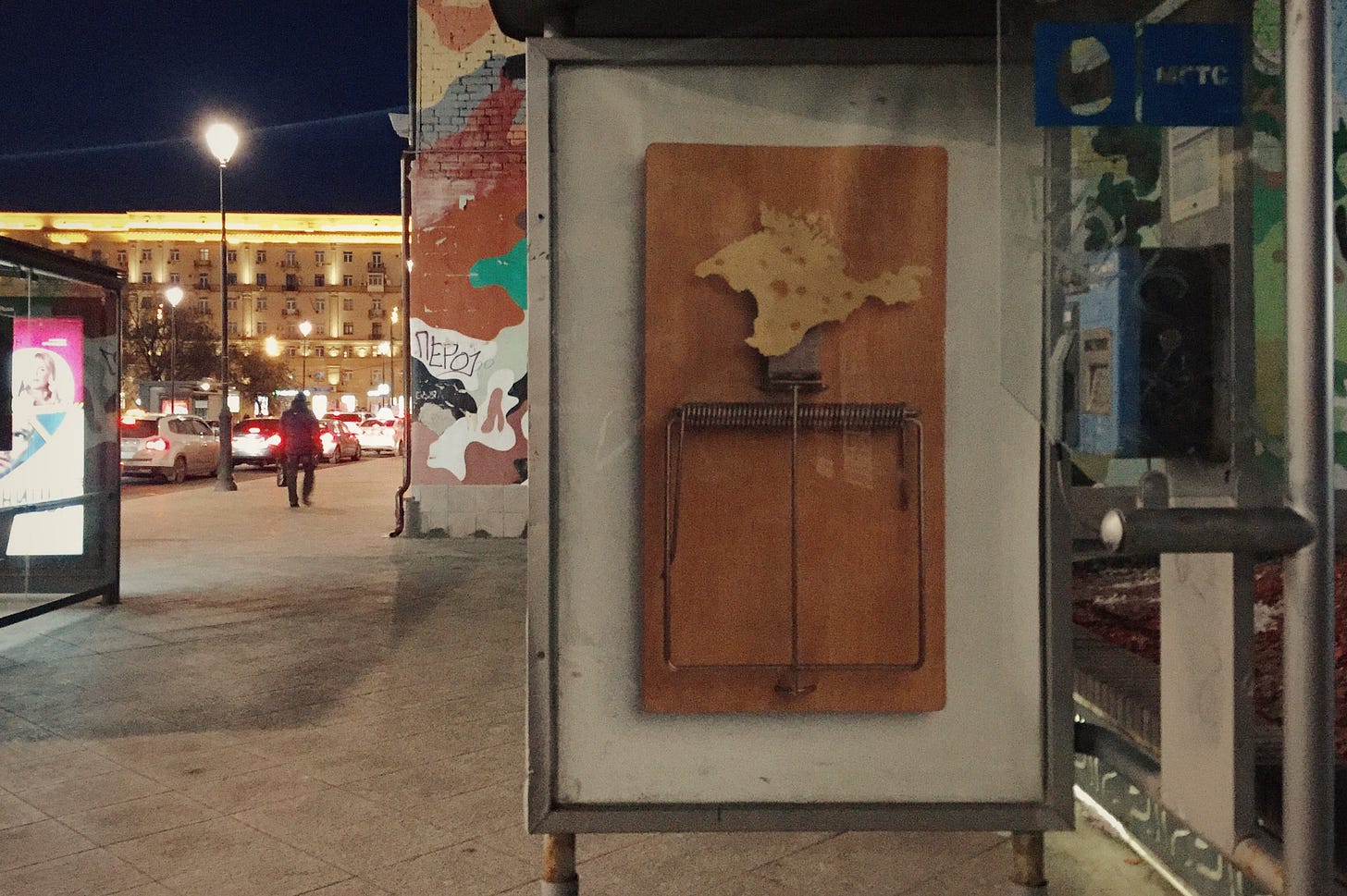
Anti-annexation street art photographed on Pokrovka Street, Moscow, 2014. Crimea shaped as the cheese on a mousetrap. The message: Russia’s promises of protection and prosperity were the bait. The trap was already set. Wikimedia Commons. Public domain.
In 1783 Catherine the Great took Crimea with a manifesto. In 1944 Stalin emptied it with cattle wagons. In February 2014, soldiers in unmarked uniforms walked onto the streets and nobody fired a shot. The third theft was the quietest. It was also the most consequential.
Parts 1, 2 and 3 of this series covered two and a half centuries of Russian behaviour toward Crimea and its people. Catherine’s annexation. The Crimean War. Stalin’s deportation. The pattern was always the same. A pretext. A promise of protection. And then erasure.
By 2014, that pattern was about to repeat for the third time. And this time, the world was watching.
THE MOMENT PUTIN CHOSE
To understand what happened in February 2014, you have to understand what was happening in Kyiv.
Ukraine’s President Viktor Yanukovych had spent months promising to sign an association agreement with the European Union, an agreement that would have moved Ukraine closer to Europe and further from Russia’s orbit. In November 2013 he abruptly reversed course under pressure from Moscow and refused to sign. Ukrainians took to the streets.
What followed was three months of protests on Kyiv’s Maidan Nezalezhnosti, Independence Square. The Euromaidan. At its height, hundreds of thousands of people stood in the snow demanding a European future for their country. In February 2014, government snipers opened fire on protesters. Over a hundred people were killed. Yanukovych fled to Russia.
Putin watched all of this and made a decision.
He later admitted in a documentary that he personally gave the order to begin work on “returning Crimea” on the night of 22 to 23 February 2014, the night Yanukovych fled. The operation had been planned. It was waiting for the right moment. The fall of a pro-Russian government in Kyiv was that moment.
THE LITTLE GREEN MEN
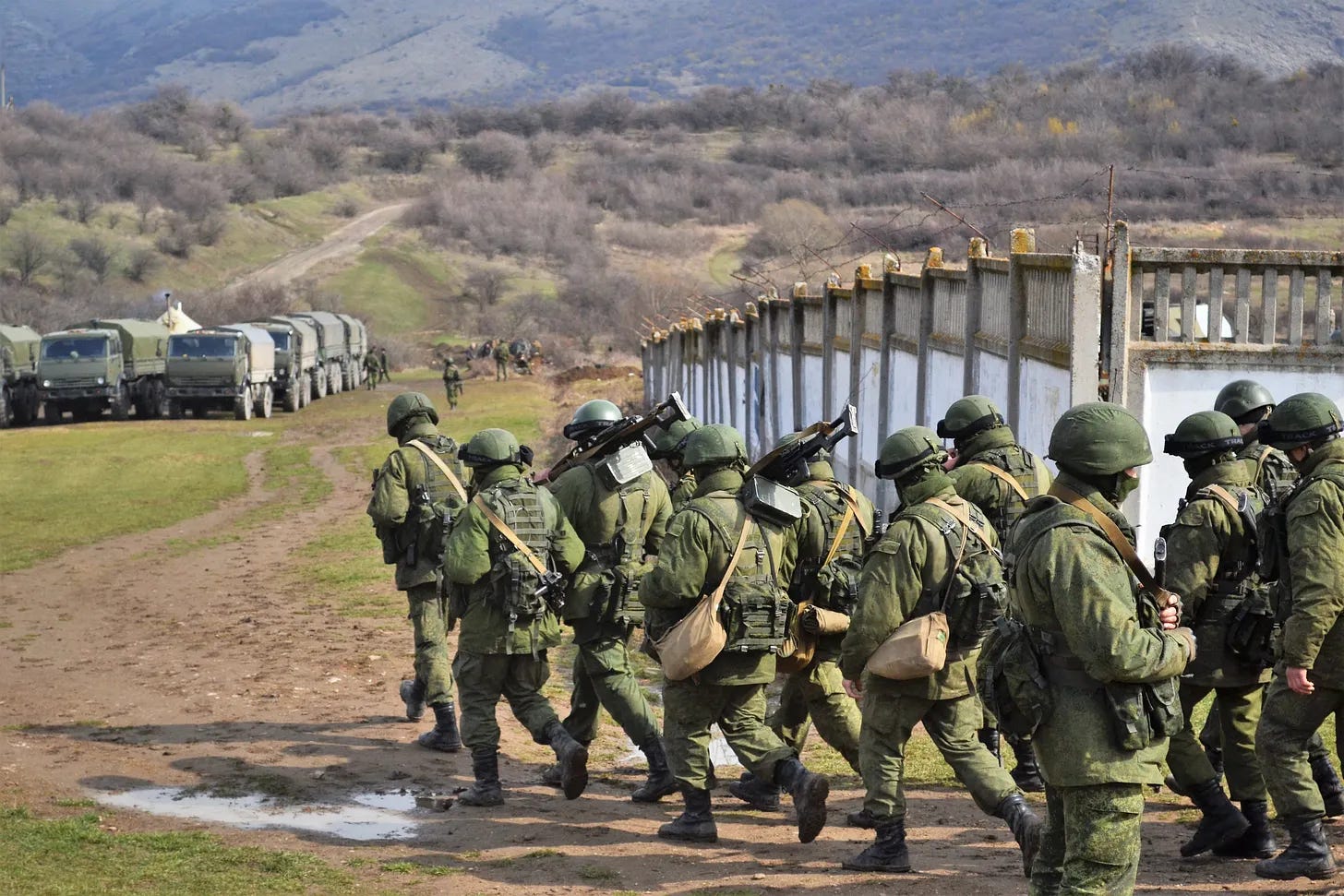
Russian troops without insignia at Perevalne military base, Crimea, March 2014. Professional soldiers, moving with military precision, using the latest military equipment. Russia initially denied they were Russian. Putin later admitted he had personally ordered the operation. Wikimedia Commons. Public domain.
On the night of 26 to 27 February 2014, armed men in unmarked green uniforms seized the Crimean parliament building and the Council of Ministers in Simferopol. They raised Russian and Crimean flags. They had no insignia. No unit markings. No identification of any kind.
At the same time, other units secured Simferopol airport and Sevastopol airport. Roads into Crimea from mainland Ukraine were blocked. Armed checkpoints appeared across the peninsula overnight.
Russia denied they were Russian soldiers.
Vladimir Putin stood in front of cameras and said the men were local self-defence forces who had bought their uniforms in shops. He called them, with a straight face, “polite people.”
The world knew exactly what it was looking at. These were professional soldiers, moving with military precision, using military equipment, securing military objectives in a sequence that had clearly been planned well in advance. They were not men who had bought uniforms in shops.
Putin later admitted, in the same 2014 documentary, that he had personally ordered Russian special forces to begin the operation. “We had to start working on returning Crimea to Russia,” he said.
The first thing they secured was not a government building. It was the naval base at Sevastopol.
Two hundred and thirty one years after Catherine built it. One hundred and fifty eight years after the Treaty of Paris stripped it away. Fifty eight years after the Soviet Union transferred Crimea to Ukraine. The port came first. It always comes first.
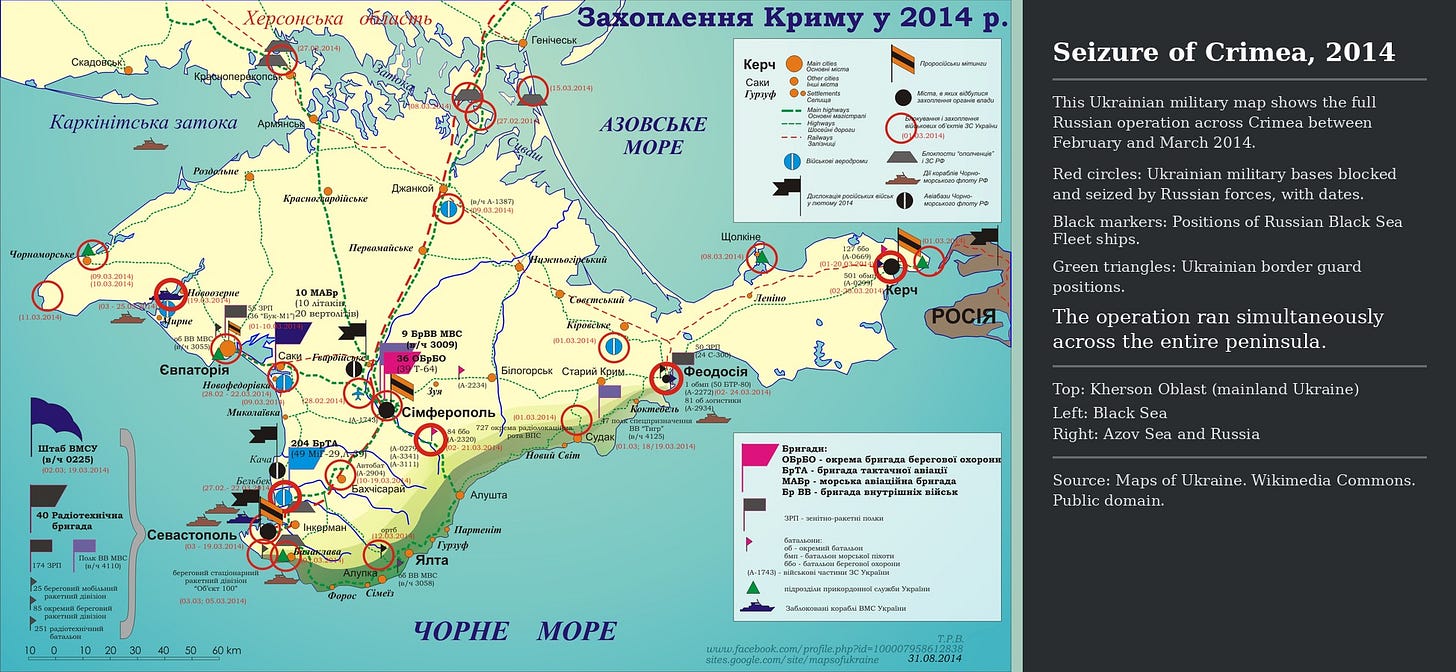
Military map showing the full Russian operation across Crimea, February to March 2014. Red circles mark Ukrainian military bases blocked and seized by Russian forces, with dates. The operation ran simultaneously across the entire peninsula. Top: Kherson Oblast, mainland Ukraine. Right: Russia. Source: Maps of Ukraine. Wikimedia Commons. Public domain.
THE REFERENDUM
With Russian troops controlling the peninsula, the newly installed Crimean authorities announced a referendum on the status of Crimea. It was scheduled for 16 March 2014, two weeks away. No independent international observers were invited. Ukrainian and Tatar media were taken off air.
Before the vote could take place, the Ukrainian military had to be dealt with.
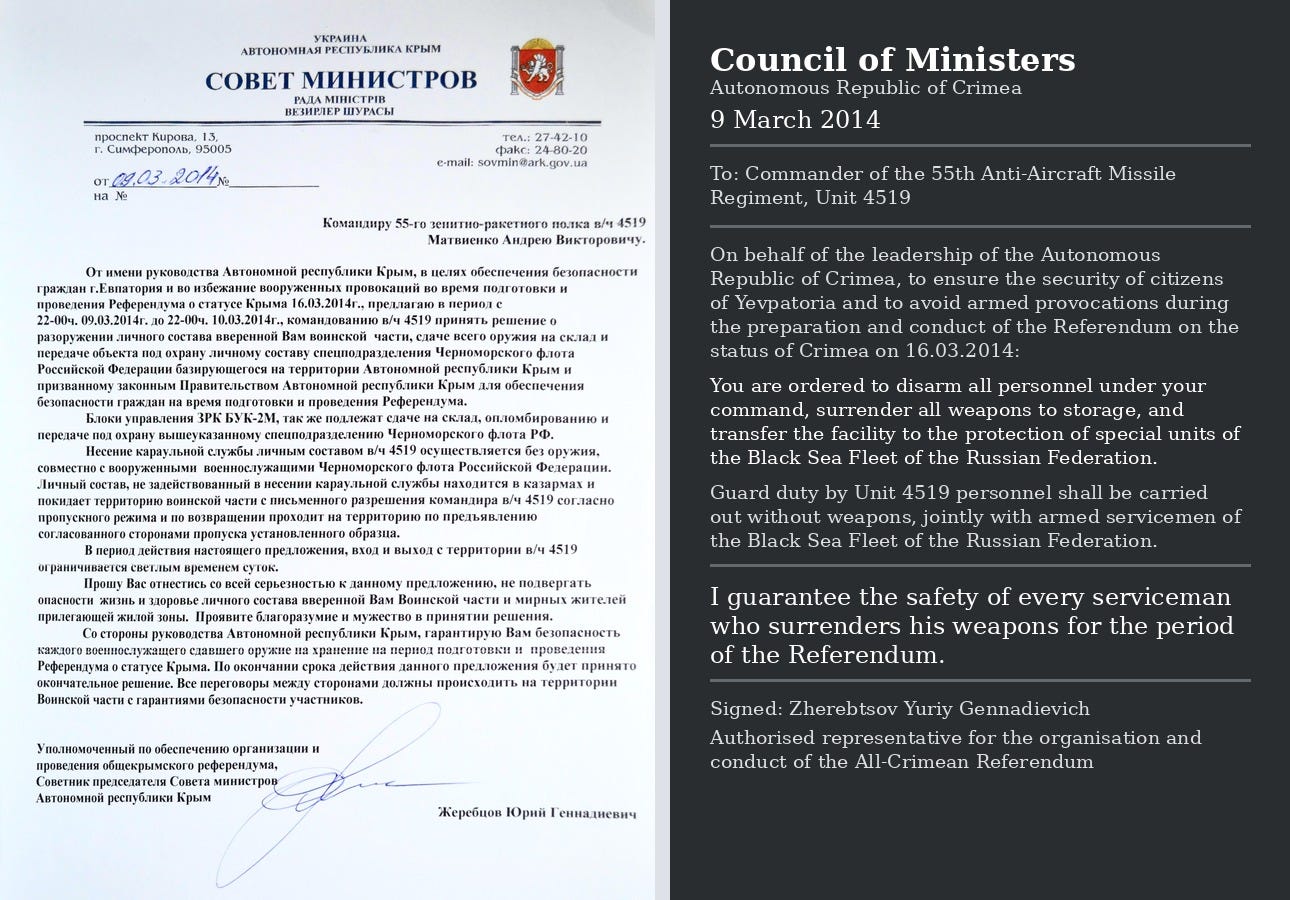
Letter from the Council of Ministers of the Autonomous Republic of Crimea, dated 9 March 2014, addressed to the commander of the 55th Anti-Aircraft Missile Regiment. It orders Ukrainian troops to disarm, surrender all weapons to Russian Black Sea Fleet forces, and transfer control of their base before the referendum. It ends: “I guarantee the safety of every serviceman who surrenders his weapons.” Wikimedia Commons. Public domain.
The ballot paper offered two choices: join Russia, or restore the 1992 constitution that had declared Crimea a republic within Ukraine. Remaining part of Ukraine as it currently existed was not an option on the ballot.
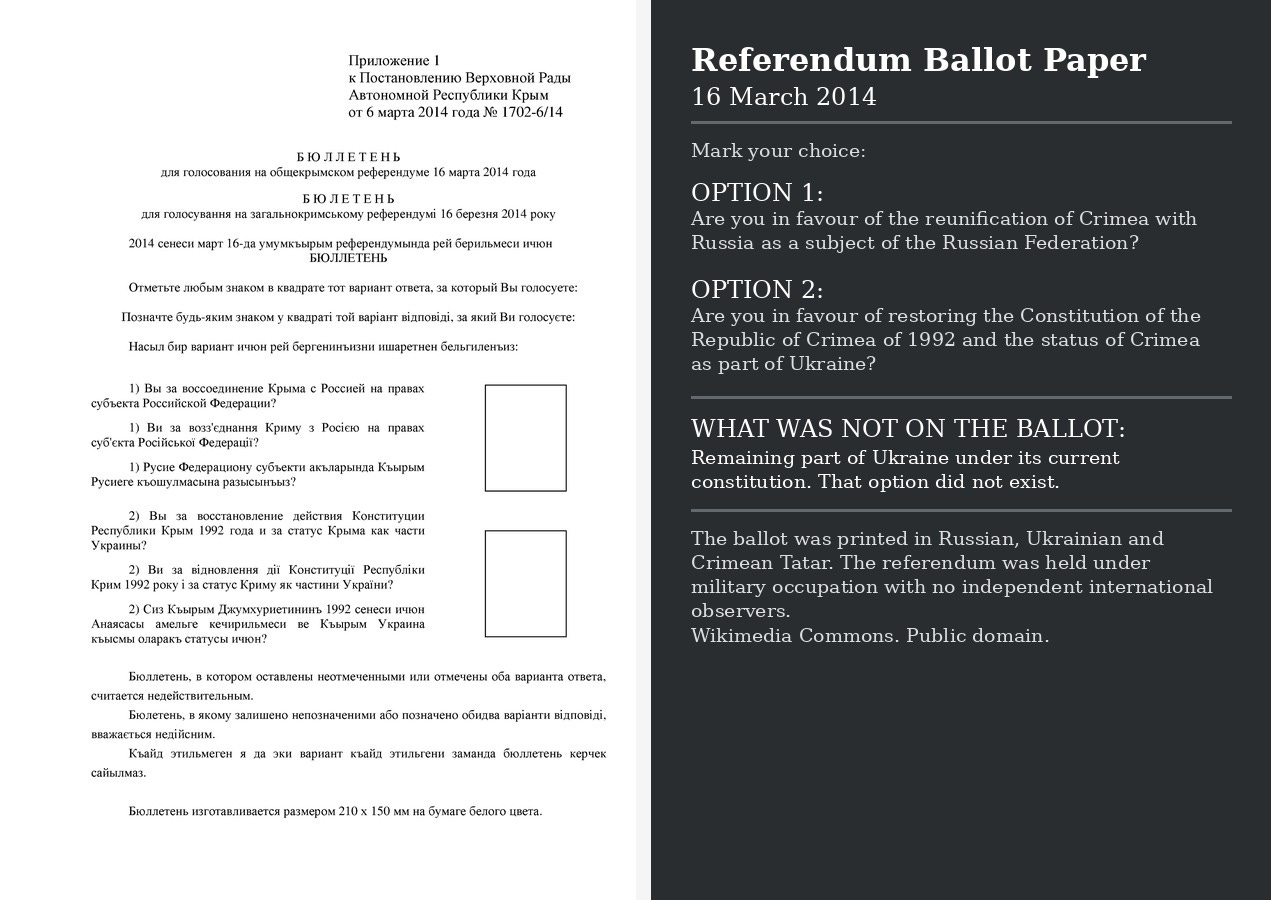
The official ballot paper for the 16 March 2014 referendum, printed in Russian, Ukrainian and Crimean Tatar. Two options: join Russia, or restore the 1992 constitution. Remaining part of Ukraine under its current constitution was not offered. The referendum was held under military occupation with no independent international observers. Wikimedia Commons. Public domain.
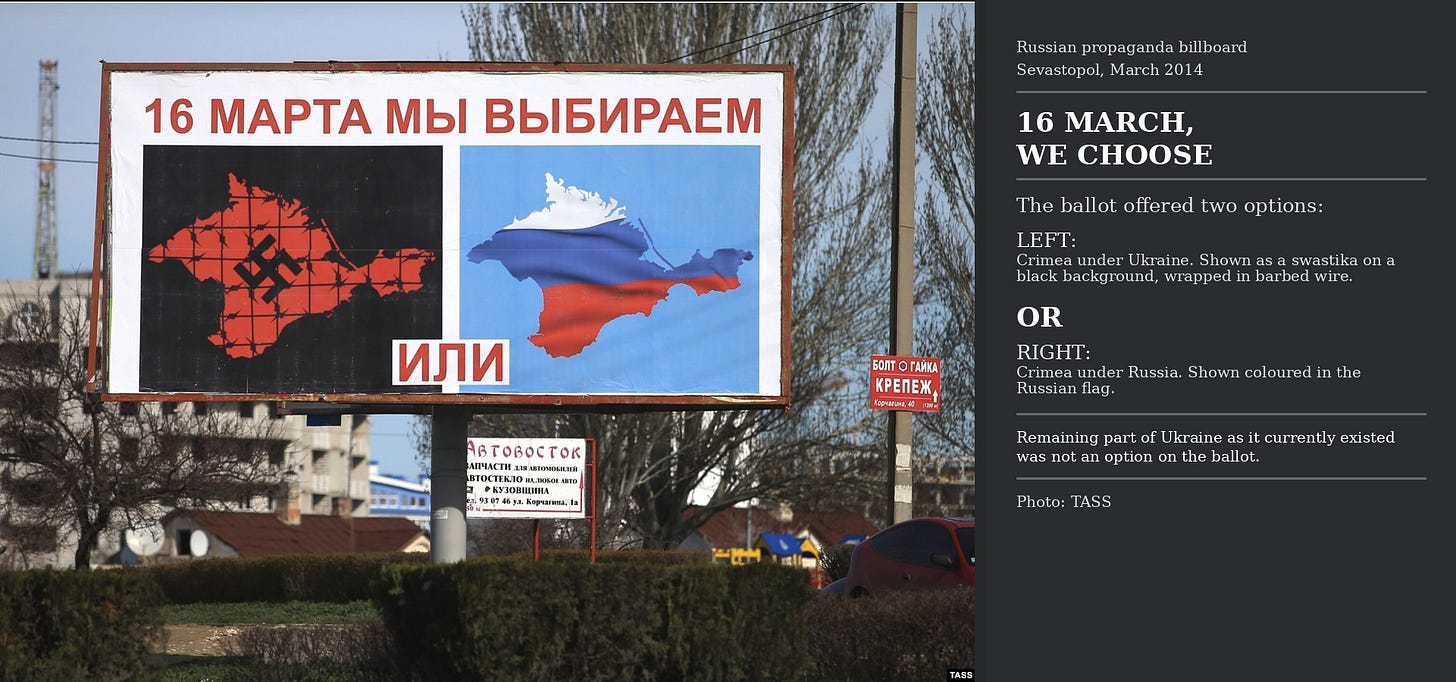
Russian propaganda billboard in Sevastopol, March 2014. The text reads: “16 March, we choose.” Left option: Crimea shown as a swastika on a black background wrapped in barbed wire. Right option: Crimea coloured in the Russian flag. This was the choice Russia offered. Photo: TASS.
The result, announced two days later, was 96.77 percent in favour of joining Russia. Turnout was reported at 83 percent.
Independent analysts and leaked documents suggested the actual result was far lower. A leaked report from the Russian Presidential Human Rights Council put the vote for joining Russia at somewhere between 50 and 60 percent, with turnout around 30 to 50 percent.
It did not matter. Two days after the result was announced, Putin signed the treaty incorporating Crimea into the Russian Federation. The UN General Assembly passed a resolution declaring the referendum invalid. 100 countries voted in favour. 11 voted against. 58 abstained.
The west imposed sanctions. Russia kept Crimea.
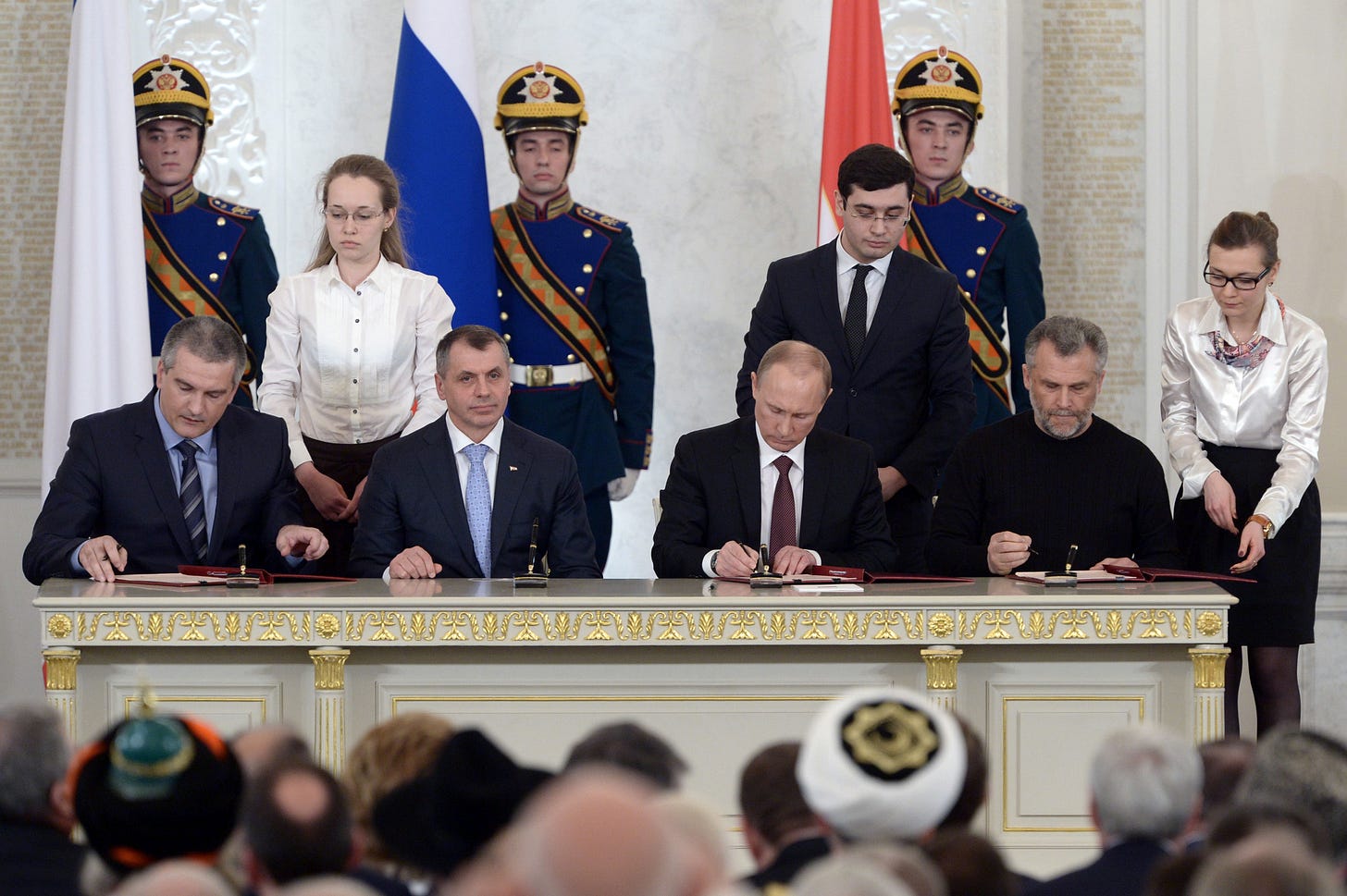
Vladimir Putin signs the treaty incorporating Crimea into the Russian Federation, 18 March 2014, alongside the installed Crimean leadership. Two weeks earlier, Russian troops had been on the streets with no insignia. Now the paperwork was done. Wikimedia Commons. Public domain.
THE TATARS KNEW
The Crimean Tatars understood what had happened before almost anyone else did.
Mustafa Dzhemilev, who had spent fifteen years in Soviet prisons fighting for the right to exist on his own land, watched Russian soldiers secure Simferopol and said: “We have seen this before.”
The Mejlis, the Crimean Tatar representative assembly, voted immediately to oppose the annexation and support Ukrainian territorial integrity. They organised peaceful protests. They refused to participate in the referendum.
Russia’s response was methodical and familiar.
In 2016, Russian authorities banned the Mejlis entirely, designating it an extremist organisation. The same body that had fought for fifty years to bring the Tatar people home from Soviet exile was now, under Russian occupation, a terrorist organisation. Tatar language broadcasting was shut down. Tatar language schools were closed or converted to Russian language instruction. ATR, the main Crimean Tatar television channel, was forced to relocate to Kyiv.
The pattern that Catherine began in 1783, that Stalin accelerated in 1944, continued without pause.
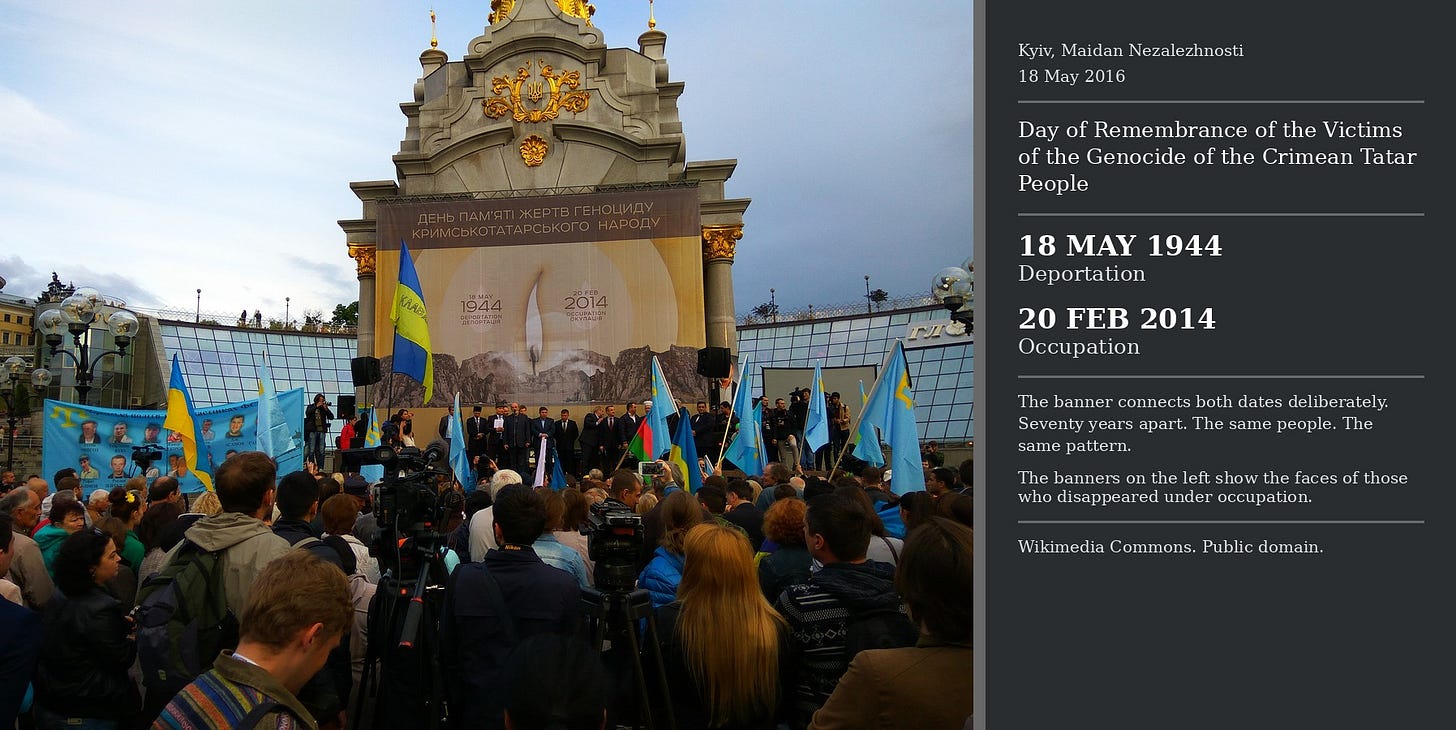
Crimean Tatar memorial gathering on Kyiv’s Maidan Nezalezhnosti, 18 May 2016. The banner reads: “Day of Remembrance of the Victims of the Genocide of the Crimean Tatar People.” The dates 18 May 1944 and 20 February 2014 appear side by side. Seventy years apart. The same people. The same pattern. The banners on the left show the faces of those who disappeared under occupation. Wikimedia Commons. Public domain.
THE WAVES
What followed the annexation was not a single act of repression. It came in waves.
Crimea SOS, the Ukrainian human rights organisation that has tracked the occupation since 2014, documented at least 66 forced disappearances in Crimea since Russia took control. Their analysts identified four distinct waves.
The first wave ran from March to May 2014, the period when the occupation was being established. At least 25 pro-Ukrainian activists disappeared. Among them was Reshat Ametov, a Crimean Tatar who staged a one-man protest in Simferopol. Twelve days later he was found dead with signs of extensive torture. Five other pro-Ukrainian activists from this period, including Valeriy Vashchuk, Ivan Bondarets, Vasyl Chernysh, Timur Shaimardanov and Seyran Zinedinov, have never been found.
The second wave came in the autumn of 2014 and targeted mostly Crimean Tatars. Among those who disappeared were the son and nephew of Abdurashit Dzhepparov, a veteran of the Crimean Tatar national movement. More than ten years later, their whereabouts remain unknown.
The third wave ran from August 2015 to May 2016 and again fell heaviest on the Tatar community. On the evening of 24 May 2016, Ervin Ibragimov, a Mejlis activist, was abducted in Bakhchysarai. Surveillance cameras captured the moment: two men, one in a law enforcement uniform, dragged him from his car, forced him into a minibus and drove away. His car was found abandoned on the street. The Russian controlled Investigative Committee opened a case, suspended it in 2017, and cited the impossibility of identifying perpetrators who had been filmed committing the crime. Ervin Ibragimov has never been found. In March 2026, his mother died under occupation without ever learning what happened to her son.
The fourth wave began with Russia’s full scale invasion of Ukraine on 24 February 2022 and expanded beyond Crimea into the occupied territories of Kherson and Zaporizhzhia. Dozens of people were abducted and held in detention facilities in Crimea. The most recent documented victim was Edie Muslimova, editor of a Crimean Tatar children’s magazine, abducted on 21 November 2024. When the case became public, she was released.
Of the 66 documented disappearances: 21 people remain missing. Six were found dead. Seven have been charged with crimes. Thirty one were released within days of being taken.
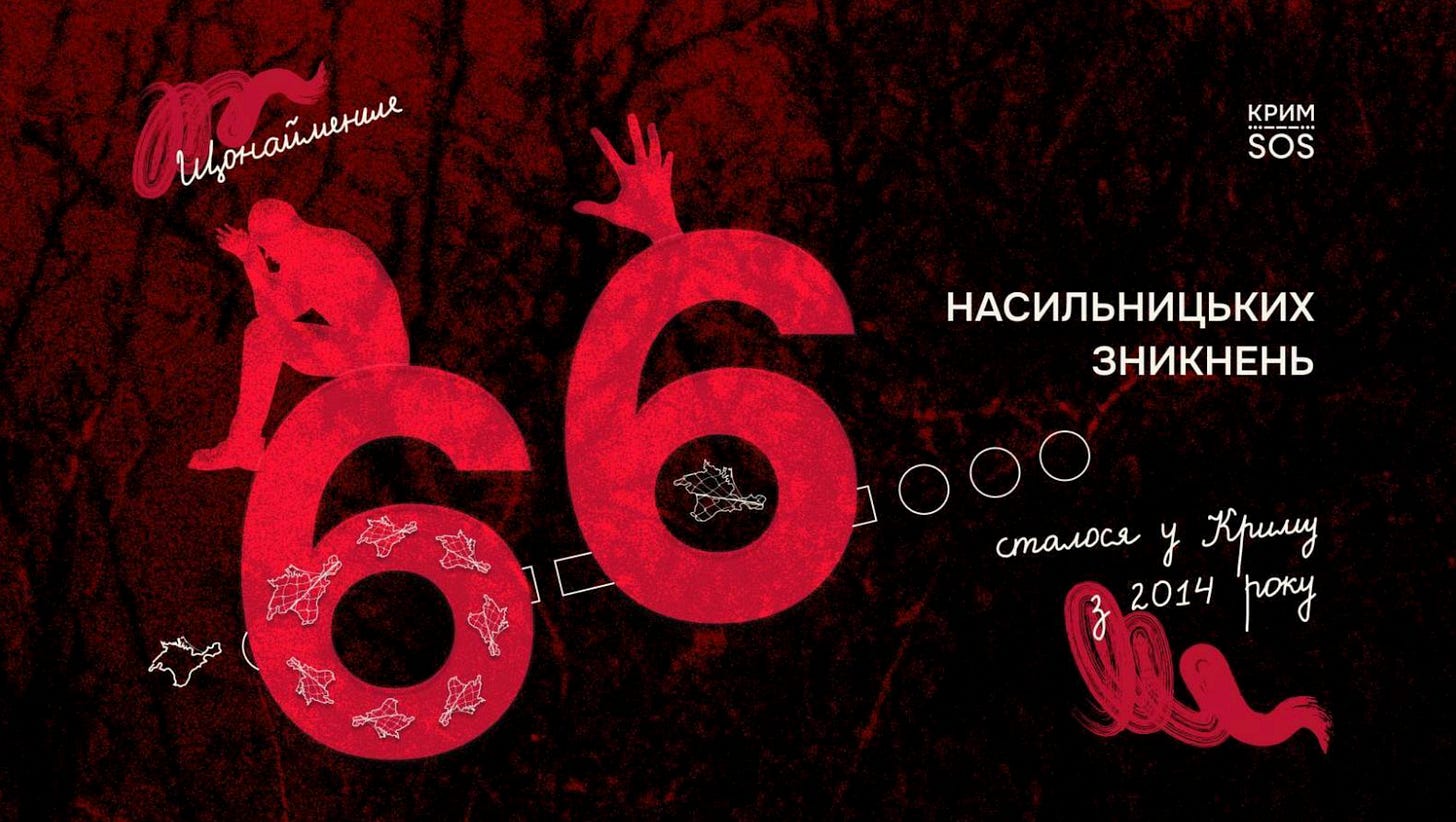
At least 66 forced disappearances have been documented in Crimea since Russia’s occupation began in 2014. Source: Crimea SOS. krymsos.com
These are not wartime casualties. These are people who disappeared from their homes, their cars, their streets, in a territory Russia claimed it had peacefully liberated.
EIGHT YEARS OF OCCUPATION
Between 2014 and 2022, the world mostly looked away.
Sanctions were imposed but not tightened. Diplomatic protests were filed. Summits were held. The language of de-escalation and dialogue filled communiques that changed nothing on the ground.
In Crimea, the occupation bedded in. Russian citizens were moved onto the peninsula in large numbers. Ukrainian property law was replaced with Russian law. Ukrainian currency was replaced with the rouble. Ukrainian passports were replaced with Russian ones, often by force. Refusing a Russian passport meant losing access to employment, healthcare and education.
The military buildup was systematic and enormous. Sevastopol was expanded and modernised. The Black Sea Fleet was reinforced. New missile systems were installed on the peninsula capable of striking targets across the entire Black Sea region and beyond. A bridge was built across the Kerch Strait connecting Crimea to mainland Russia, removing the peninsula’s geographic isolation and creating a direct land and rail link to Russian territory.
NATO watched. Intelligence agencies tracked. Reports were written.
And Putin kept building.
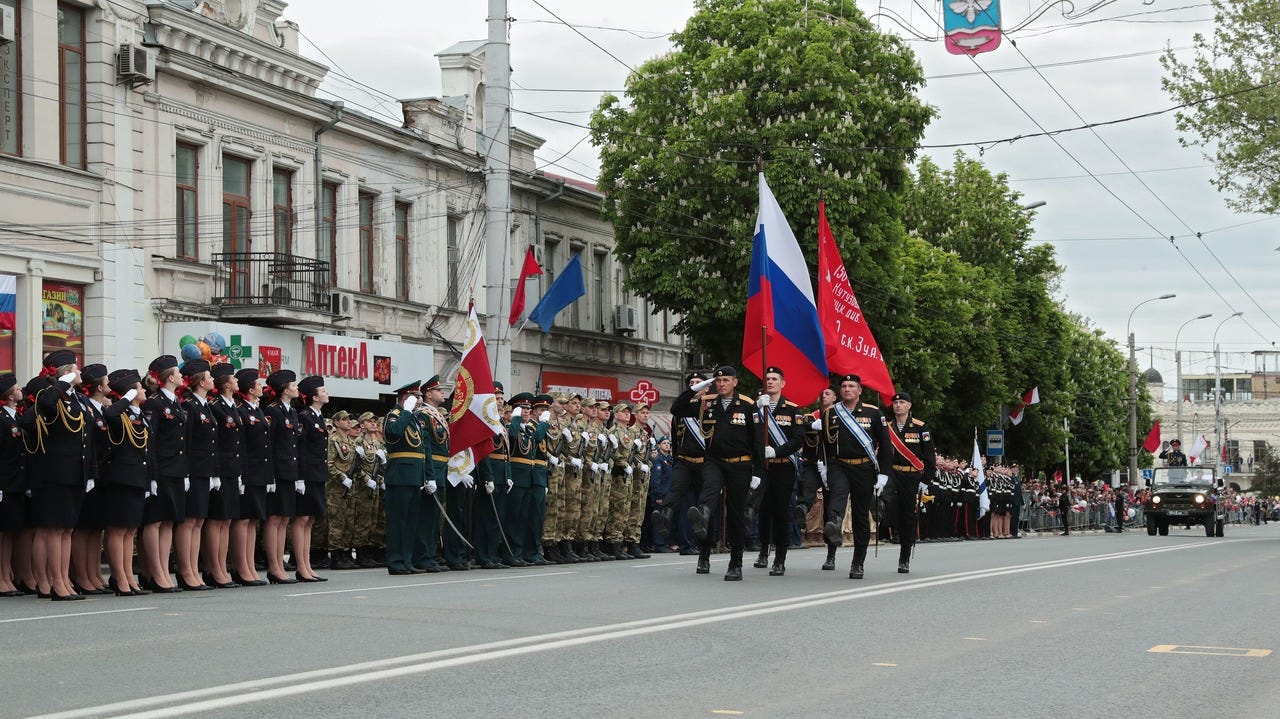
Russian Victory Day parade in Simferopol, Crimea, 2019. Five years into occupation, Russian military marches through Crimea’s capital with Russian flags. The same streets where Catherine’s manifesto was proclaimed in 1783. The same city whose name Russia changed from Aqmescit after the first annexation. Wikimedia Commons. Public domain.
THE LAUNCHPAD
On 24 February 2022, Russia launched the largest land invasion in Europe since the Second World War. Its targets were Kyiv, Kharkiv, Mariupol, and a dozen other Ukrainian cities simultaneously.
The southern axis of that invasion came from Crimea.
Russian forces drove north from the peninsula into Kherson Oblast within hours of the invasion beginning. They reached the outskirts of Kherson city by the end of the first day. The same roads that Catherine’s settlers had used to move into Crimea in the 18th century were now being used to drive tanks in the opposite direction.
The Black Sea Fleet, operating from Sevastopol, launched cruise missiles into Ukrainian cities from the first night of the war. The same naval base that Russia had fought the Crimean War to keep, that it had rebuilt after the Treaty of Paris stripped it away, that Putin’s soldiers had secured before anything else in February 2014, was now the platform from which Russia was trying to destroy Ukraine.
Crimea had not just been taken. It had been turned into a weapon.
The Ukrainian military understood this from the start. Throughout 2022 and 2023, Ukrainian forces systematically targeted Russian military infrastructure in Crimea: the Kerch Bridge, twice damaged by Ukrainian strikes. The Black Sea Fleet headquarters in Sevastopol, struck by Ukrainian missiles. Russian air defence systems, ammunition depots, and command posts across the peninsula, hit by drones and long range weapons.
Russia had spent eight years turning Crimea into an unsinkable aircraft carrier. Ukraine spent the following years proving it was not unsinkable.
WHERE THE STORY ENDS
This series began in 1783, with Catherine the Great signing a manifesto in St Petersburg that nobody in Crimea was asked to approve. It ends here, at the moment the consequences of that manifesto, and everything that followed it, became a full scale war in the heart of Europe.
The third theft of Crimea made the 2022 invasion possible. The naval base, the land bridge, the missile systems, the eight years of military buildup while the world negotiated and filed protests and held summits, all of it fed directly into 24 February 2022.
Russia took Crimea three times. Each time with a different method. Each time with the same justification: protection, rescue, reluctant intervention on behalf of people who had not asked for help. Each time followed by erasure, demographic replacement and the patient work of making the land look like it was always Russian.
Catherine renamed the streets. Stalin emptied them. Putin filled them with soldiers and called them polite.
What none of them has ever managed, across two hundred and forty one years of trying, is to make Crimea Russian in any way that does not require force to maintain.
The Crimean Tatars are still there. Diminished, persecuted, surveilled, their leadership in exile, their language under pressure. Still there.
The war that Russia started from Crimea in 2022 is still being fought. Its outcome will determine whether Crimea remains a stolen peninsula or becomes, finally, what it has always been: Ukrainian territory, home to a people who were there long before Russia arrived and who have refused, across two and a half centuries of pressure, to disappear.
That is not history yet. That is now.
And that is where this series ends.
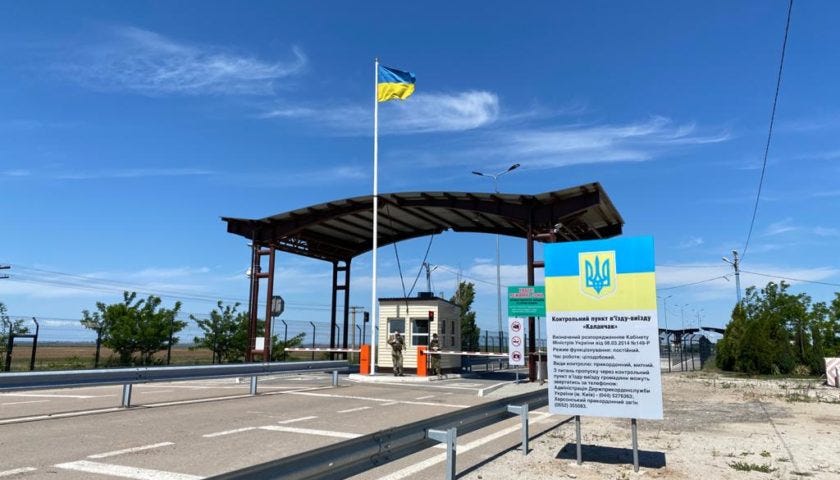
The Ukrainian checkpoint at Kalanchak, photographed before Russia’s full scale invasion in 2022. It marked the de facto border between Ukrainian Kherson Oblast and Russian-occupied Crimea. A border that should never have existed, between a country and its own peninsula. Since February 2022, even this crossing is gone. Wikimedia Commons. Public domain.
Sources: Vladimir Putin documentary “Crimea: The Road Back to the Motherland,” Rossiya 1, 2015; UN General Assembly Resolution 68/262, March 2014; Human Rights Watch, “Crimea: Tatar Community Under Pressure,” 2014; Amnesty International, “Crimea: One Year On, Human Rights Deteriorating,” 2015; Crimea SOS, “At Least 66 Victims of Forced Disappearances in Crimea,” krymsos.com; Euromaidan Press, “A Year After Prominent Activist Was Kidnapped in Crimea, Nobody Knows If He Is Alive,” 2017; BBC News, “Crimea profile,” 2022; Reuters, “Russia’s Black Sea Fleet: history and significance,” 2022; Euromaidan Press, “Eight years of Russian occupation: what happened to Crimea,” 2022; Ukrainian Institute of National Memory; International Crisis Group, “Russia and the Separatists in Eastern Ukraine,” 2016.