
As Artemis reaches for the lunar surface, a Ukrainian mathematician who died in a World War II trench deserves to be remembered — because without his idea, none of it would be possible
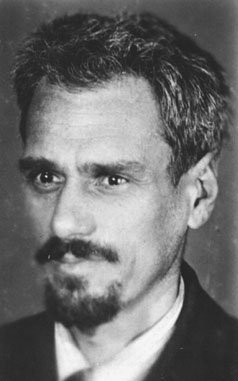
POLTAVA, Ukraine, 1919 — A young man — a deserter, a fugitive, a man living under a stolen name — is filling notebooks with mathematics. He has no laboratory, no university post, no funding, and no colleagues. He is hiding from a government that would shoot him for who he was before he changed his name. And yet, in those notebooks, he has just worked out how humanity will one day walk on the Moon.
His name — the name he borrowed from a dead man to survive — was Yuri Kondratyuk. His real name was Oleksandr Shargei. He was born in Poltava in 1897, in what is now Ukraine. He died somewhere on the Eastern Front in early, most likely in a trench, in a war he had volunteered to fight. He left no grave. He left no wife or children. What he left was a set of calculations that, five decades later, an American engineer would read — and that would change the course of the Space Race.
Today, as NASA’s Artemis programme prepares to return humans to the Moon for the first time since 1972, the mission profile it uses descends directly from the concept Kondratyuk sketched in those fugitive notebooks: Lunar Orbit Rendezvous. His name is barely mentioned in any press briefing. His face appears on no mission patch. In the vast, carefully curated mythology of the space age, he remains an almost invisible figure — which is precisely why he deserves to be seen.
A Life Lived in Hiding
Shargei’s story begins in tragedy and never fully escapes it. His mother died in a psychiatric institution. His father was largely absent. He was raised by his grandmother in Poltava, devouring his father’s mathematics and physics books with the intensity of a child who had nothing else to hold onto. He won a gold medal for academic excellence. He enrolled at the Great Polytechnic in Petrograd to study engineering. Then the war came, and took him away from all of it.
During his military service on the Caucasian Front in World War I, somewhere between the mud and the dying, Shargei filled four notebooks. In them, he described, in meticulous mathematical detail, how a spacecraft could reach the Moon. Not just reach it — return from it, efficiently, economically, in a way that the fuel and weight constraints of any conceivable rocket could actually permit. He proposed a modular vehicle: one part would travel to the Moon, enter lunar orbit, and wait. A smaller lander would descend to the surface and return. The two modules would rendezvous in orbit. Only the command ship would make the journey back to Earth.
He called the trajectory he calculated to achieve this ‘Kondratyuk’s loop’ — though he was not yet called Kondratyuk. It was 1919. The Wright Brothers had made their first flight just sixteen years earlier. Nobody had ever been to space. The word ‘astronaut’ did not yet exist in any language.
“During his military service, Kondratyuk filled four notebooks with his ideas of interplanetary flight — including suggesting the use of a modular spacecraft to reach the Moon.”
— Wikipedia, citing multiple historical sources
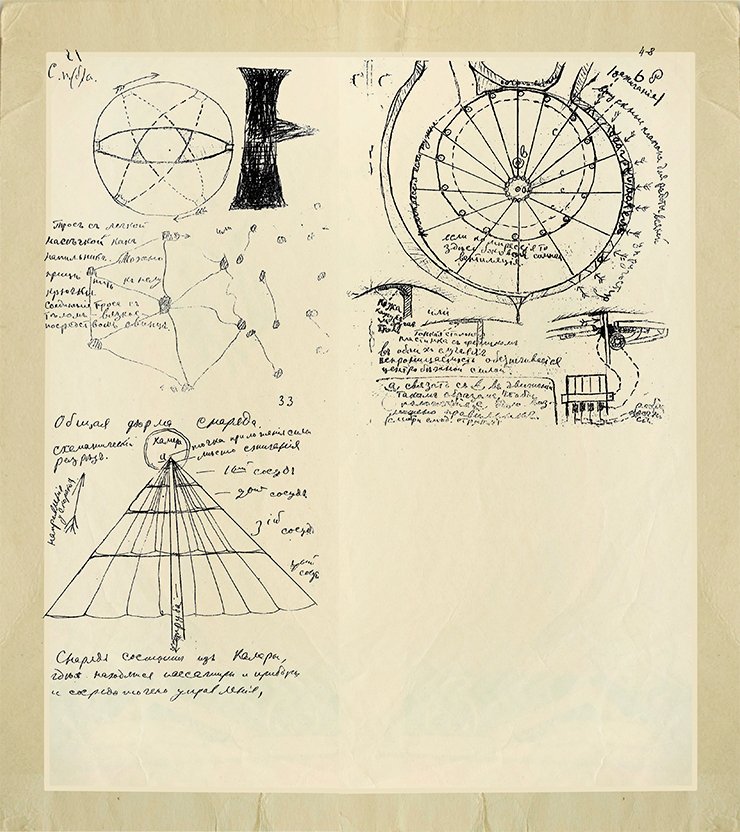
Pages fromKondratyuk’s manuscript he submitted in 1938 to B. N. Vorobiyev, the keeper of K. E. Tsiolkovsky archives. At present they are kept in the archive of the Vavilov Institute of History of Natural Sciences and Technology (RAS)
After the Russian Revolution, Shargei tried to flee to Poland. He was turned back at the border — and was fortunate not to be shot. As a former Tsarist army officer, he was on the Bolshevik list of enemies of the people. Friends helped him obtain forged papers under the identity of one Yuri Vasilievich Kondratyuk, a man who had died of tuberculosis in 1921. He took the name, moved to Siberia, found work as a mechanic and railway worker, and continued, in secret, to think about space.
In 1929, working as a mechanic and paying out of his own pocket, he published a book: The Conquest of Interplanetary Space. It had a print run of 2,000 copies. He typeset much of it himself because the equations baffled the printer. Scientists in Moscow were impressed. No mainstream publisher would touch it.
The Soviet state’s relationship with independent scientists was, at best, uneasy. In 1930, Kondratyuk was arrested by the NKVD and charged with sabotage — the evidence being that the enormous wooden grain elevator he had engineered contained no nails, an innovation forced on him by Siberia’s metal shortage. He was sentenced to three years in a gulag, though his evident genius saved him from the labour camps; he was sent instead to a sharashka, a research prison, where he worked on coal mining machinery. When Nazi Germany invaded in 1941, Kondratyuk volunteered for the Red Army. He disappeared sometime in early 1942. No confirmed record of his death exists.
The Idea That Won the Space Race
In 1961, NASA faced a crisis of engineering imagination. President Kennedy had declared that America would reach the Moon before the decade was out. The problem was: nobody could agree on how. The agency was divided between three approaches. Direct Ascent would send a single enormous spacecraft — bigger than the already-immense Saturn V — directly to the lunar surface and back. Earth Orbit Rendezvous would assemble the mission in stages around Earth before departure. Both approaches were either technically impossible within the timeline, financially ruinous, or both.
The third option — Lunar Orbit Rendezvous — was championed inside NASA by a Langley Research Center engineer named John Houbolt, who fought for years against institutional resistance to get it heard. Houbolt’s case was elegantly simple: by leaving the return spacecraft in lunar orbit and sending only a small lander to the surface, you eliminate the need to carry Earth-return fuel down to the Moon and back up again. The weight savings were transformative. A single Saturn V could do the whole job.
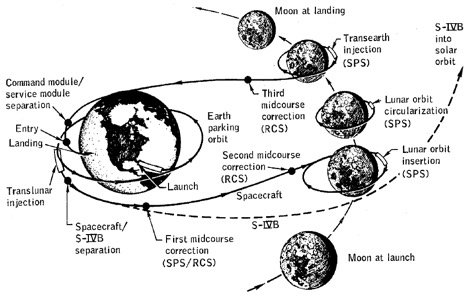
“Kondratyuk route” on the example of the flight scheme of the American Apollo 8 apparatus. NASA drawing
In November 1961, Houbolt bypassed official channels and wrote directly to NASA’s Associate Administrator Robert Seamans, describing himself, in what must rank as one of the great understatements in engineering history, as ‘somewhat as a voice in the wilderness.’ NASA adopted LOR in 1962. The Apollo programme was built around it. Seven years later, Neil Armstrong stepped onto the Moon.
“Lunar orbit rendezvous was first proposed in 1919 by Ukrainian engineer Yuri Kondratyuk, as the most economical way of sending a human on a round-trip journey to the Moon.”
— Wikipedia, Lunar Orbit Rendezvous
The question of exactly how much of this traces back to Kondratyuk is, honestly, contested. The Linda Hall Library — one of the world’s great science history collections — has noted that direct evidence of NASA engineers reading and acting on Kondratyuk’s specific publications is thin. Houbolt arrived at LOR largely through his own analysis. It is entirely possible that the same logic — the same iron mathematics of fuel mass and payload — led two minds in very different circumstances to the same solution, independently, forty years apart.
What is not contested is that Kondratyuk got there first. The concept, the calculations, the modular architecture — all of it is in his notebooks from 1919 and his book from 1929. And there is one piece of testimony that carries a weight beyond any archival document.
After his historic moon landing, Neil Armstrong made a visit to Novosibirsk. He stopped outside the house where Kondratyuk had lived and worked. He knelt down. He picked up a handful of soil from the ground outside the door, and kept it. Armstrong said he took it to acknowledge the man who, he believed, had made his journey possible.
The Route to Artemis
The Artemis programme, which plans to return humans to the lunar south pole, uses a variation of the same fundamental mission profile: a main spacecraft in a near-rectilinear halo orbit around the Moon, a separate lander descending to the surface, a rendezvous before the journey home. Kondratyuk’s loop, formalised into the architecture of the 21st century’s most ambitious human spaceflight programme.
Ukraine has not forgotten him entirely. Poltava National Technical University has carried his name since 1997. He was inducted into the International Space Hall of Fame in New Mexico in 2014. Google honoured him with a Doodle on his birthday in 2012 — visible only in Ukraine. NASA’s own website, in a moment of carelessness, once described him as a ‘Russian engineer.’ The Ukrainian internet did not let that pass quietly.
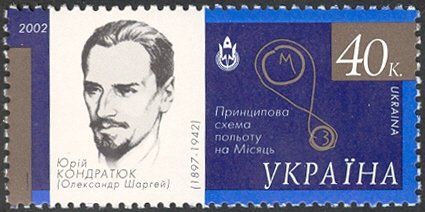
By Post of Ukraine – http://www.stamp.kiev.ua/ukr/stamp/?p=1&fi=1&rubrID=12, Public Domain, https://commons.wikimedia.org/w/index.php?curid=5277889
But in the broader public consciousness of the space age — in the documentaries, the anniversaries, the press kits, the names on mission plaques — Kondratyuk barely registers. The story of the Moon landings is told through Kennedy, through Armstrong, through von Braun and Houbolt and the engineers of Houston. The Ukrainian fugitive who did the mathematics first, in a notebook, while hiding from a government that wanted him dead, is a footnote at best.
That is worth sitting with for a moment. The most consequential insight in the history of human space exploration — the idea that made the Moon landings logistically possible — was arrived at by a self-taught mathematician, working in secret, under a false name, in one of the most repressive political environments of the twentieth century. He published it in a book he typeset himself, in a print run of 2,000, that almost no one read. And then the idea survived him, crossed an ocean, and put twelve people on the Moon.
As Artemis lifts off, that story is worth telling again. Not to diminish Houbolt, or the extraordinary Americans who built Apollo and are building Artemis. But because the route to the Moon was first drawn by a young man from Poltava who spent his life being erased — by revolution, by state terror, by war, and finally by history itself. He deserves, at minimum, to be named.
- ACKNOWLEDGEMENTS
- This report draws on the following sources, whose researchers and editors have done the essential work of keeping Kondratyuk’s story in the record. Any errors of fact or interpretation are the responsibility of the author.
- America House Kyiv, whose 2019 essay on Kondratyuk provided a thorough account of his biography and the LOR concept, and whose work to preserve Ukrainian scientific heritage deserves recognition in its own right.
- The Wikipedia articles on Yuri Kondratyuk and on Lunar Orbit Rendezvous, which aggregate decades of scholarship and provide the most widely accessible account of both subjects.
- The New Mexico Museum of Space History, which inducted Kondratyuk into its International Space Hall of Fame in 2014 and maintains his biographical record.
- Dr. William B. Ashworth Jr. of the Linda Hall Library, whose careful and honest assessment of the limits of what we can claim about Kondratyuk’s direct influence on NASA is a model of responsible science history.
- The Apollo11Space research site, whose detailed account of the LOR decision and Houbolt’s role at NASA informed the reconstruction of that institutional debate.
- The u-krane.com archive, for its documentation of Neil Armstrong’s visit to Novosibirsk and the soil he took from outside Kondratyuk’s former home — a tribute that speaks more clearly than any citation.
- SOURCES
- 1 Wikipedia — ‘Yuri Kondratyuk’ (updated December 2025)
- 2 Wikipedia — ‘Lunar Orbit Rendezvous’ (updated October 2025)
- 3 America House Kyiv — ‘Yuriy Kondratyuk: A Ukrainian Mathematician Ahead of His Time’ (2019)
- 4 New Mexico Museum of Space History — ‘Yuri Vasilievich Kondratyuk’ inductee profile
- 5 Linda Hall Library — Dr. William B. Ashworth Jr., ‘Yuri Kondratyuk’ (2022)
- 6 Apollo11Space — ‘Lunar Orbit Rendezvous: The Key to Apollo’s Moon Landing Success’ (2025)
- 7 u-krane.com — ‘Gravitational Slingshot Trajectory adopted by Apollo-11 program’ (2025)
- 8 Grokipedia — ‘Yuri Kondratyuk’ (January 2026)
