The Man Who Came To Feed Ukraine
Fridtjof Nansen and the Forgotten Famine, 1921
AUG 24, 2026
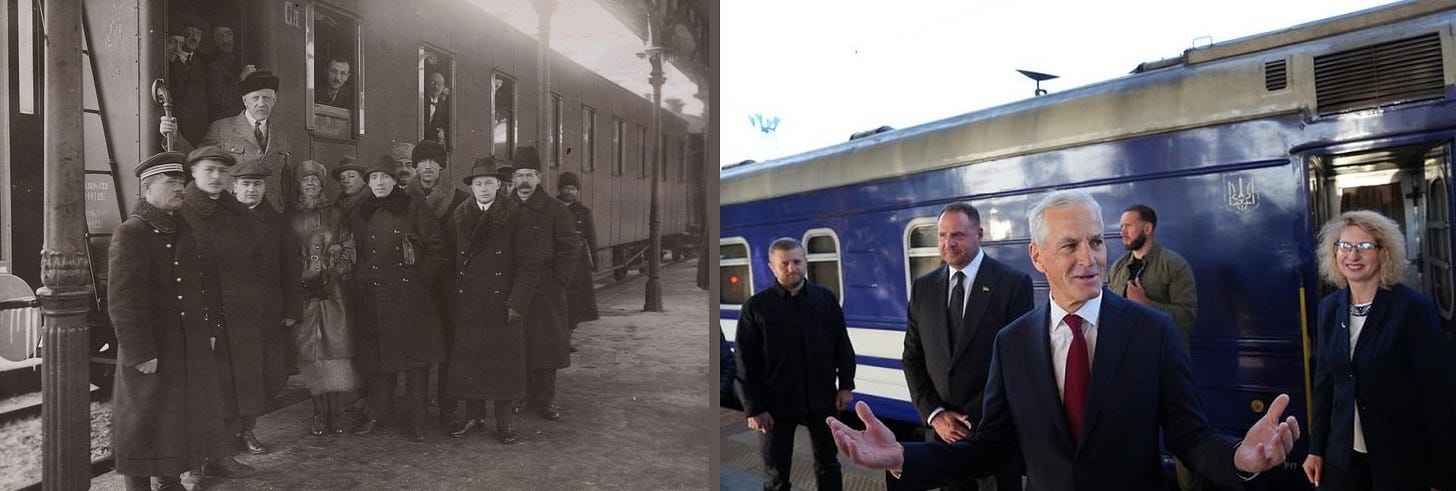
Left: Fridtjof Nansen arriving by train during his relief mission to Ukraine, 1922. National Library of Norway. Public domain. Right: Norwegian Prime Minister Jonas Gahr Støre arrives by train at Kyiv railway station, 23 August 2026, his 65th birthday, bringing Norway’s commitment of 9.2 billion dollars in support for Ukraine. Photo: Oleksandr Techynskyi / Norway’s Embassy in Kyiv.
Yesterday, Norwegian Prime Minister Jonas Gahr Støre stood in Kyiv beside President Zelenskyy and announced that Norway will give Ukraine another 9.2 billion dollars in 2027. The money will be delivered through a programme called the Nansen Support Programme for Ukraine.
Almost nobody outside Norway knows who Nansen was. They should.
He crossed Greenland on skis. He almost reached the North Pole. He invented the modern refugee passport. He saved seven million people from starvation. And the Norwegian Prime Minister standing in Kyiv yesterday was delivering aid through a programme that bears his name, because what Nansen did for Ukraine a century ago has never been forgotten in Norway, even if the rest of the world forgot it entirely.
This is his story.
THE EXPLORER
Most people who have heard of Nansen know him as a polar explorer, if they know him at all.
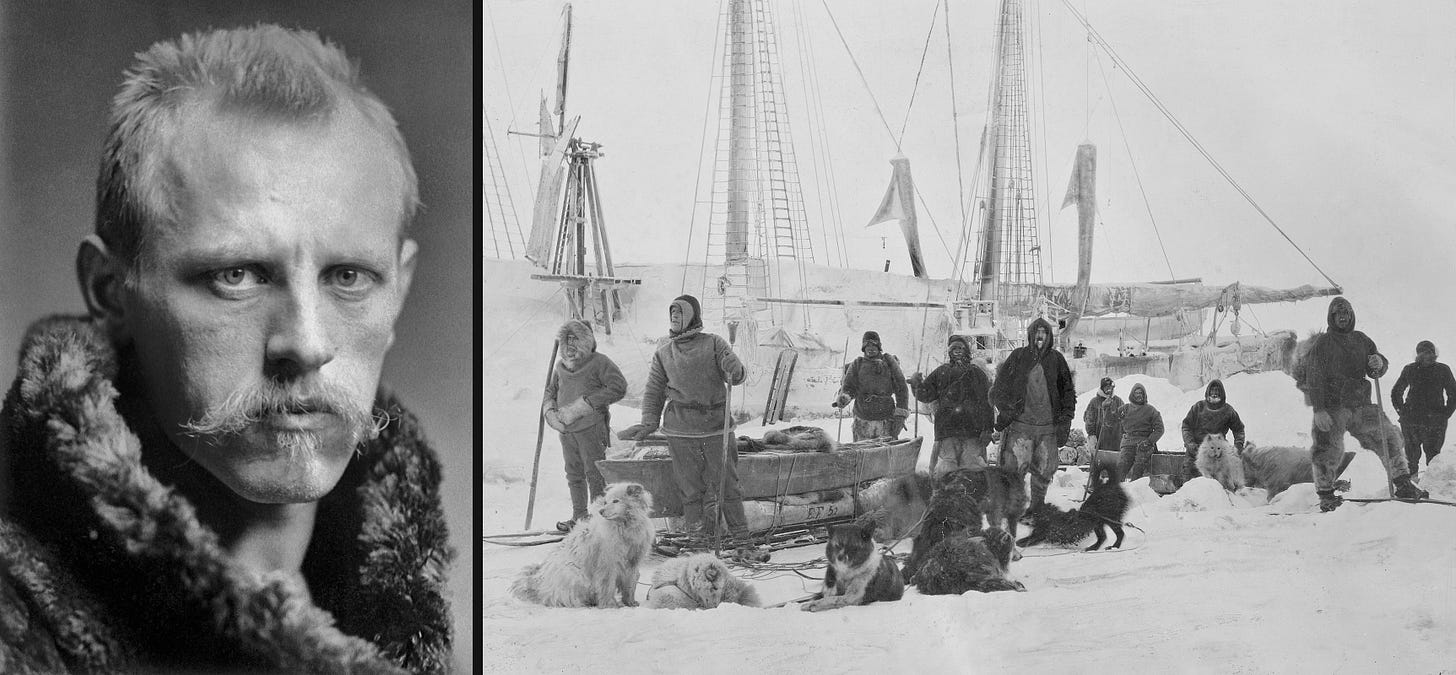
Left: Fridtjof Nansen, c. 1890s (Library of Congress). Right: Nansen and Hjalmar Johansen depart the Fram, 14 March 1895, on their attempt to reach the North Pole.
In 1888, aged twenty-six, he led the first crossing of Greenland’s ice cap on skis. Nobody had done it before. Most people who attempted it died. Nansen and his team did it in six weeks, hauling sledges across hundreds of miles of ice in temperatures that dropped to minus forty.
In 1893 he sailed north on a specially built ship called the Fram, deliberately letting it get locked in Arctic ice, planning to drift toward the North Pole over three years. When the drift was not going far enough north, he left the ship with one companion and skied toward the pole, reaching a latitude of 86 degrees north, further than any human being had ever been. He turned back only because he had to, knowing that going further meant dying.
He came home a hero. Crowds lined the streets of Christiania, now Oslo. He was the most famous Norwegian alive.
He could have spent the rest of his life giving lectures and accepting honours.
He did not.
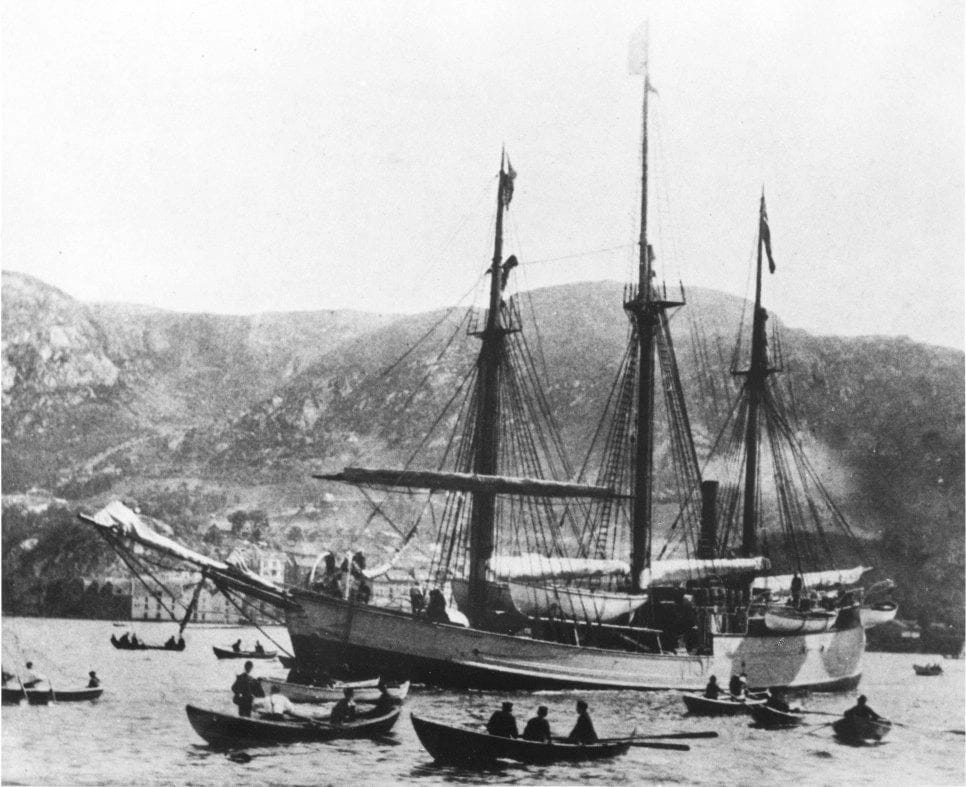
The Fram leaving Bergen, 1893, at the start of Nansen’s attempt to drift across the polar ice to the North Pole. (Library of Congress, Prints and Photographs Division)
THE TURN
After Norwegian independence from Sweden in 1905, Nansen became a diplomat. He served as Norway’s first ambassador to London. He helped negotiate Norwegian membership of the League of Nations. And when the League needed someone to take on its most difficult, most thankless humanitarian tasks, they kept asking Nansen.
In 1920 he repatriated 427,000 prisoners of war, men stranded in camps across Russia and Germany years after the fighting had stopped, moving them home across a continent that was still barely functioning. He did it with almost no budget, using personal contacts and sheer force of will, receiving no salary for any of it.
Then came Ukraine.
THE FAMINE
By the summer of 1921 something catastrophic was happening across the southern regions of the former Russian Empire. Ukraine, the Volga region, the Caucasus. The breadbasket of Europe was starving.
It was not simply a natural disaster. Ukraine had always been one of the most fertile agricultural regions in the world. But between 1918 and 1921, three armies had moved across it in succession, each requisitioning food from peasants at gunpoint. The new Bolshevik government had imposed a grain tax so heavy that farmers had nothing left to eat. In 1921 drought hit the weakened land. The result was catastrophic.
By the time foreign organisations were allowed in, people were dying in the streets. Children were dying of starvation in numbers that nobody had a reliable count for. In Zaporizhzhia province alone, by early 1922, an estimated 900,000 of the province’s 1,288,000 residents were without food.
The Soviet government had denied the famine for as long as it could. Admitting it meant admitting failure, and admitting failure meant asking the capitalist West for help, which was ideologically intolerable. It was only in August 1921 that Lenin finally allowed foreign aid organisations in.
The International Red Cross turned immediately to the only man they believed could navigate the impossible politics of the situation.
They asked Fridtjof Nansen to take charge.
He was sixty years old. He said yes.
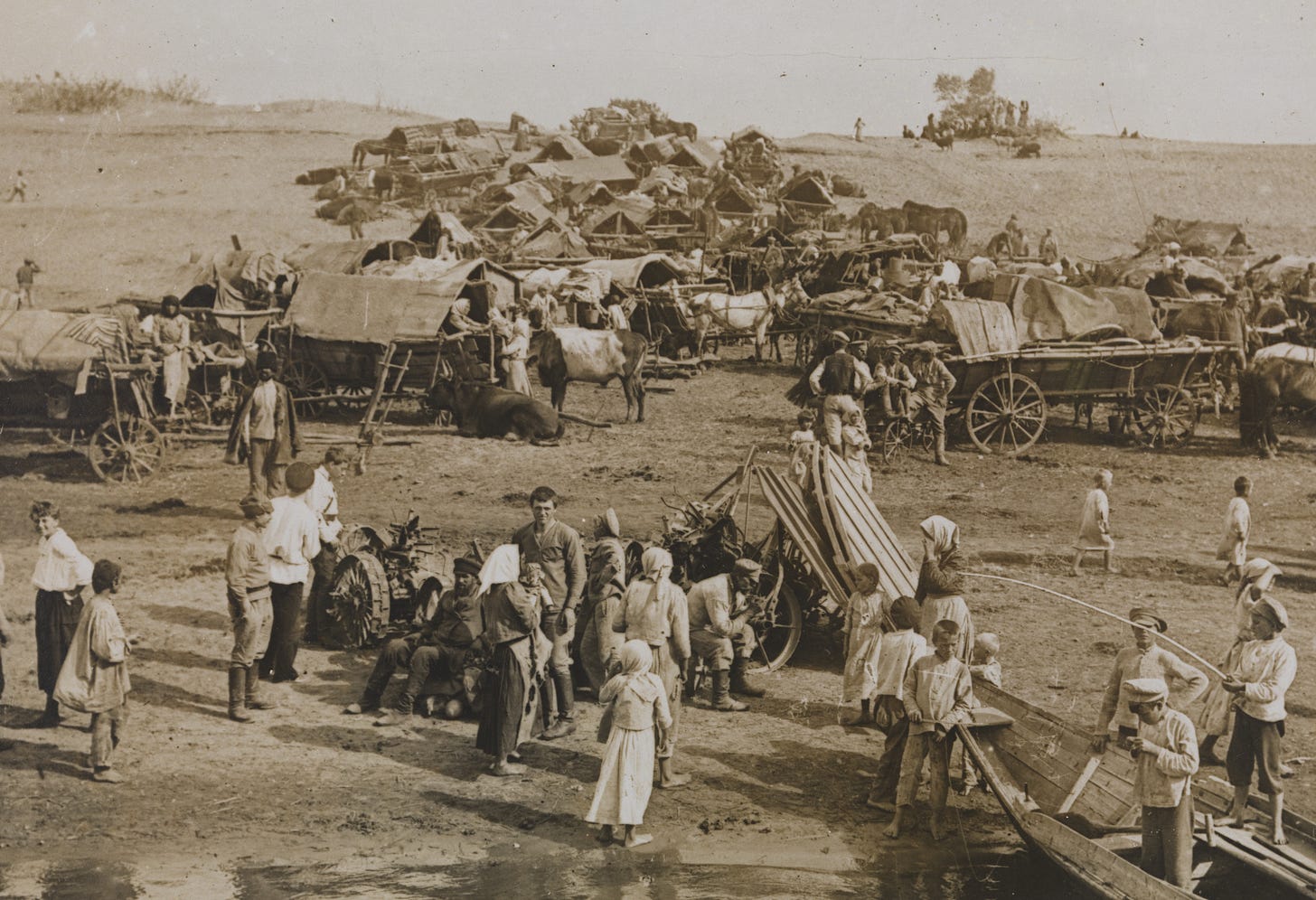
Famine refugees in southern Russia and Ukraine, 1921. Hundreds of families with horse-drawn carts and makeshift shelters, stretching to the horizon. This is what Nansen arrived to find. National Library of Norway. Public domain.
THE POLITICS
Getting food to starving people sounds simple. It was not.
Western governments were deeply suspicious of anything that might be seen as legitimising Lenin’s regime. The argument was made, openly, in the chambers of the League of Nations and in the press, that feeding Soviet Russia was helping the Bolsheviks consolidate power. Better to let the famine run its course and weaken the communist government.
Nansen went to the League of Nations and said, in plain language, what he thought of that argument.
Standing before the assembly on 30 September 1921, he said: “In the USA, wheat is rotting among farmers who cannot find buyers for surplus grain. In Argentina, such a quantity of corn has been collected that there is nowhere to put it, and it is already being used as fuel for steam locomotives. And in Russia, twenty million people are starving.”
He asked for funding. He was refused.
He went back to Europe and raised the money privately, from charities, from governments that would listen, from ordinary people who read about what was happening and sent what they could. He built a coalition of European relief organisations and put himself at the head of it.
A hundred years later, Ukrainians are doing the same thing themselves. Crowdfunding drones. Raising money for armour and ambulances and generators from ordinary people around the world, because waiting for institutions has never been fast enough.
Some things do not change.
The Nansen mission reached around 400,000 people in Ukraine directly. But in the provinces of Zaporizhzhia, Kherson and Mykolaiv, where the Soviet government had delayed allowing foreign aid the longest, his relief effort became the difference between life and death for tens of thousands of people who would have received nothing otherwise.
Each standard food parcel delivered by the mission contained 7 kilograms of flour, four tins of condensed milk, one kilogram each of lard and sugar, and 40 grams of tea. It cost two US dollars. In Kharkiv alone, Nansen’s organisation opened two canteens for students, each feeding a thousand people a day. Professors received food parcels and academic supplies. In Mykolaiv, 22 food distribution points operated across the region by August 1922.
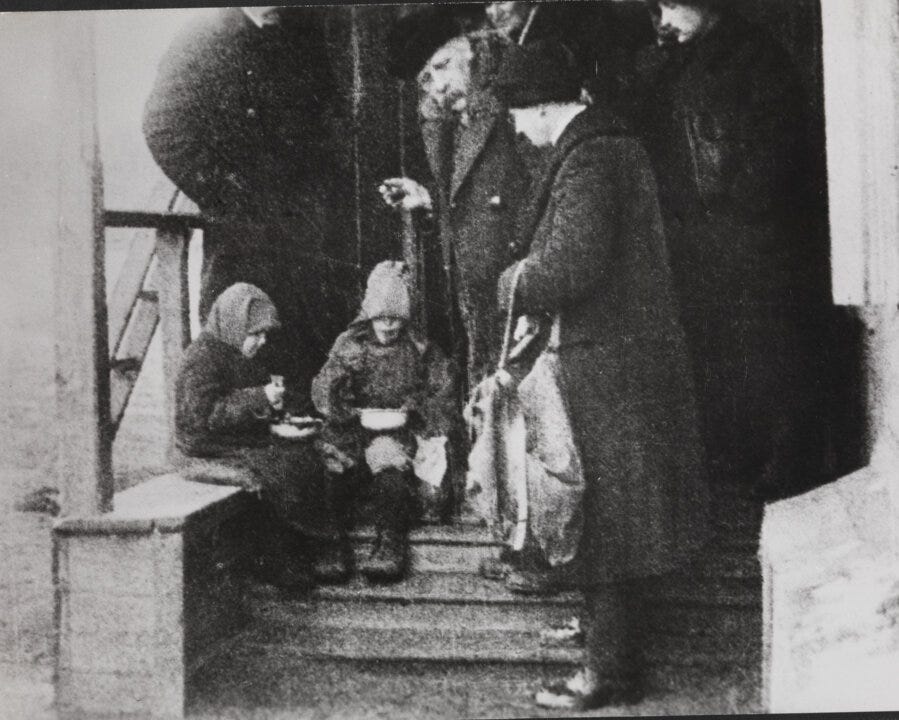
Children being fed at a Nansen mission relief station, Ukraine, 1921-22. Photo: Nobel Prize Outreach / NobelPrize.org. Public domain.
THE MAN HE SENT
Here is the detail that stops everyone who hears it.
Nansen needed a representative on the ground in Ukraine. Someone to travel the famine regions, document what he saw, negotiate with Soviet officials, and report back. He chose a young Norwegian army officer named Vidkun Quisling.
Quisling headed the Ukrainian office of the mission from Kharkiv, with sub-offices in Mykolaiv and Odesa. He spent months travelling through Zaporizhzhia, Kherson and Kharkiv. He sent detailed telegrams to Nansen describing what he saw. From Zaporizhzhia on 25 February 1922: “The situation is terrible. Of the province’s 1,288,000 inhabitants, 900,000 are without food. Sixty percent of the famished are children.”
He filed some of the most detailed and accurate reports on the Ukrainian famine of any foreign observer.
Twenty years later, Vidkun Quisling became the head of the Norwegian Nazi collaborationist government during the German occupation. His name became a word in several languages, synonymous with traitor.
The man who documented Ukraine’s starvation in 1922 became the most reviled figure in Norwegian history by 1945.
History does not simplify easily.
THE PRIZE
On 10 December 1922, Fridtjof Nansen was awarded the Nobel Peace Prize.
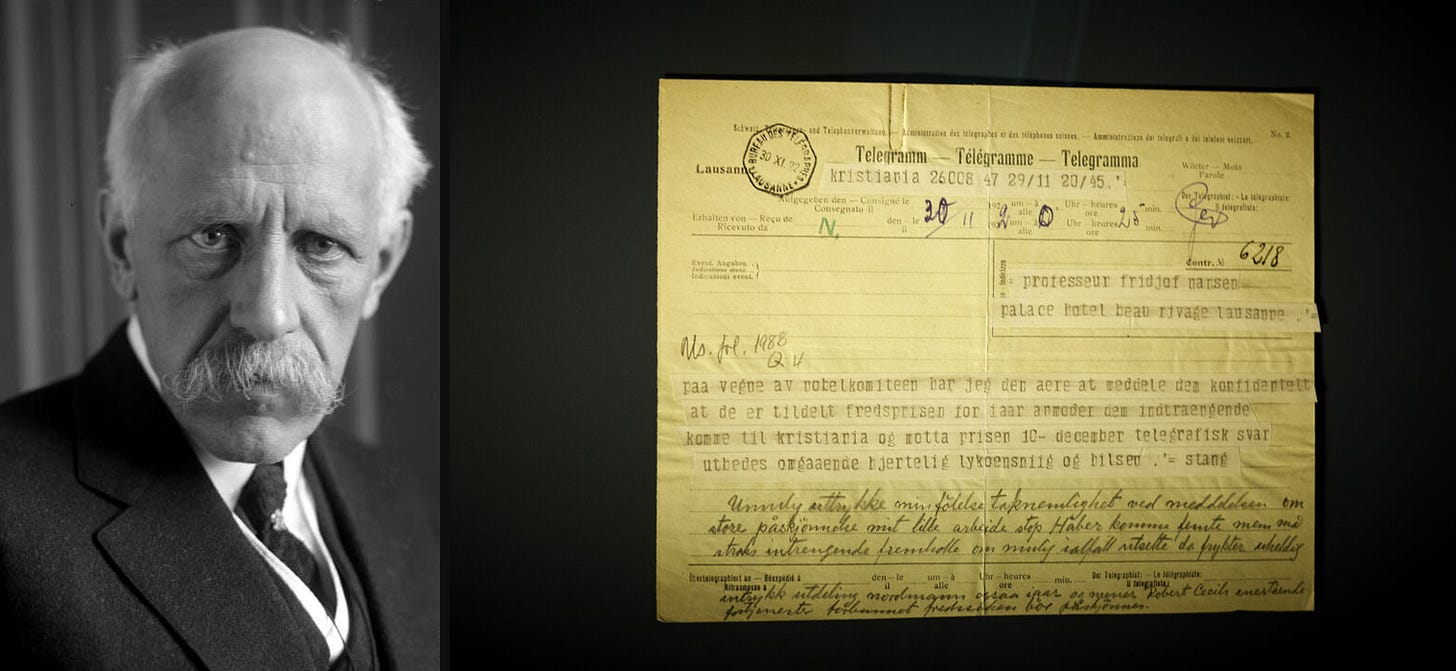
Nansen in later life, and the telegram that reached him at the Palace Hotel Beau Rivage in Lausanne on 29 November 1922: the Nobel Committee informing him, in confidence, that he’d won that year’s Peace Prize, and asking him to come to Kristiania to receive it on 10 December. His handwritten reply is visible below it. (Photo: Bundesarchiv / telegram: Nobel Prize Outreach, NobelPrize.org)
The Nobel committee was not honouring Ukraine specifically. The prize recognised the whole of Nansen’s relief work: the repatriation of prisoners of war, the resettlement of refugees scattered across a broken Europe, and his efforts for Greek and Armenian refugees driven from Asia Minor. In 1922 he organised an exchange of 1.25 million Greeks and half a million Turks caught on the wrong side of a new border after the Greco-Turkish War. In 1925 the League sent him to Soviet Armenia to find land for the survivors of the Armenian Genocide, tasking him with assessing a plan to irrigate desert near Yerevan and settle refugees there. The League never fully funded it, but Nansen secured Nansen passports for tens of thousands of Armenians and helped repatriate close to 7,000 people to a home in Soviet Armenia. Armenia has not forgotten. The country has issued postage stamps in his honour twice, in 1996 and again for his 150th birth anniversary in 2011.
In his acceptance lecture he said: “When one has stood face to face with famine, with death by starvation itself, then surely one should have had one’s eyes opened to the full extent of this misfortune.”
He spent part of the prize money establishing two model agricultural stations to test modern farming methods, one in Ukraine and one in the Volga region of Russia. The Ukraine station, at Mikhailovka village in Katerynoslav province, now Dnipropetrovsk Oblast, provided local peasants with machinery and seed grain to restart production on land that had been stripped bare. Forty-five American tractors were imported. It became a model farm and training centre for Ukrainian agronomists, the first time modern mechanised agriculture had been introduced to the region on that scale.
He also built and supplied an orphanage in Kharkiv for children who had survived the famine but had nobody left. He visited it himself, going from child to child to check that the food was adequate, that the conditions were bearable, that the money was reaching the people it was meant for.
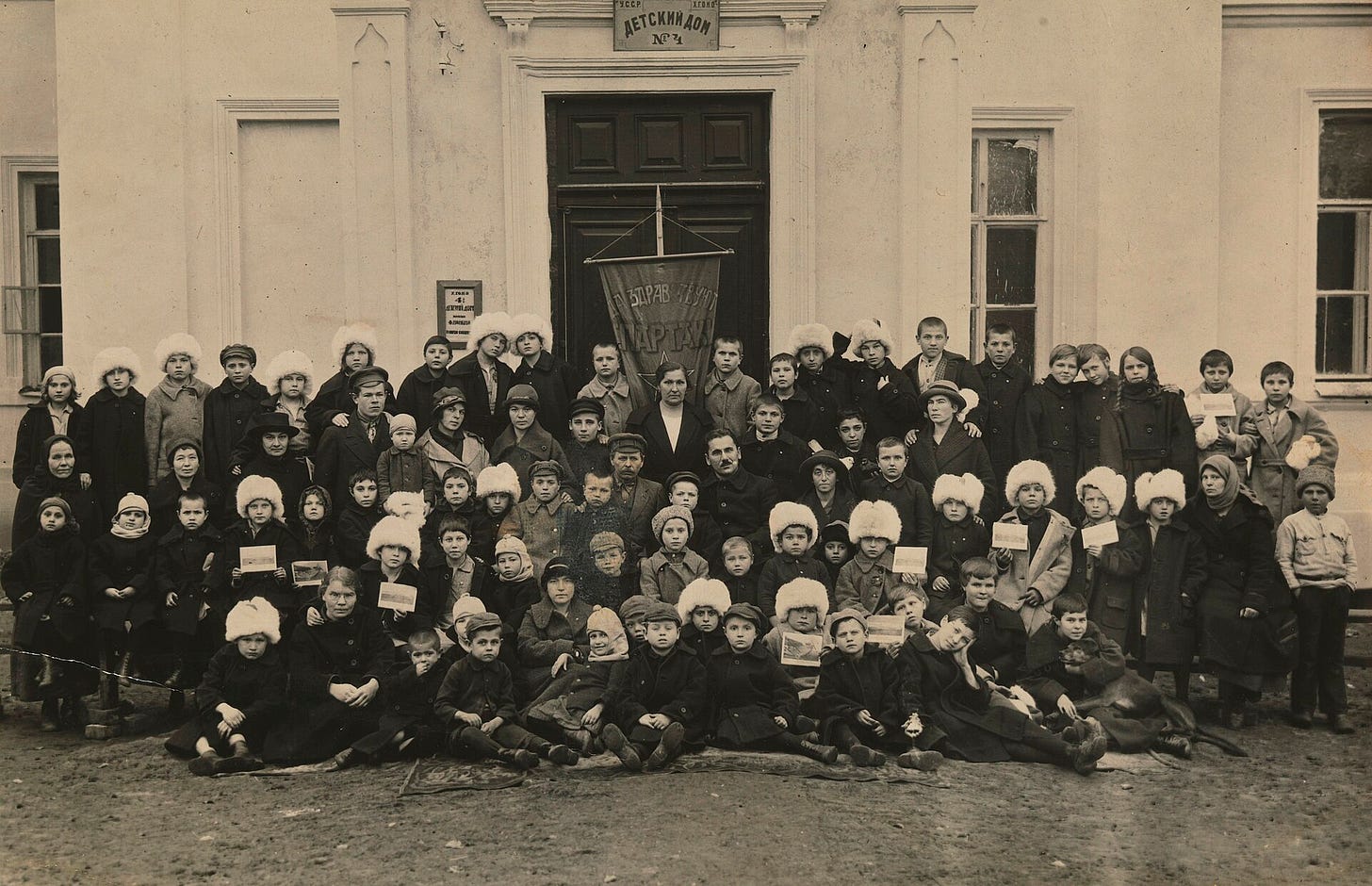
Children photographed outside Children’s House No.1, Ukrainian SSR, during the famine relief period. Many are holding documents, likely food ration cards. These are the children the Nansen mission was feeding in Kharkiv. National Library of Norway. Public domain.
THE PASSPORT
Nansen’s other great legacy from this period has outlasted everything else.
After the Russian Revolution, hundreds of thousands of people were stateless. They had fled, or been expelled, from countries that no longer existed in the form they had known. They had no legal identity. No country recognised them. They could not travel, work legally, or access any of the protections that citizenship provides.
In 1922, Nansen created a document for them. A certificate of identity, bearing his signature, recognised by 52 countries, that allowed stateless people to cross borders, find work, and build lives. It was called the Nansen passport.
Among those who used it: Igor Stravinsky. Sergei Rachmaninov. Marc Chagall. Aristotle Onassis. Thousands of Ukrainians fleeing Bolshevik repression.
The Nansen passport is the direct ancestor of the modern travel document issued by the UNHCR to refugees today. Every refugee travel document in use anywhere in the world traces its lineage back to a piece of paper Nansen designed in 1922.
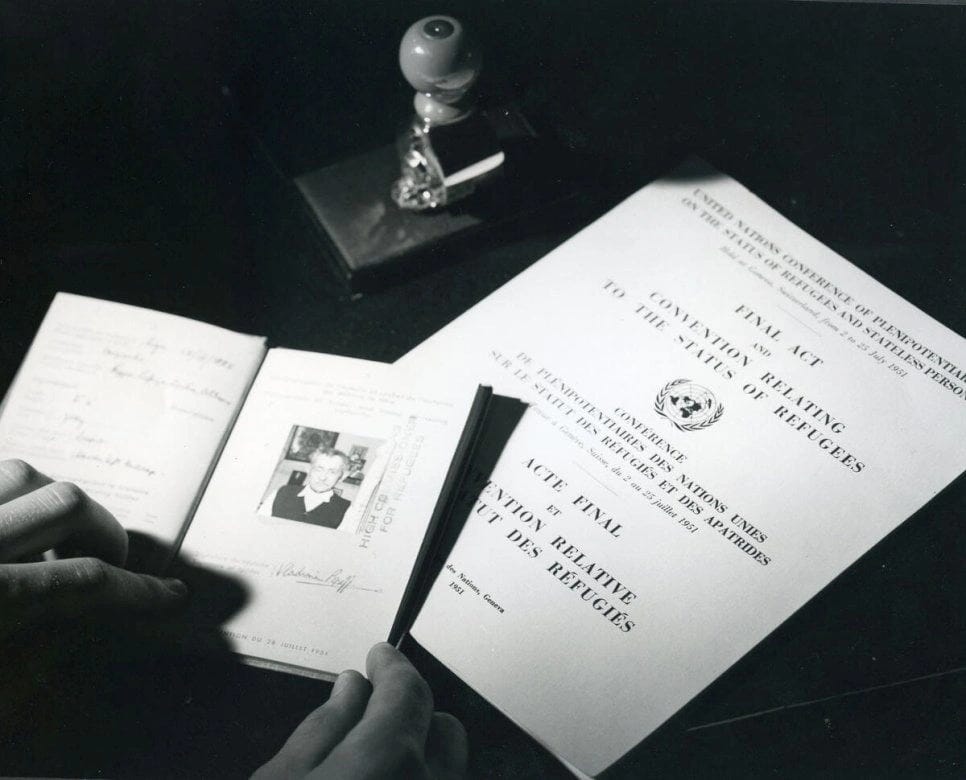
A Nansen passport alongside the 1951 United Nations Convention Relating to the Status of Refugees. The direct line runs from Nansen’s 1922 invention to the foundation of modern international refugee law. Photo: Nobel Prize Outreach / NobelPrize.org. Public domain.
THE SECOND NOBEL
Nansen died on 13 May 1930, at his home outside Oslo, at his desk, working. He was 68 years old. He was buried on 17 May, Norway’s Constitution Day. The country stopped to mark its independence and buried the man who had given that independence its greatest meaning on the same afternoon.
Eight years later, in 1938, the Nobel Peace Prize was awarded again. This time to the Nansen International Office for Refugees, established after his death to carry on his work. The citation was for “having carried on the work of Fridtjof Nansen to the benefit of refugees across Europe.” It is the closest the Nobel committee has ever come to awarding the same prize twice for the same cause.
In 1954, UNHCR created the Nansen Refugee Award in his name. The first recipient was Eleanor Roosevelt, first chair of the UN Human Rights Commission. The award is still given annually today, to individuals and organisations showing exceptional dedication to refugees, the stateless and the displaced.
One man. Three Nobel connections. A legacy that has now run for over a century.
THE ECHO
Yesterday, 23 August 2026, Norwegian Prime Minister Jonas Gahr Støre stood in Kyiv on Ukraine’s Flag Day alongside Zelenskyy and leaders from Denmark, Finland, Estonia, Latvia and Lithuania. He announced that Norway will maintain its support for Ukraine at 9.2 billion dollars in 2027. He inspected damage from Russian strikes. He condemned attacks on civilian infrastructure.
The money, as it has been since 2022, will be delivered through the Nansen Support Programme for Ukraine.
The connection is deliberate. A century ago, Nansen went to Ukraine when Western governments refused to help, raised money when institutions failed, stood in front of the League of Nations and pointed out that there was grain rotting in Argentina while twenty million people starved. Norway’s modern programme was named after him explicitly because what he did then and what Norway does now are the same act: showing up when it matters, not when it is convenient.
Støre said in Kyiv yesterday: “Russia has no remorse when it comes to distinguishing between civilian and military targets. It is precisely civilian infrastructure, residential buildings, schools and hospitals that have suffered, which is a systematic violation of international law.”
Nansen said something similar in Geneva in 1921. Different words. The same truth. The same country on the same side.
The question Nansen faced, which is whether the politics of Western governments will allow them to help Ukraine or whether strategic calculation will override humanitarian obligation, is the same question being asked in every European capital right now.
Nansen already answered it. He answered it by going anyway.
Norway is still going.
Sources: Nobel Prize Outreach, “Fridtjof Nansen biographical,” nobelprize.org; National Library of Norway, Nansen photo archive, nb.no; D.V. Arkhireyskyi, “Fridtjof Nansen and Ukraine,” Suchasni doslidzhennia z nimetskoi istorii, 2019; UNHCR, “His efforts saved seven million lives,” unhcr.org/ua; Norwegian Government, “The Nansen Support Programme for Ukraine,” regjeringen.no; Reuters, “Norway to give over $9 billion to Ukraine in 2027,” 23 August 2026; Kyiv Post, “Nordic leaders arrive in Kyiv,” 23 August 2026; NordiskPost, “Nordic leaders in Kyiv as Ukraine asks for more air defence,” 23 August 2026; Fram Museum, “Fridtjof Nansen 1861-1930,” frammuseum.no.