The Journalist Who Told the Truth and the One Who Buried It
The story of Gareth Jones and the famine he risked everything to expose.
AUG 30, 2026
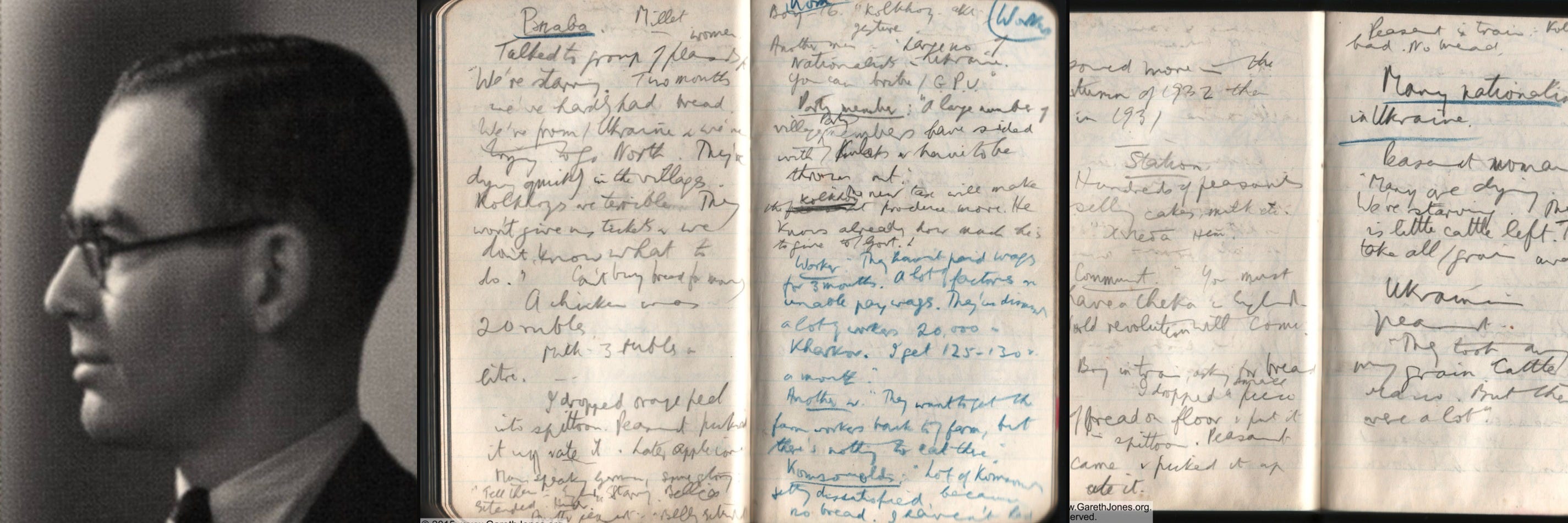
Gareth Jones in the early 1930s, alongside pages from his personal diary recording what he saw on his 1933 walk into famine-stricken Ukraine. Portrait and diary images courtesy of the Gareth Vaughan Jones archive, National Library of Wales and garethjones.org.
In March 1933, a twenty seven year old Welsh journalist named Gareth Jones arrived in Moscow with an official cover story. Through his connections to David Lloyd George (the former British Prime Minister, for whom Jones had worked as a foreign affairs adviser), he’d secured an invitation to visit a tractor factory in Kharkiv, Ukraine, the kind of sanctioned, chaperoned trip the Soviet authorities were happy to let a foreigner take.He never made it to the factory. Seventy miles short of Kharkiv, Jones got off the train.
For the next forty miles, he walked. No official guide. No government minder. No permission, in fact, since leaving the approved route wasn’t something foreigners were supposed to do. He passed through roughly twenty villages and collective farms on foot, and at each one he stopped, and looked, and wrote down what he saw.
He walked through villages that had stopped functioning as villages. He walked past frozen fields that should have been full of grain and weren’t. He was walking through Soviet Ukraine, one of the regions hit hardest, and he wrote down exactly what he found there. He talked to peasants who told him, again and again, the same thing. He wrote it down almost exactly as he heard it, village after village, and it became the line his reporting is remembered for.
“We have no bread. We are dying.”
That was it. That was the whole horror, in seven words, repeated by every mouth he passed. All of it. Every starving face, every empty barn, every official denial he was fed by the men in Moscow who wanted him to believe nothing was wrong. Then he did something almost nobody else in his position was willing to do.
He put his name on it.
On 29 March 1933, Jones stood in front of reporters in Berlin and told the world what he’d seen. Millions of people, he said, were being starved to death, not by drought, not by bad luck, but by policy. Whether Stalin specifically targeted Ukraine, or Ukraine simply bore the worst of a famine sweeping the Soviet Union, is still argued over by historians today. What isn’t argued over is who was dying, and how many, and that the world was being told nothing was wrong.
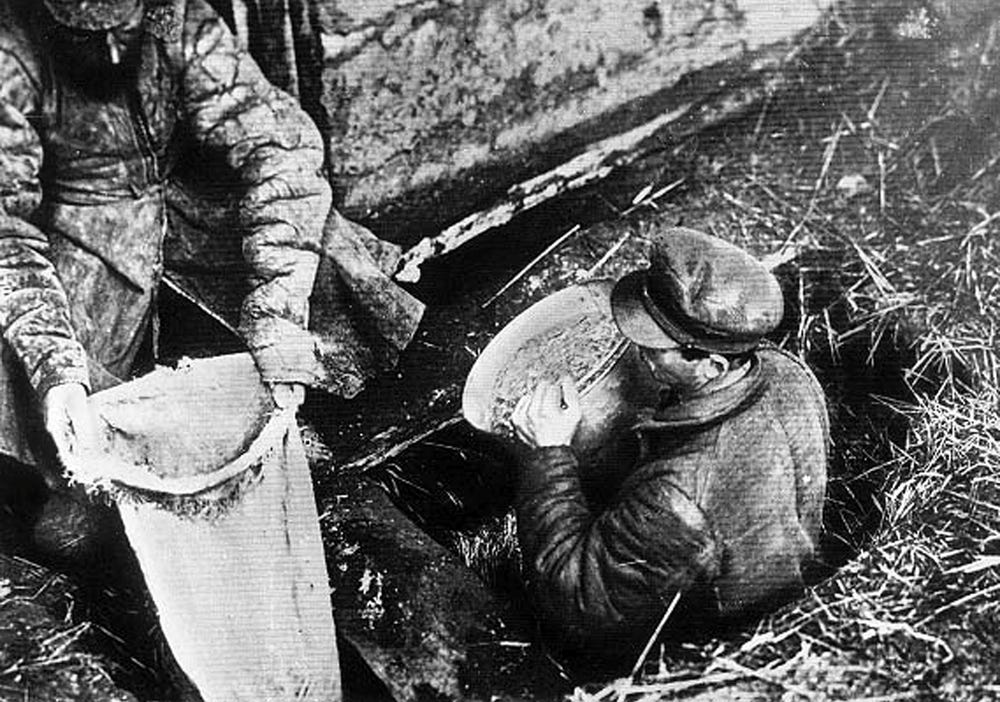
Soviet officials confiscate grain from a peasant household in Ukraine, 1932 to 1933. Image: Pictures from History/Universal Images Group via Getty Images, via NPR.
He was right.
Historians now put the death toll at somewhere between five and seven million people. It’s one of the great engineered atrocities of the twentieth century, and Gareth Jones was the man who told the West it was happening, under his own name, while it was still happening.
You’d think that would make him famous. It made him a target instead.
Decades later, the historian Timothy Snyder pointed out that almost no one who suspected mass death was happening in Ukraine said so clearly, in public, under their own name. Jones did. Snyder identifies only one other English-language journalist willing to do the same at the time, Malcolm Muggeridge, and even he published anonymously in the Manchester Guardian, too cautious to risk his byline on it. But Muggeridge did write, in his own words, that the famine was “one of the most monstrous crimes in history.”
Two men. One with his name on it, one without. Everyone else in the Western press either didn’t know, didn’t say, or actively said the opposite.
Because two thousand kilometres away, in a comfortable office in Moscow, sat a man who had a very different story to tell, and a very good reason to keep telling it.
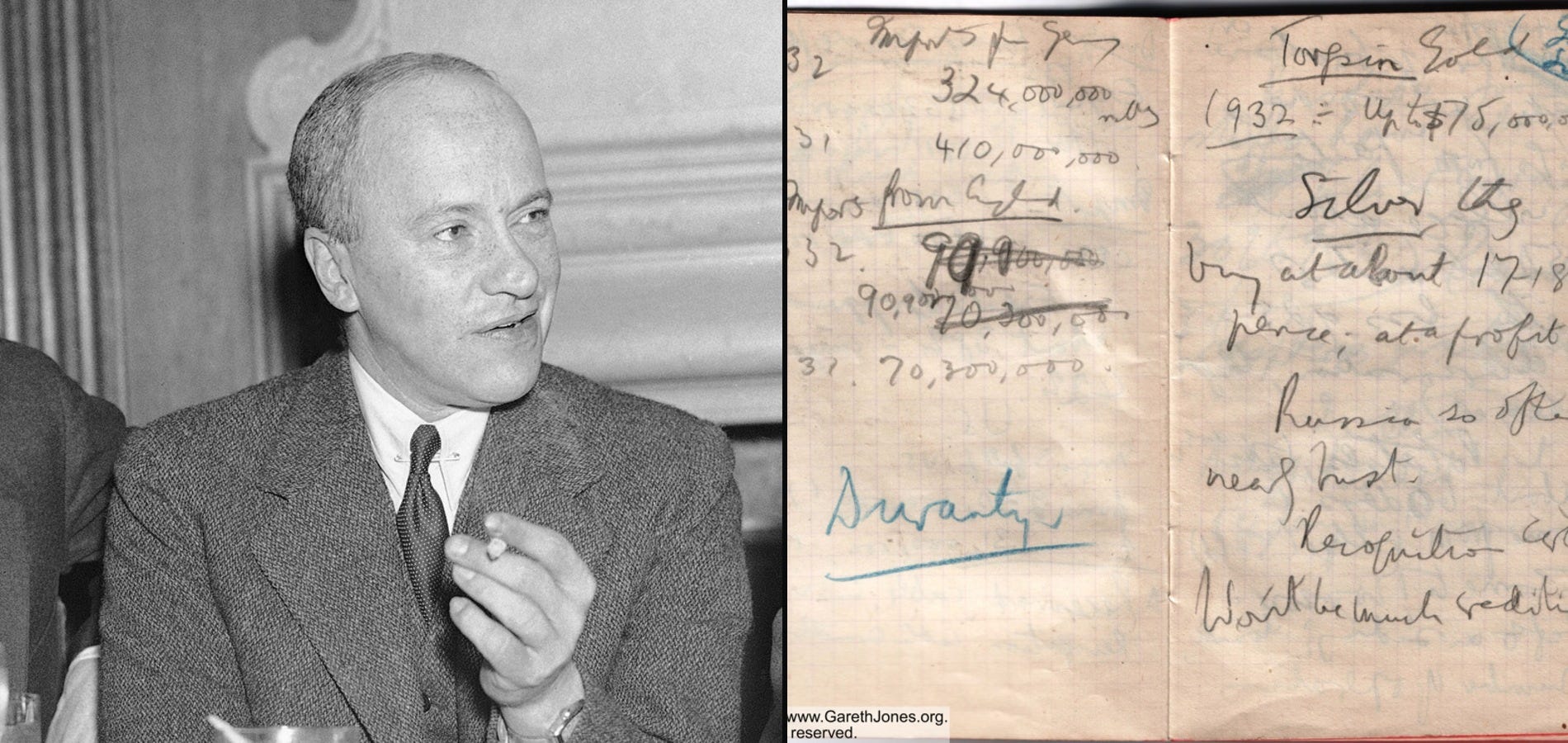
Walter Duranty, photographed in 1936 at a luncheon held in his honour in New York, alongside the page in Gareth Jones’s diary recording a conversation with Duranty over Soviet gold and silver prices. Photo: John Rooney/AP, via NPR. Diary page courtesy of garethjones.org.
His name was Walter Duranty, and he was the Moscow bureau chief for the New York Times. He had access. He had status. He had, by 1933, already won a Pulitzer Prize for his reporting on the Soviet Union, awarded to him the year before Jones went public.
And Duranty knew exactly what Jones had seen, because Duranty had seen it too.
Privately, he told a British diplomat that as many as ten million people might be dead. He knew the number. He knew the scale.
Publicly, he wrote something else entirely.
Days after Jones’s Berlin press conference, Duranty published a piece in the Times naming him directly. He allowed that Jones had a “keen and active mind,” then dismissed his eyewitness account as “a rather inadequate cross-section of a big country.” He’d tried to talk Jones out of his conclusions himself, Duranty wrote, but “nothing could shake his conviction of impending doom.” The headline over the whole thing said the rest: “Russians Hungry But Not Starving.”
In the same piece, defending the human cost of Stalin’s policies, Duranty offered the line he’s remembered for above all others: “To put it brutally, you can’t make an omelet without breaking eggs.”
He knew it was a lie when he wrote it. He wrote it anyway, because the truth would have cost him his access, his standing, and his relationship with the Soviet officials who let him keep working.
This is the part of the story that should make you angry, and it should. Duranty didn’t just fail to report the famine. He actively worked to discredit the one man who did. He used his platform, his prestige, and his Pulitzer to bury a colleague who’d done the harder, riskier, more honest job.
And it worked. The world believed the man with the byline at the New York Times over the freelance Welsh reporter nobody had heard of. Jones was frozen out. Other correspondents in Moscow, terrified of losing their own visas, fell in line behind Duranty’s denial rather than risk backing Jones. The famine kept killing people, and most of the West simply stopped listening to the man telling them it was happening.
Jones’s career never recovered the way it should have. Two years later, in August 1935, he was in Inner Mongolia reporting on the Japanese occupation of Manchuria when bandits captured him and his travelling companion, a German journalist named Herbert Müller. Müller was released within two days. Jones was held, moved twice, and shot dead on 12 August, the day before his thirtieth birthday.
Decades later, declassified British intelligence files revealed who Müller actually was. He’d been an NKVD agent since at least 1917, tracked by British security services for over three decades under multiple aliases. The German transport firm that arranged the pair’s route through the region wasn’t a real company. It was a front for Soviet military intelligence. Some historians still argue the Japanese were behind the killing rather than Moscow. But the man who walked free after two days was a Soviet spy, and the company that sent them both into bandit country answered to the Red Army’s intelligence directorate. Draw your own conclusion.
He died a day before turning thirty, having told the truth about one of the worst atrocities of his century, largely forgotten by the world he’d tried to warn.
David Lloyd George, his old employer and friend, said afterward that he had “always been afraid that he would take one risk too many.”
None of this ended in 1933. The reporter who goes and looks is still, usually, just one person. The institution that decides what to print still has more to lose from the truth than from the silence. That calculation hasn’t changed in ninety years, it’s just wearing different names.
Walter Duranty never apologised. He never retracted a word of his denial. He kept his Pulitzer Prize until the day he died, and the Pulitzer board, petitioned for decades by historians, journalists, and Gareth Jones’s own family to revoke it, has never done so. It’s still there. Still recognised. Still sitting in the record as an honour, not a warning.
Even people who knew him had no illusions about what he was. Malcolm Muggeridge, who’d been in Moscow at the same time and seen the same famine, said it plainly decades later: Duranty was “the greatest liar of any journalist that I ever met in fifty years of journalism.”
Sit with that for a second. The man who told the truth was killed within two years and forgotten for eighty. The man who called him a liar to protect his own access kept his prize forever.
This isn’t ancient history dressed up as a lesson. This is the oldest story in journalism, repeating itself in every generation that lets it. Someone goes and looks. Someone else, comfortable and connected, decides the truth is inconvenient and calls the person who found it a fraud instead. And too often, the institution with the bigger platform wins that argument, at least for a while.
Gareth Jones won it eventually. It just took the better part of a century, a body of archival research, a 2019 film, and a great many people deciding his name was worth saying out loud again.
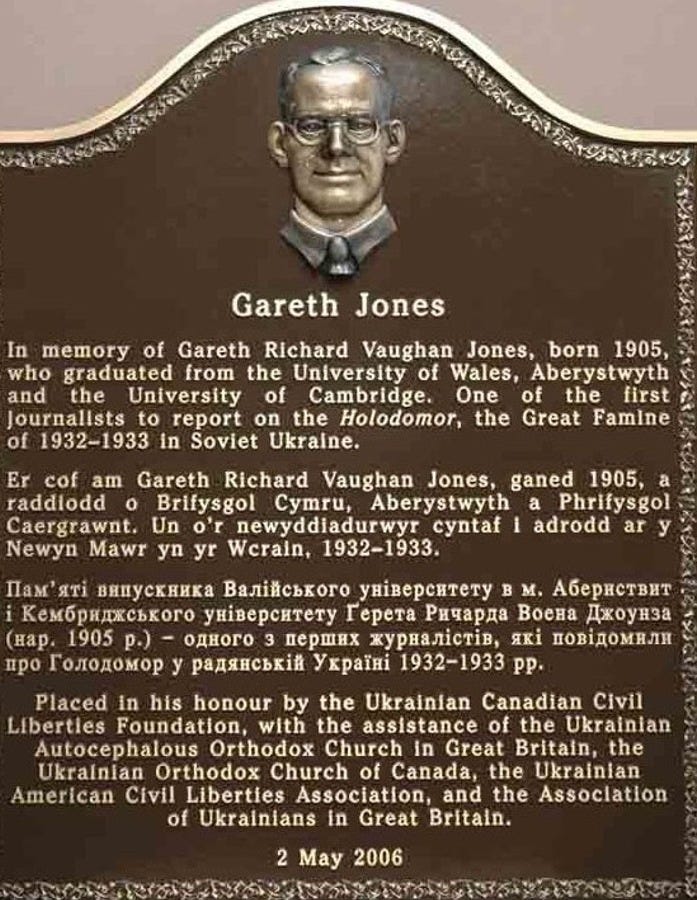
This trilingual plaque, in Welsh, English, and Ukrainian, was unveiled on 2 May 2006 in the Quadrangle of the Old College, Aberystwyth University, Wales.
That’s the whole reason to tell this story now. Not because it’s a neat piece of 1930s history, but because the pattern it describes never actually went away. The people willing to walk into the story and report what they find are still out there. So are the people who’d rather they didn’t.
It’s worth noticing which kind of journalism came out of this looking right. Jones had no institution behind him. No editor, no bureau, no expense account, no relationship with Moscow to protect. He had a notebook, a pair of boots, and nothing to lose by telling the truth. Duranty had all the things Jones didn’t, and every one of them became a reason to lie. Ninety years on, that’s still roughly the trade being made. Independence costs a reporter almost everything except their credibility. Institutional access buys comfort at the price of it. History, so far, has only ever settled that argument in one direction, it’s just slow about it.
Gareth Jones chose to walk. That choice cost him almost everything, and it turned out, in the end, to be the only thing that mattered.