The First Theft
Potemkin wrote the manual. Putin read it.
AUG 08, 2026
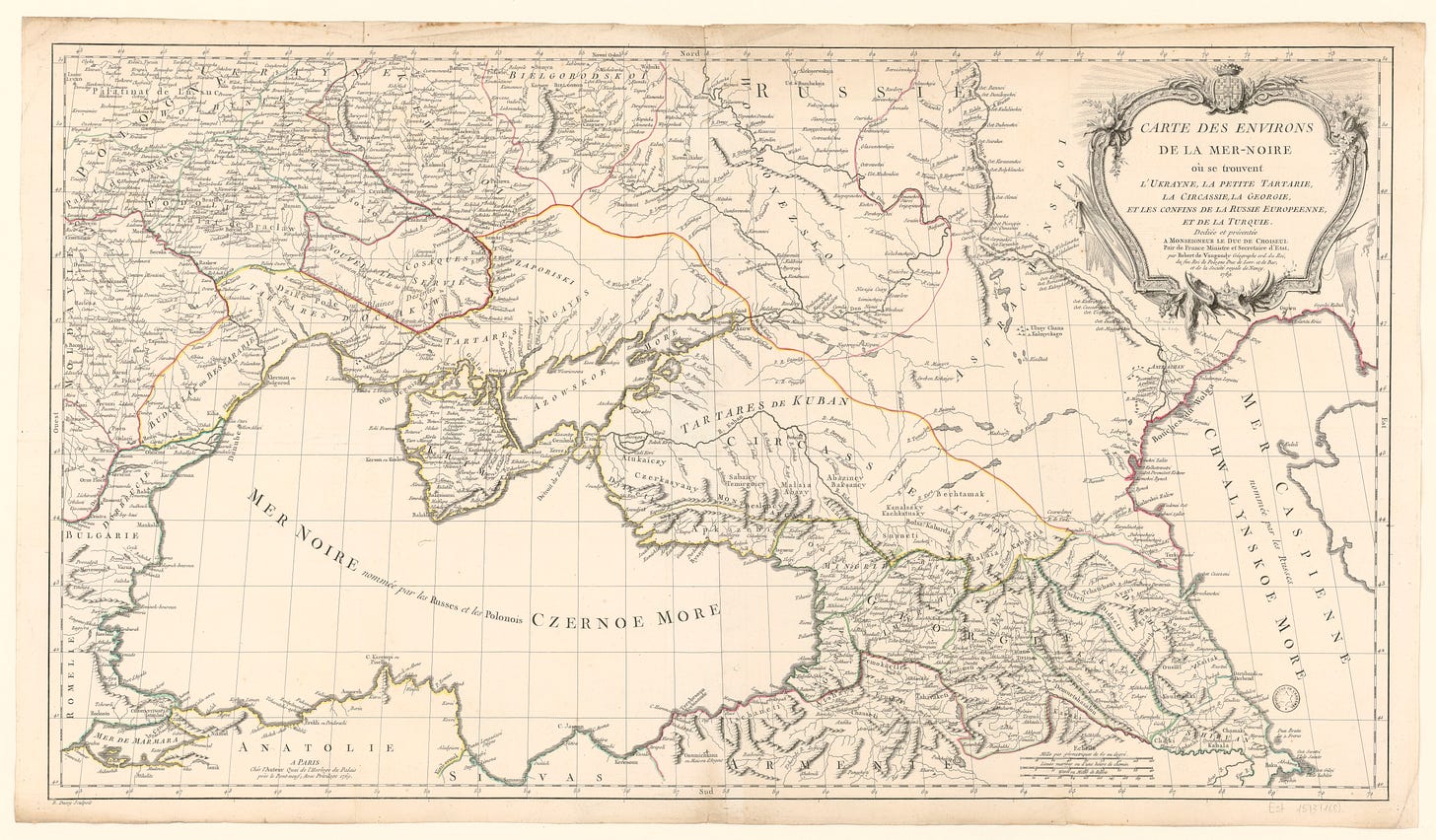
Carte des environs de la Mer-Noire où se trouvent l’Ukrayne, la petite Tartarie… Robert de Vaugondy, 1769. Public domain via Wikimedia Commons / Bibliothèque nationale de France. This French map, published in 1769 on the eve of the Russo-Turkish War that would lead directly to the 1783 annexation, translates as “Map of the environs of the Black Sea where one finds Ukraine, Little Tartary…” Crimea is shown entirely in Tatar place names: Bakczisarai (Bakhchysarai), the Khan’s capital, sits at the centre of the peninsula. Kozlow carries both its Tatar name and its emerging Russian alias “Eupatorie” in brackets. There is no Sevastopol. No Simferopol. No Feodosia. Those names did not exist yet. They would be invented by Russian colonisers fourteen years later, stamped over a world that looked exactly like this.
Part 1: Catherine the Great and the Annexation of 1783
The peninsula had survived Mongols, Genoese merchants and Ottoman conquest. It did not survive enlightenment.
One autumn morning in 1782, Empress Catherine II of Russia sat in her study in the Winter Palace drinking coffee. In her hand was a letter from Prince Grigory Potemkin, her most trusted advisor, commander of her armies and the man who had been urging her for months to move on Crimea before someone else did. “There will come a time,” Potemkin warned her, “when everything that we might now receive for free, we shall obtain for a high price.”
He was not wrong. On 19 April 1783, Catherine signed the manifesto formally annexing the Crimean Khanate to the Russian Empire. A sovereign state that had existed for three hundred and forty years, that had outlasted the Golden Horde that birthed it, that had traded with Venice and Genoa and Constantinople and Kyiv, that had burned Moscow and held half of Europe in terror for generations, was dissolved by a signature over a cup of coffee.
Potemkin was appointed its first governor. He named the new capital Sevastopol.
This is how Russia took Crimea the first time. Not in a day, and not without preparation. What looked like a sudden annexation was the final step of a decade-long campaign of manipulation, installation of puppet leaders, suppression of revolts and deliberate economic sabotage. The playbook Russia ran in 2014 was not invented in 2014. It was perfected in 1783. And the man who wrote it presented it to his empress over morning correspondence in the Winter Palace as a matter of strategic common sense.
THE ENLIGHTENED EMPRESS AND HER ENLIGHTENED AMBITIONS
Catherine the Great is one of history’s more instructive hypocrites.
She corresponded with Voltaire. She collected Rembrandt. She read Montesquieu and fancied herself a philosopher queen, a monarch guided by reason and the welfare of her subjects. She founded schools and hospitals, reformed the legal code, and cultivated an image across Europe as the embodiment of Enlightenment values applied to statecraft.
She also extended the institution of serfdom, binding millions of Russian peasants more tightly to the land than they had been under any of her predecessors. She brutally suppressed the Pugachev Rebellion of 1773, in which a Cossack leader led one of the largest peasant uprisings in Russian history, ending it with mass executions and the public display of dismembered bodies as a deterrent. And she spent the better part of her reign systematically dismantling every independent political entity on Russia’s borders: the Zaporozhian Sich, the Polish-Lithuanian Commonwealth in three successive partitions, and finally the Crimean Khanate.
Catherine’s view of Crimea was not complicated. It was a warm water port, a strategic gateway to the Black Sea and through it to the Mediterranean, and a persistent irritant on Russia’s southern flank. The Crimean Tatars had been raiding Russian territory for centuries. The Khanate had burned Moscow. For generations, the Russian state had paid tribute to Crimean khans to ransom its own captives. Catherine intended to end that humiliation permanently.
But she dressed it, as all Russian imperial ambitions have been dressed, in the language of liberation.
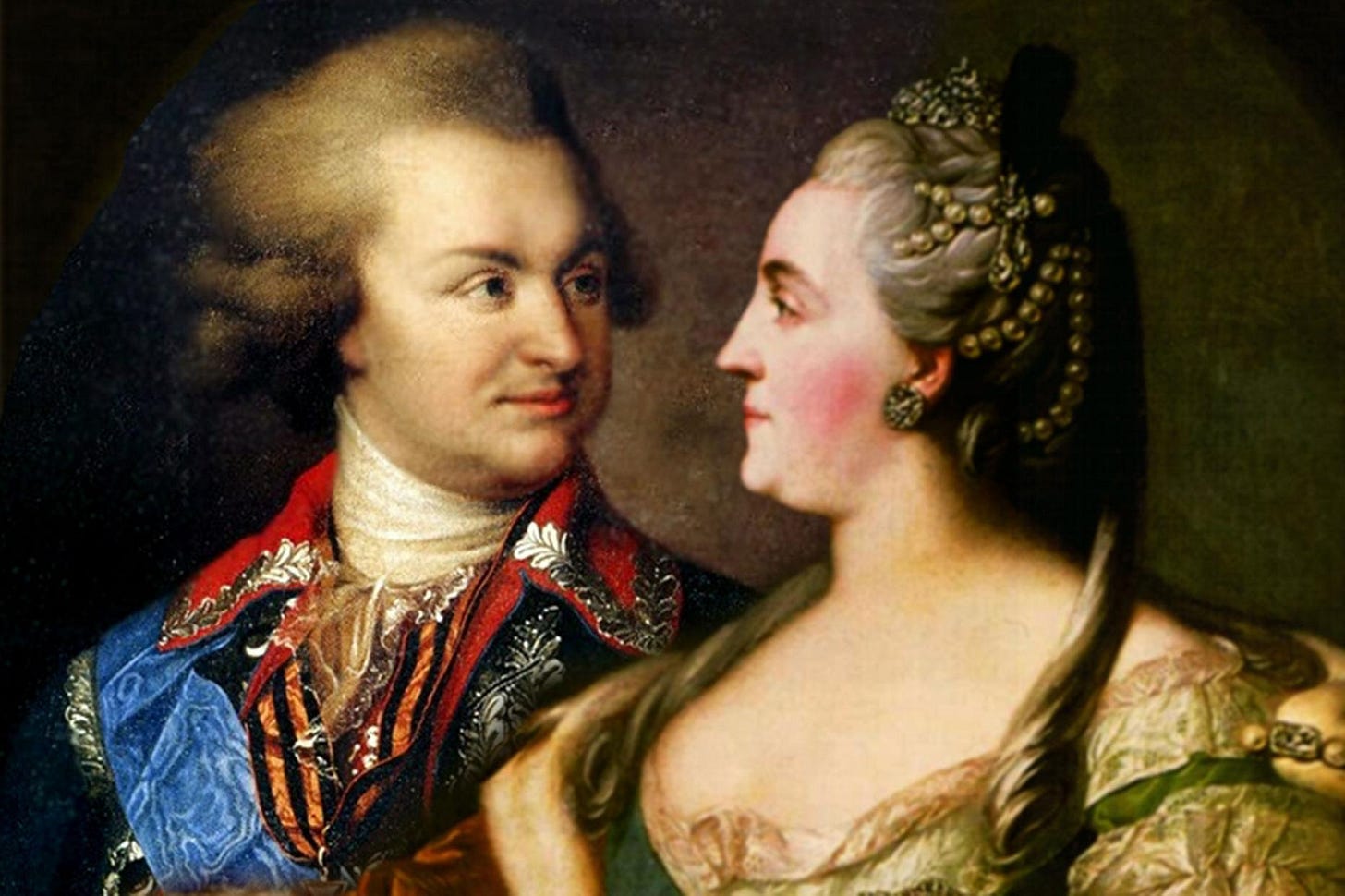
Modern collage of Catherine II and Potemkin. Wikimedia Commons/shakko
THE DECADE OF MANIPULATION
Catherine did not simply invade. She understood that naked conquest required justification, and she was patient enough to manufacture it.
The process began with the Russo-Turkish War of 1768 to 1774, in which Russian forces inflicted some of the heaviest defeats in Ottoman history. The resulting Treaty of Küçük Kaynarca was the turning point. It formally recognised the Crimean Khanate as independent of the Ottoman Empire, but the independence it granted was entirely nominal. Russia retained military garrisons at Kerch and Yenikale, key ports on the peninsula. The Khanate could no longer be considered truly sovereign with Russian troops stationed within its borders, a fact that Ottoman envoys protested and Russian diplomats ignored.
The treaty also granted Russia something else: the right to act as protector of Orthodox Christians living within the Ottoman Empire. This was not humanitarian sentiment. It was a legal instrument, a lever Catherine could pull whenever she needed a pretext for intervention. Russia would use this exact mechanism, the claim to protect a religious or ethnic minority, as a justification for territorial aggression again in 1853, in 1878, in 2008, and in 2014. The pattern is so consistent it deserves its own name.
Having secured nominal Crimean independence, Catherine immediately began undermining it. Russian agents worked to destabilise the Khanate’s internal politics, provoking rivalries between claimants to the throne. When unrest followed, Russian troops intervened to restore order, which they defined as installing whichever Khan was most amenable to Russian direction. By 1777 Catherine had her preferred candidate on the throne: Şahin Giray, a Westernised reformer who had spent time at the Russian court and believed he could modernise the Khanate on Enlightenment principles.
He could not. Şahin Giray’s reforms, including a centralised bureaucracy, a standing army and taxation of the Tatar nobility, were deeply unpopular. His subjects saw him, correctly, as a Russian instrument. Uprisings followed. Russian troops suppressed them. The cycle repeated until the Khanate’s political will was exhausted and its economic foundations were deliberately hollowed out.
Before the formal annexation, Russia had already removed the Khanate’s most productive taxpayers. Between 1778 and 1779, under the direct orders of General Alexander Suvorov and with Catherine’s personal approval, over 30,000 Armenian and Greek Christians were forcibly relocated from Crimea to the Russian interior. Russian propaganda described this as the rescue of Christians from Muslim rule. The Christians of Crimea had lived peacefully alongside the Tatars for centuries. The relocation was not rescue. It was economic sabotage. The Christian merchant class was the backbone of the Khanate’s urban economy. Remove them and the tax base collapses. Collapse the tax base and the state cannot function. A state that cannot function cannot resist.
By 1782 Şahin Giray had renounced his throne. There was nothing left to govern. In the autumn of that year, Potemkin wrote his famous letter to Catherine outlining the case for annexation. “The position of Crimea interferes into our borders,” he wrote. “Believe me, with this acquisition you will achieve immortal glory such as no other Sovereign in Russia has ever had.”
On 19 April 1783, she signed the manifesto. Officially, over 30,000 Crimean Tatars were killed in the immediate aftermath of the annexation as Russian punitive squads dealt with those who resisted. The actual death toll was higher.
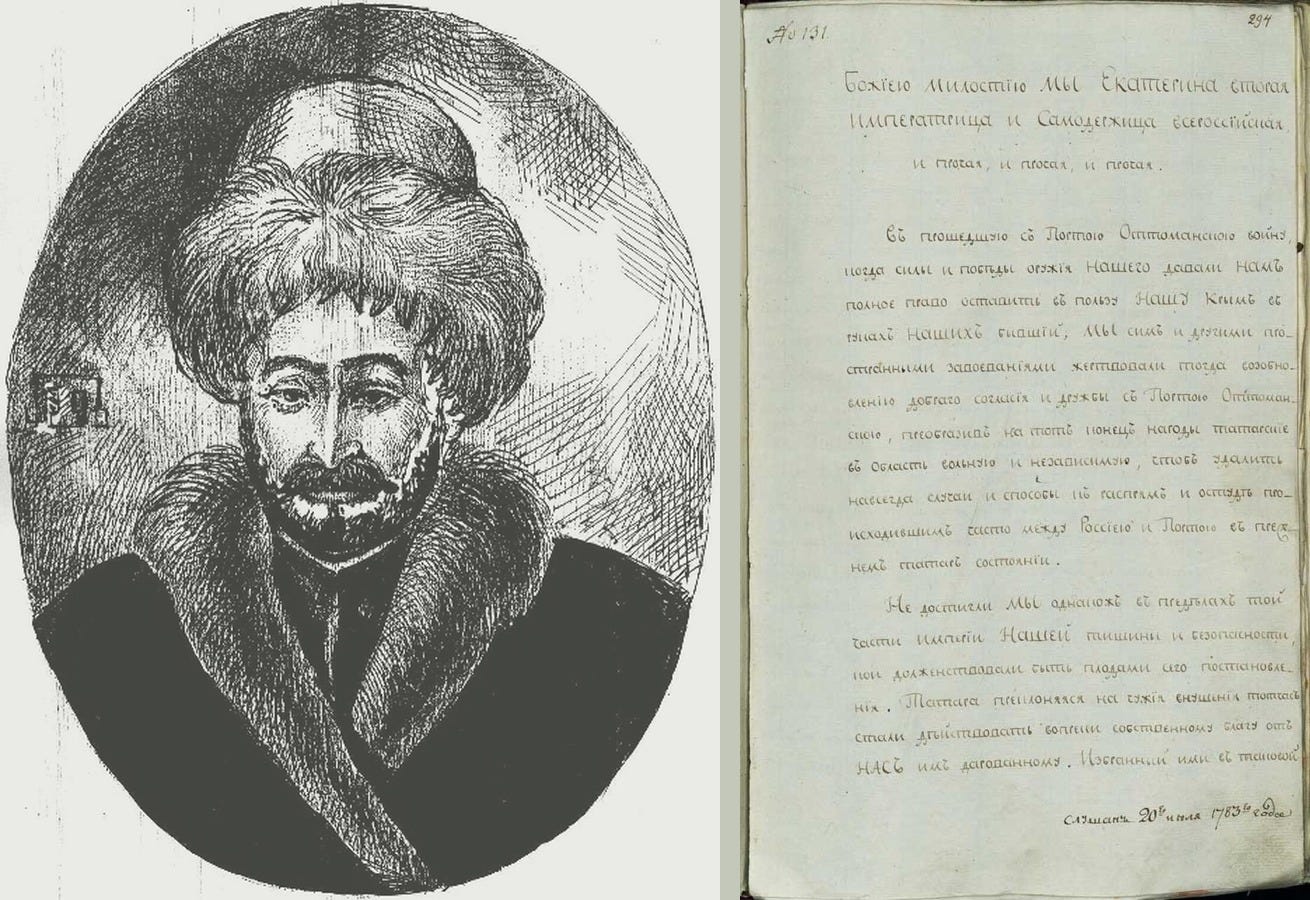
Left: Şahin Giray, the last Khan of Crimea. Right: Catherine the Great’s annexation manifesto, dated 20 July 1783. Both images public domain.
THE RENAMING OF THE WORLD
Once the manifesto was signed, the work of erasure began.
Potemkin, as governor of the new Taurida Oblast, moved immediately to expropriate Tatar land and redistribute it to Russian nobles. Catherine herself gave away vast estates on the peninsula to her favourites at court. The Tatar nobility, the social and administrative structure that had governed the Khanate for three centuries, was dismantled and replaced with Russian imperial bureaucracy.
Then came the renaming.
The Crimean Tatars had named this land across generations. Their place names carried history, geography, memory. Aqmescit, the White Mosque, became Simferopol. Aqyar, the White Cliff, became Sevastopol. Kezlev became Yevpatoria. Kefe, the ancient Genoese slave port that had been the commercial heart of the Khanate, became Feodosia, a Greek name applied by Russian colonisers to a city the Greeks had not controlled for a thousand years. Everywhere the Tatar names were stripped away and replaced with Greek-sounding Russian inventions, designed to suggest an ancient classical heritage for a colonial project that was barely a decade old.
This was deliberate, and it was understood as such at the time. Catherine had tasked imperial scholars explicitly with justifying the 1783 occupation and proving that the Crimean Tatars had no legitimate historical claim to their own homeland. History, in the Russian imperial tradition, was always something to be written rather than recorded.
The magnificent Khan’s Palace at Bakhchysarai, the administrative and cultural heart of the Crimean Khanate for three centuries, was not destroyed. It was kept, partially, as a curiosity. Russian aristocrats visited it on tours of the new acquisition. Alexander Pushkin wrote a famous poem about its fountain. The palace was preserved the way a trophy is preserved: as evidence of what had been conquered, stripped of the living culture that had built it.
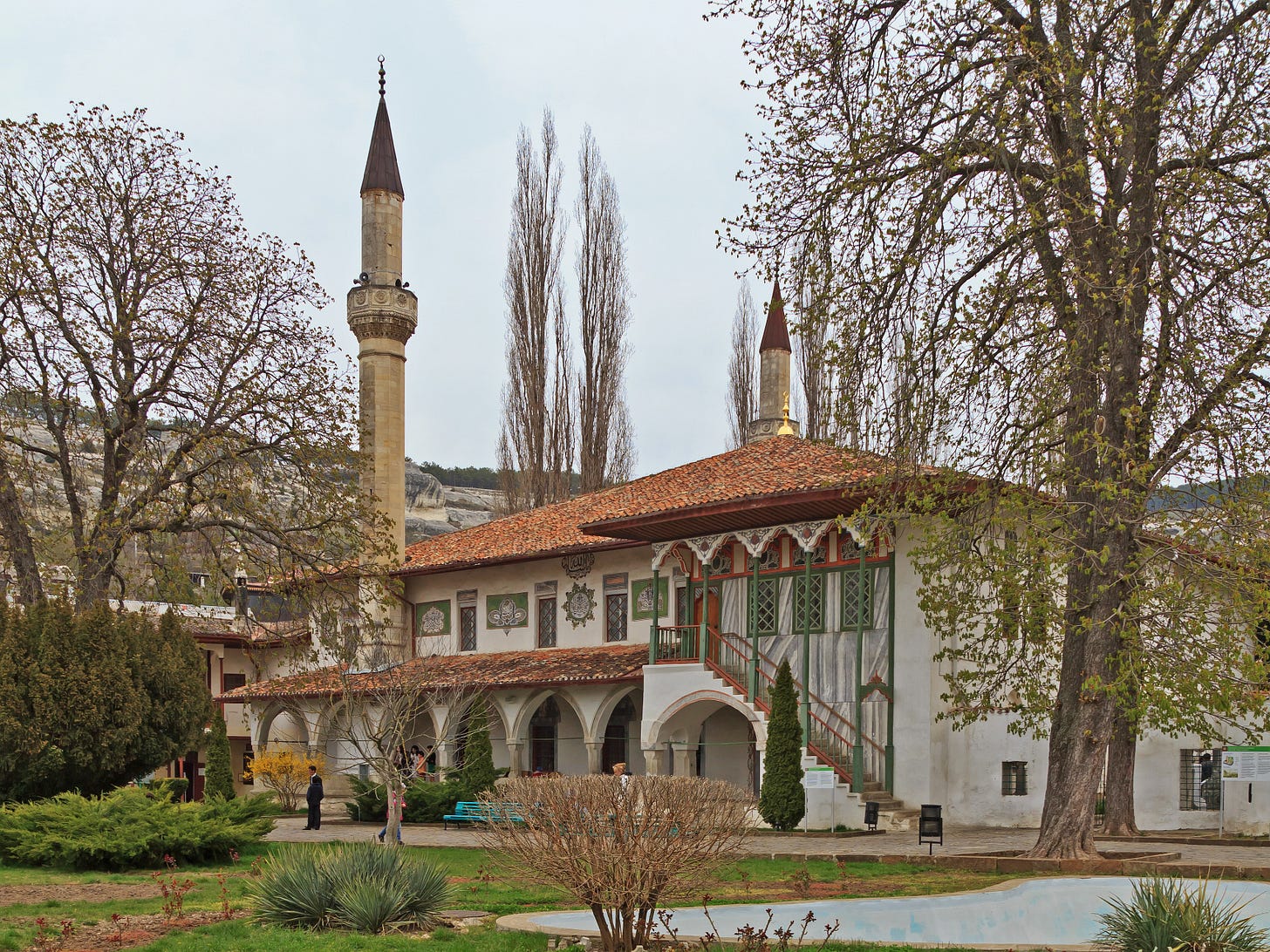
The Grand Mosque of the Khan’s Palace, Bakhchysarai. The palace was the seat of Crimean Tatar power for over three centuries. Wikimedia Commons. Public domain. A.Savin – Own work
THE NUMBERS THAT TELL THE STORY
Before 1783, Crimean Tatars made up between 90 and 98 percent of the peninsula’s population. They were not a minority. They were the people of Crimea. They had been there, continuously, for centuries.
By 1800, between 100,000 and 300,000 Tatars had left the peninsula for the Ottoman Empire, a first wave of an exodus that would continue in surges for the next two centuries. In just ten years after the annexation, historians estimate that approximately 330,000 Crimean Tatars had been driven into exile.
The Crimean War of 1853 to 1856 triggered another mass exodus. Between 1855 and 1866, at least 500,000 Muslims, possibly up to 900,000, left the Russian Empire for the Ottoman world. A significant proportion came from Crimea.
By 1897, a century after the annexation, Crimean Tatars had gone from being 98 percent of the population to 34 percent. By the time of the Soviet census of 1939, they were 19 percent. And then in May 1944, Stalin finished what Catherine had started.
That number, from 98 percent to 13 percent today, is not the result of natural demographic change. It is the result of deliberate, sustained, multigenerational ethnic displacement pursued as state policy across two centuries by two successive imperial systems.
Russia calls this history. The Crimean Tatars call it what it is.
THE TEMPLATE
In February 2014, Russian troops without insignia appeared on the streets of Crimea. They occupied government buildings, seized the airport, surrounded Ukrainian military bases. The Kremlin denied they were Russian soldiers. Putin later admitted they were.
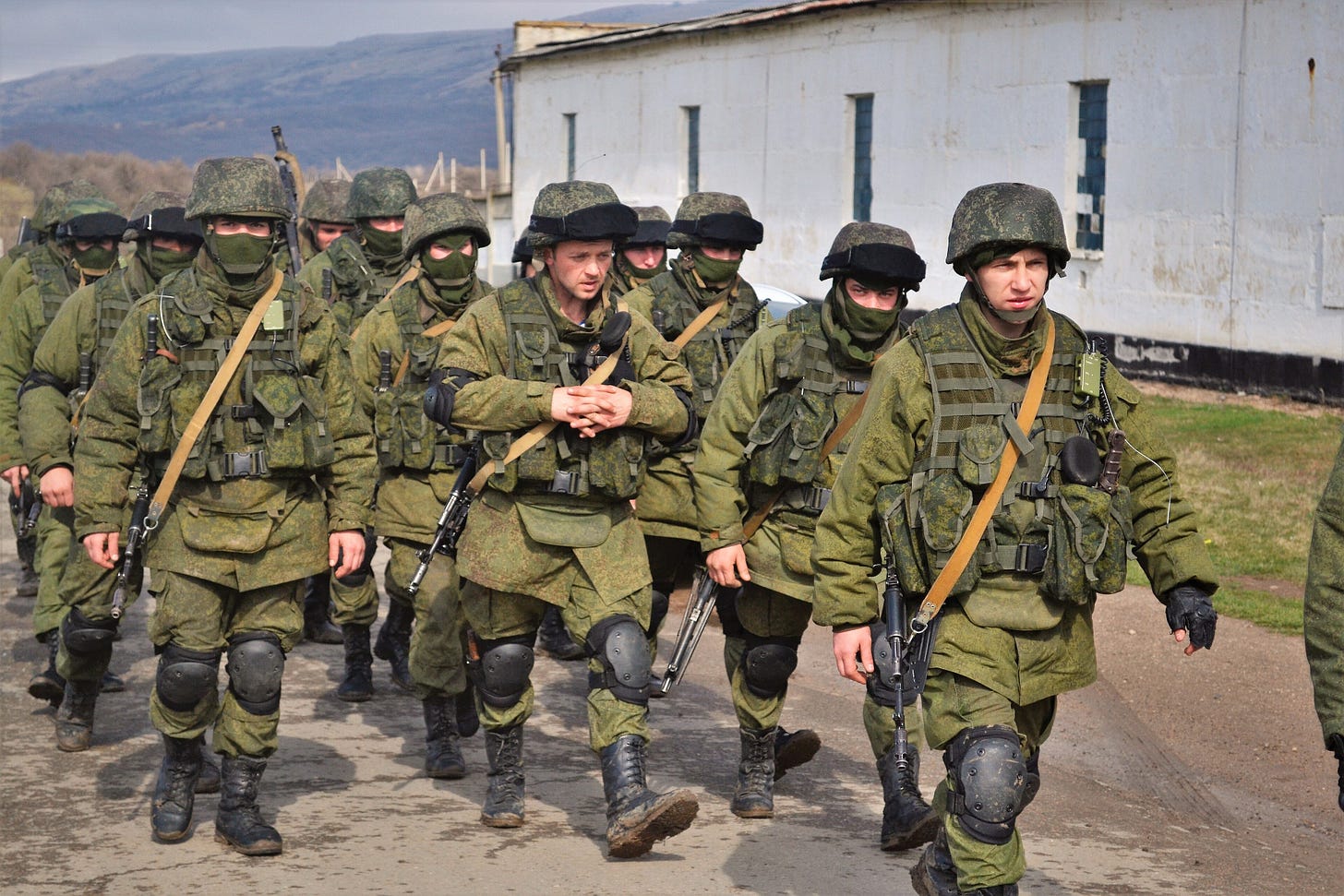
Russian troops without insignia at Perevalne military base, Crimea, March 2014. The soldiers Russia initially denied were its own. Wikimedia Commons. Public domain. Anton Holoborodko
A referendum was organised in two weeks. International observers were not permitted. The result, 96.77 percent in favour of joining Russia, was accepted by no recognised international body. The annexation was declared complete on 18 March 2014.
The parallels with 1783 are not coincidental. They are structural. Install a compliant local leadership. Destabilise the existing government. Manufacture a pretext based on the protection of a threatened population. Move troops in under ambiguous circumstances. Annex. Rename. Resettle.
Potemkin wrote the manual. Putin read it.
The one difference between 1783 and 2014 is that in 1783, the great powers of Europe eventually accepted what Russia had done. France filed a note of protest and then dropped it when Russia reminded them that France had annexed Corsica without objection. Britain and Austria looked away. The Treaty of Constantinople in 1784 formalised the loss.
In 2014, the world said it would not accept the annexation. A decade later, Russia occupies Crimea still, the Crimean Tatars face renewed persecution, and the international community’s response remains the subject of ongoing debate.
The theft of 1783 was never reversed. It took a hundred and sixty eight years, a world war, and twenty million Soviet deaths before even the question of Crimea’s status was reconsidered. And then in 1954, Khrushchev transferred Crimea from the Russian Soviet Federative Socialist Republic to the Ukrainian Soviet Socialist Republic, an administrative gesture inside a single state that became one of the most consequential decisions in post-Soviet history.
NEXT
Russia had its fleet. It had its renamed cities. It had reduced the Tatar population from nine in ten Crimeans to a shrinking minority. But it had not finished with Crimea, and the rest of the world had not finished with Russia.
Seventy years after Catherine signed her manifesto, Britain, France and the Ottoman Empire went to war specifically to stop Russia doing to the wider region what it had already done to Crimea. The battle that followed was fought on the same peninsula, around the same naval base, and it would produce some of the most famous military disasters in British history.
That is Part 2.