The Crossroads
Three thousand years of Crimea. Russia accounts for two hundred and forty of them.
JUN 26, 2026
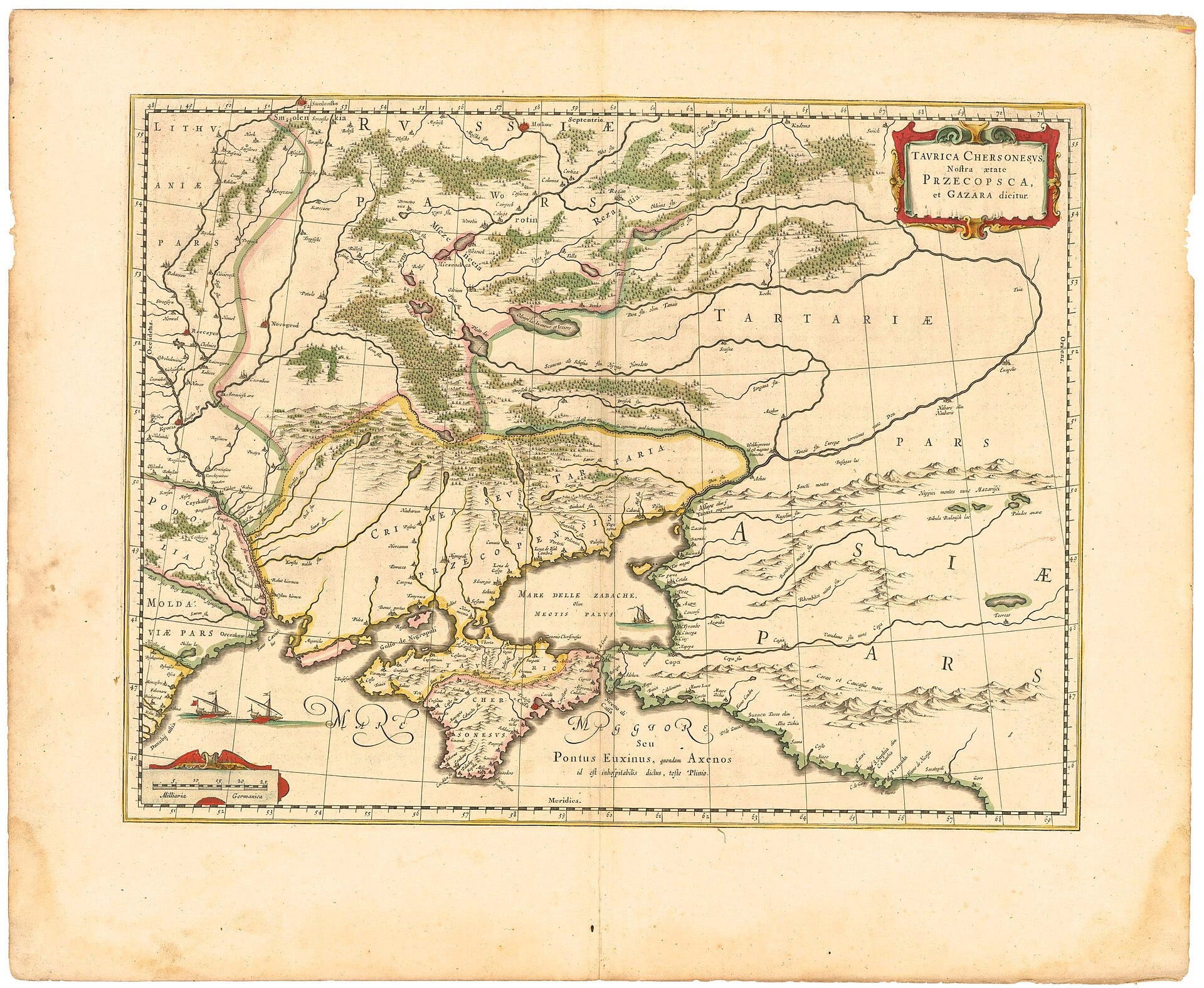
Taurica Chersonesus (Crimea), Willem Blaeu, 1645. Public domain via Wikimedia Commons.
Crimea Series: Prologue
Before we talk about what Russia stole, we need to talk about what was there.
Because the lie at the heart of Russia’s claim to Crimea is not just political or legal. It is historical. It is the claim that Crimea is, and has always been, Russian. That the 2014 annexation was a homecoming rather than a theft, a correction of a historical anomaly rather than the violent seizure of another country’s land. Putin has said as much explicitly. Russian state media repeats it daily.
It is not true. It is not even close to true.
Crimea is a small peninsula, roughly the size of Wales, jutting southward into the Black Sea from the southern edge of what is now Ukraine. It sits at the meeting point of the European steppe, the Mediterranean world and the Asian heartland. For three thousand years, that geography made it one of the most contested, most cosmopolitan and most consequential pieces of land on earth. Empires have risen and fallen on its shores. Civilisations have left their mark in its stones, its place names, its graves.
Russia arrived in 1783. That is where its story in Crimea begins. Everything before that belongs to someone else.
THE FIRST PEOPLES
The oldest human traces in Crimea go back nearly 100,000 years. Neanderthal remains have been found in caves in the Belogorsk district and near Simferopol, making the peninsula one of the last known Neanderthal habitats before their extinction. Modern humans arrived later and eventually lived alongside them.
By the early Bronze Age, a nomadic people the Greeks called the Cimmerians had settled the Crimean steppe. Homer wrote about them. Their burial mounds, more than fourteen identified so far, still dot the landscape. The Cimmerians were eventually driven out by a wave of Iranian nomads from the east: the Scythians.
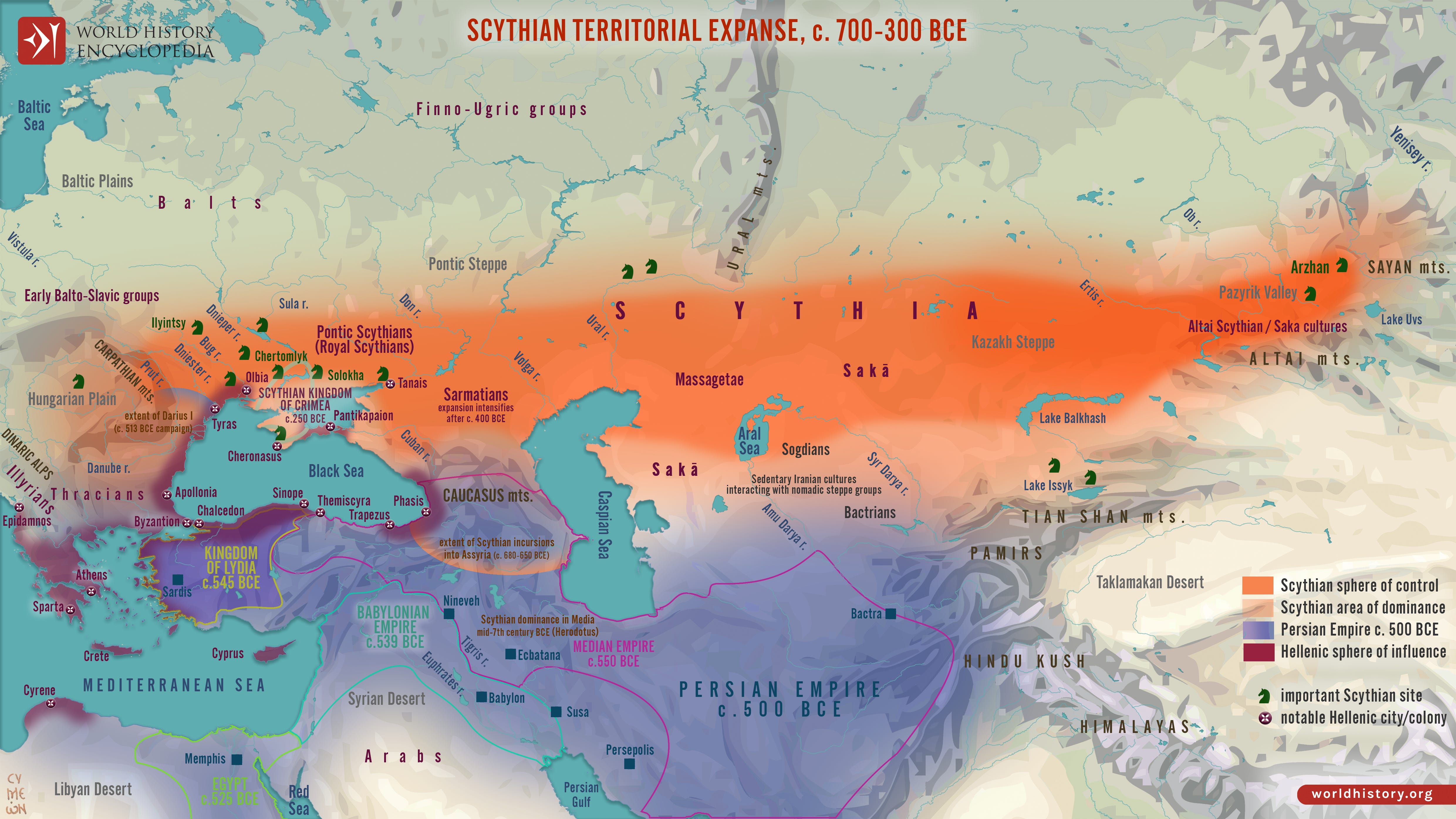
Scythian Territorial Expanse, c. 700–300 BCE. World History Encyclopedia. CC License.
The Scythians were one of the great peoples of the ancient world, and Crimea was the heart of their empire. Skilled horsemen, feared warriors, and sophisticated artists, they built a capital at what is now Simferopol and controlled territory stretching from the Danube to the borders of Persia. When the Persian king Darius I tried to conquer them in 513 BC, they refused to give battle and simply withdrew into the steppe until his army starved. When Philip II of Macedonia came for them, their king Ateas died fighting at the age of ninety rather than submit. The Scythians left behind extraordinary gold work, burial mounds of staggering richness, and a civilisation that lasted centuries.
They shared the peninsula with the Tauri, an older indigenous people who lived in the mountain regions and who gave Crimea one of its ancient names: Taurica. The Greeks, who would arrive on the coasts, considered the Tauri fearsome and ungovernable. Even after centuries of contact, they were never fully absorbed.
None of this has anything to do with Russia.
THE GREEK WORLD
In the seventh and sixth centuries BC, Greek colonists from Miletus and other Ionian cities began establishing trading settlements along the Crimean coast. They came looking for grain, honey, fish and furs. What they built was something that would last nearly two thousand years.
The colony of Panticapaeum, founded around 610 BC near the modern city of Kerch, grew into the capital of the Bosporan Kingdom, a remarkable hybrid state where Greek and Scythian cultures fused into something entirely their own. The Bosporan kings intermarried with Greek nobility, commissioned Greek art and architecture, and supplied Athens with wheat, a trading relationship so important that Athenian politicians debated its strategic value in the assembly. In 438 BC the ruler of Panticapaeum took the title King of Cimmerian Bosporus.
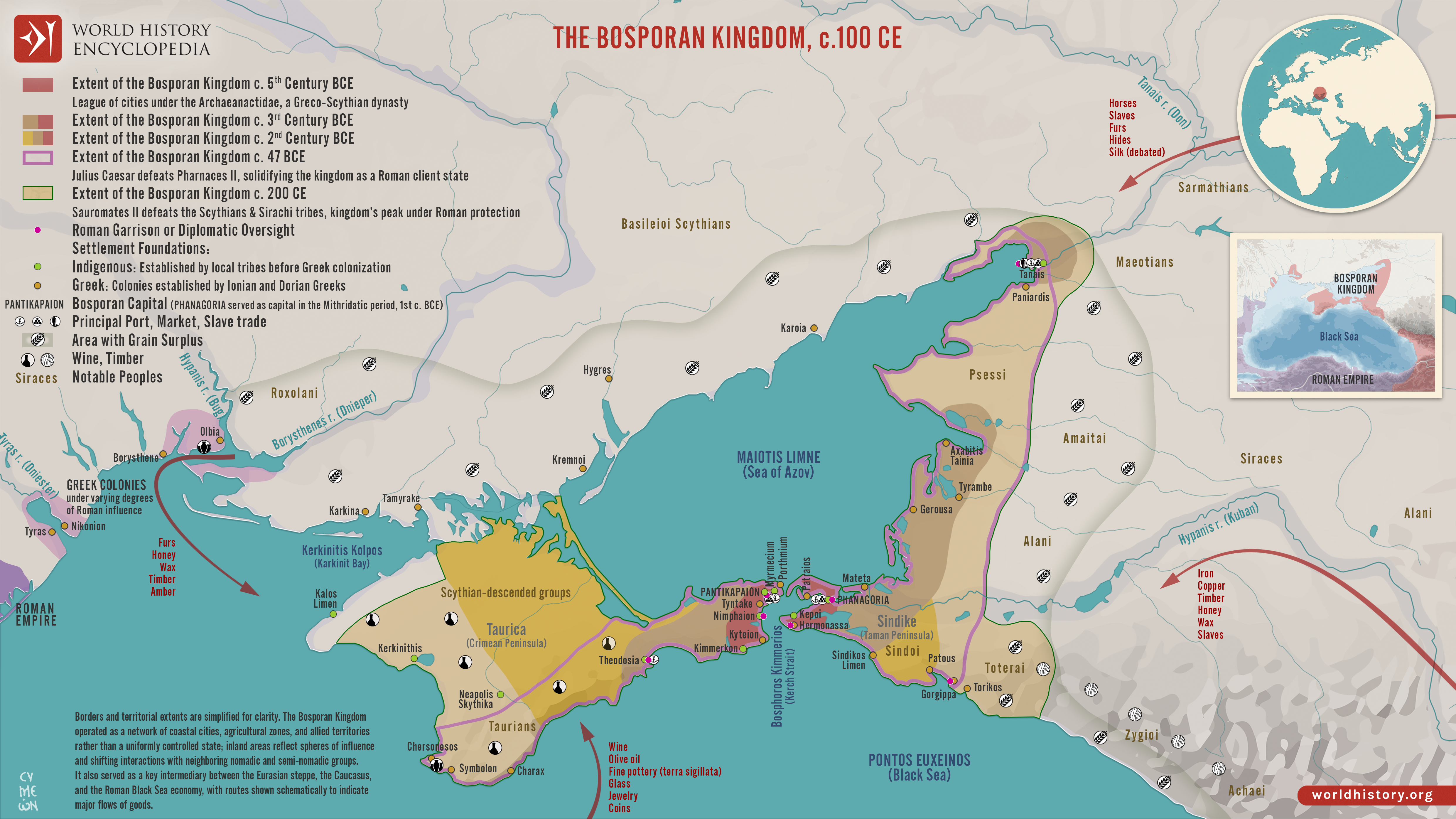
The Bosporan Kingdom, c. 100 CE. World History Encyclopedia. CC License.
On the southwestern tip of the peninsula, the Dorian colony of Chersonesos grew into a democratic republic, one of the few genuine democracies of the ancient world outside Athens itself. It maintained its independence for centuries, resisting Scythian pressure through alliances with a succession of powerful patrons. Today its ruins lie within the city of Sevastopol, the same Sevastopol that Russia seized in 2014 and has occupied ever since.
The Persian Empire reached Crimea. Rome reached Crimea. In the first and second centuries AD, Roman legions were stationed at a garrison called Charax, protecting the Bosporan trade routes from Scythian raids. The Legio I Italica was among the units posted there. Roman Crimea was a real thing, as documented and substantial as Roman Britain.
After Rome came Byzantium. For the better part of a millennium, the coastal cities of Crimea remained culturally and administratively Greek, part of the Byzantine world, conducting commerce with Constantinople, maintaining the Orthodox faith, producing scholars and sailors and merchants. When the Byzantine Empire fractured in 1204 after the Fourth Crusade, Crimea passed to the Empire of Trebizond, and the southernmost mountain principality, Theodoro, maintained its independence as a Greek Christian state until 1475.
Nearly two thousand years of continuous Greek civilisation on the Crimean coast. Not Russian. Greek.
THE INVADERS FROM THE STEPPE
While the coastal cities maintained their Mediterranean character, the interior and northern steppe of Crimea was a different world entirely: a corridor through which the peoples of the Eurasian steppe passed in successive waves, each displacing or absorbing the last.
After the Scythians, came the Sarmatians. After the Sarmatians came the Goths, who arrived in the third century AD and proved remarkably persistent. Crimean Gothic, an East Germanic language spoken by the descendants of those Gothic settlers, survived in isolated mountain villages until the late eighteenth century, a linguistic fossil of a civilisation that had endured for fifteen hundred years. The Huns came through. The Bulgars. The Khazars, a Turkic people whose ruling class converted to Judaism in the eighth century, controlled the peninsula for generations. The Kipchaks. The Mongols, who swept through in 1238 under Batu Khan, devastating the peninsula and absorbing it into the Golden Horde.
Each wave left traces. Each reshaped what came before without erasing it entirely. Crimea was never a blank slate waiting for a single people to claim it as their own.
Kyivan Rus had its own connections to Crimea. In the tenth century, the Rus prince Sviatoslav I controlled parts of the peninsula. It was in Chersonesos, the ancient Greek city, that Prince Vladimir of Kyiv was baptised in 988, the event traditionally taken as the beginning of Christianity in the Rus lands. This is the same Chersonesos, in the same Sevastopol, that Putin invoked in 2014 as sacred Russian ground. He was not wrong that it mattered. He was wrong about who it belonged to.
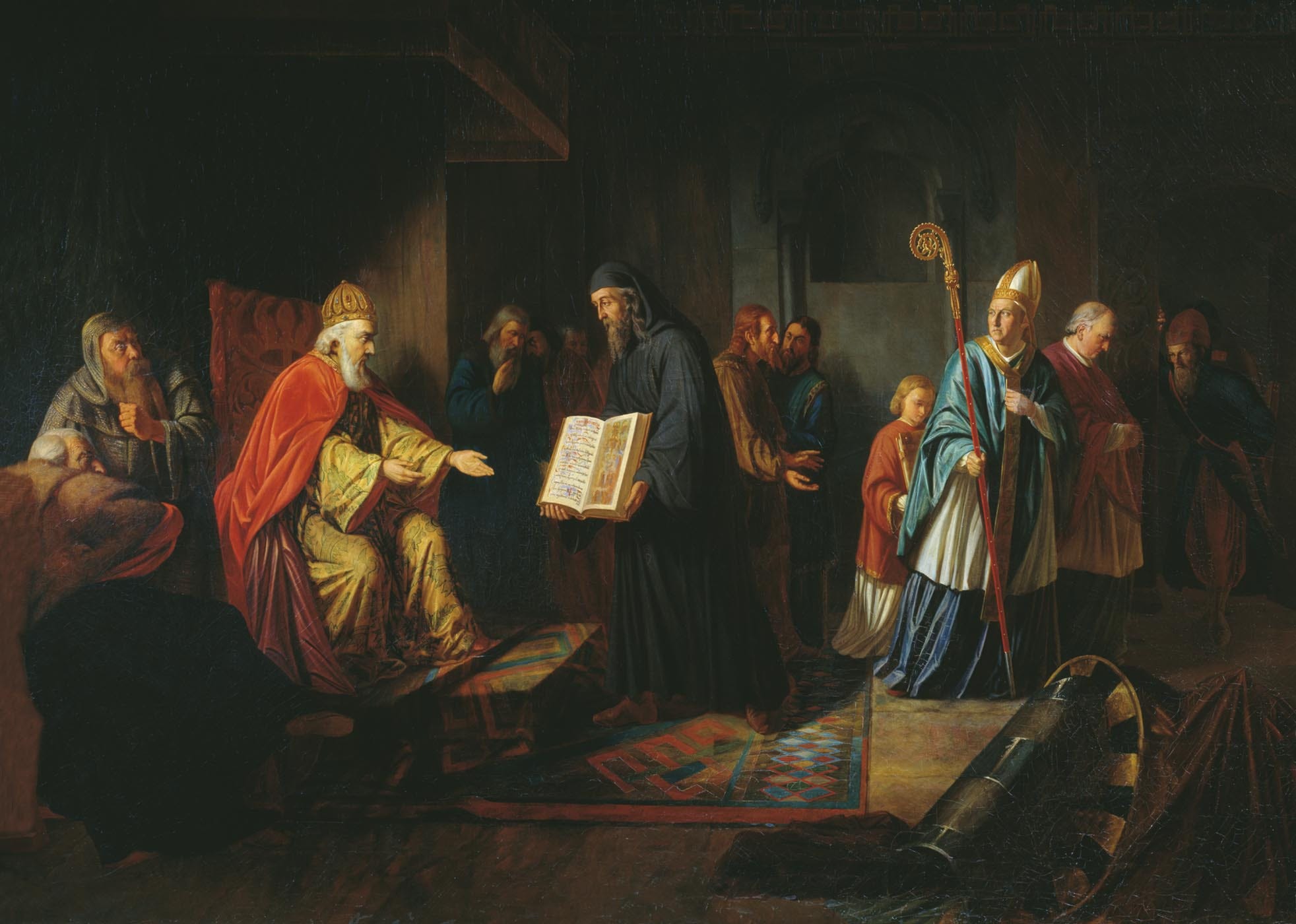
Prince Vladimir chooses a religion, 988. Johann Leberecht Eggink, 1822. Public domain.
The thread that runs from that baptism forward is worth holding onto. The same Christian faith that entered the Rus lands through a ceremony in a Crimean city would, sixty years later, inspire a monk named Anthony to dig a cave on the banks of the Dnipro and found what would become the Kyiv Pechersk Lavra. Anthony had travelled to Mount Athos in Greece to receive that faith, carrying it back through the same Byzantine civilisational current that had shaped Chersonesos for a thousand years before Vladimir ever set foot there. Chersonesos and the Lavra are part of the same story, the same unbroken thread of Christian culture stretching from ancient Crimea to the golden domes of Kyiv.
Russia bombed the Lavra in June 2026. It has occupied Chersonesos since 2014.
The thread connects. Russia is cutting it.
THE GENOESE AND THE VENETIANS
In the thirteenth and fourteenth centuries, as the Mongol Golden Horde’s grip on Crimea loosened into something more like overlordship, the great Italian merchant republics moved in. Genoa and Venice established trading colonies along the coast, and Caffa, the modern city of Feodosia, became one of the most important commercial centres in the medieval world.
From Caffa, Genoese merchants traded in grain, spices, furs, silk and human beings. The slave trade was already ancient in Crimea by the time the Italians arrived, and they participated in it enthusiastically, buying captives taken in steppe raids and selling them on to markets in Egypt, the Levant and southern Europe. The Genoese built massive stone fortresses to protect their interests. Their towers still stand in Feodosia and Sudak.
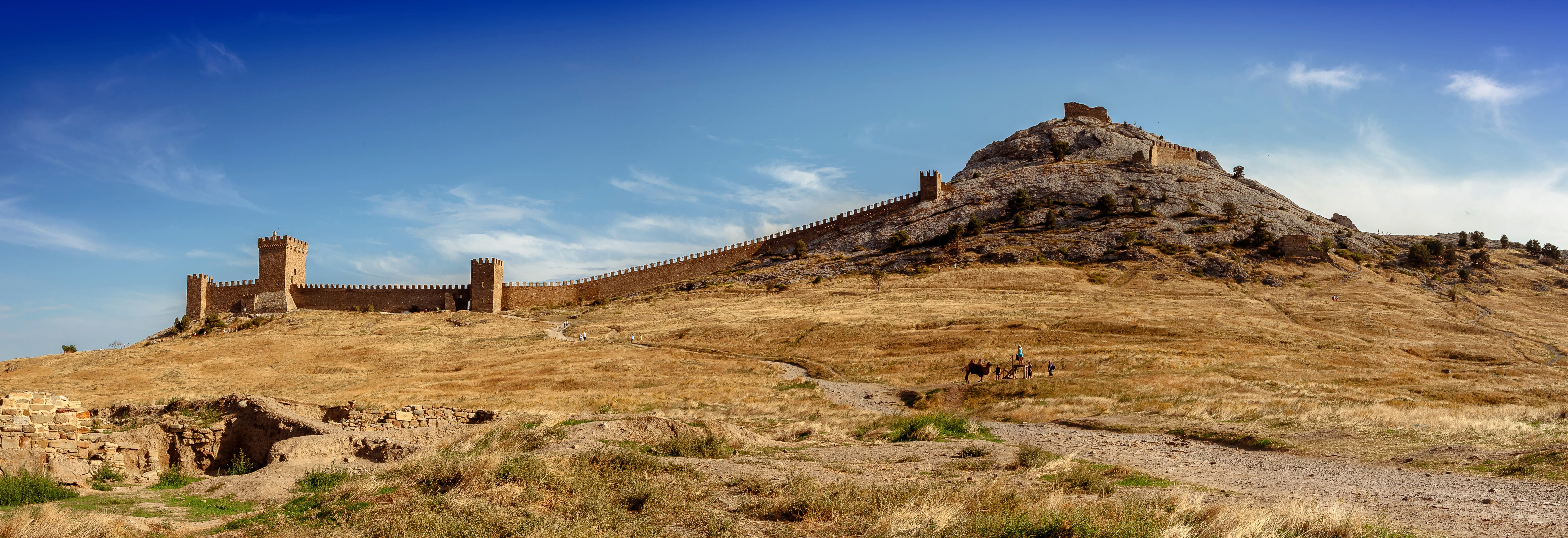
Genoese fortress, Sudak, Crimea. Serhii Zysko, CC BY-SA 4.0 via Wikimedia Commons.
It was also from Caffa that the Black Death reached Europe. In 1346, Mongol forces besieging the city catapulted plague-infected corpses over the walls. Genoese ships fled, carrying the disease west. By the time those ships reached Sicily in 1347, the pandemic that would kill a third of Europe’s population was already aboard.
Crimea was not a backwater. It was a hinge of history.
THE CRIMEAN KHANATE AND THE SLAVE WORLD
In 1441, as the Golden Horde broke apart, a Tatar nobleman named Hacı Geray established the independent Crimean Khanate. It was the last surviving successor state of the Mongol empire, and it would prove remarkably durable, lasting until 1783. At its height it controlled not just the peninsula but vast stretches of the northern Black Sea steppe.
In 1475, the Ottoman Empire seized the Genoese coastal colonies and the Principality of Theodoro, ending a thousand years of continuous Greek civilisation on the Crimean coast in a single military campaign. The Crimean Khans became vassals of the Ottoman Sultans, paying tribute and providing soldiers. But within the Khanate’s own territory, the Khans remained sovereign.
The economy of the Khanate rested on a single foundation: the slave trade.
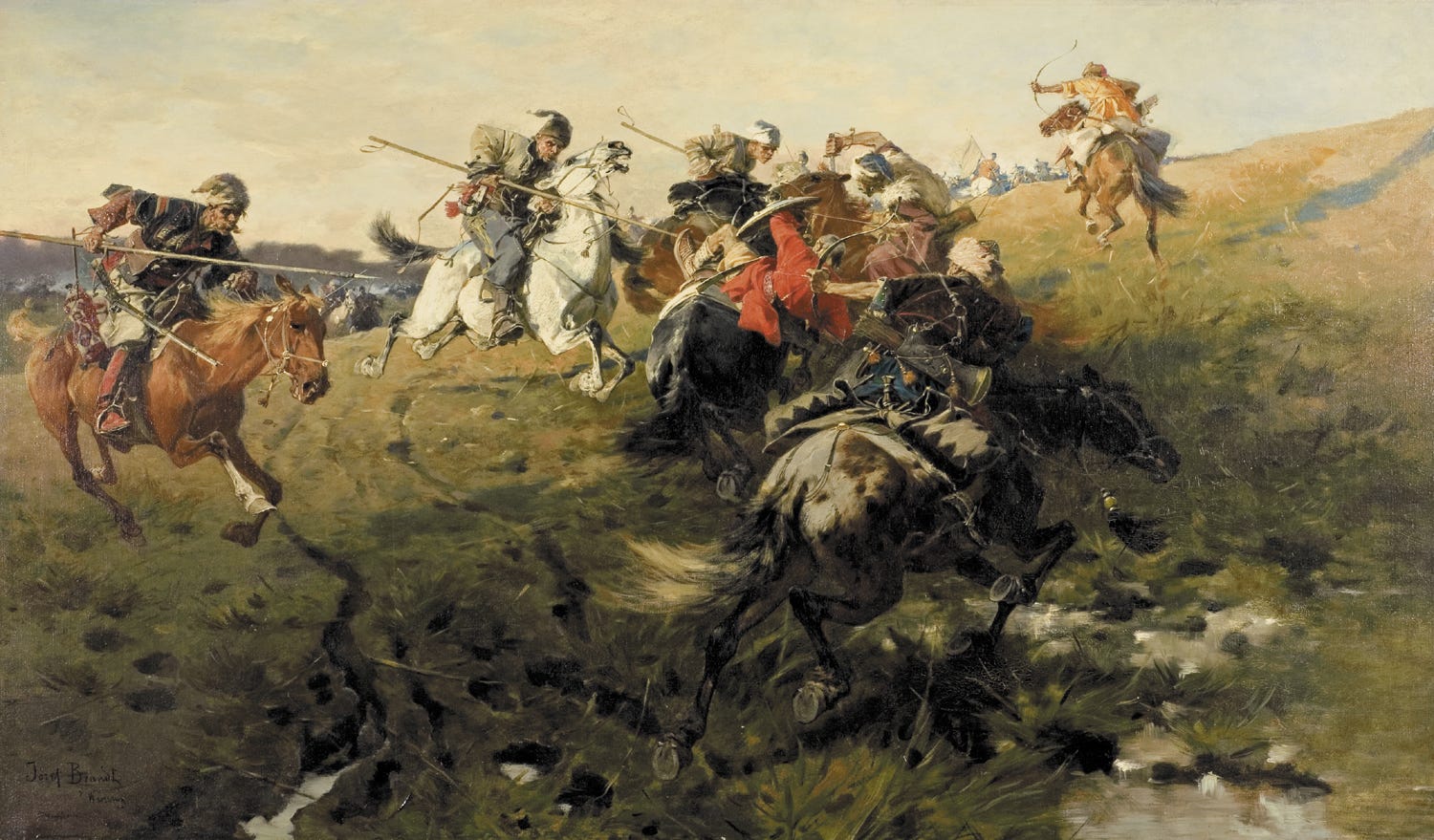
Crimean Tatar slave raid. Józef Brandt, 19th century. Public domain via Wikimedia Commons.
Every year, Crimean Tatar cavalry rode north into the lands of Poland-Lithuania, Muscovy and Ukraine in expeditions known, with chilling frankness, as the “harvesting of the steppe.” Villages were burned. Men were killed or taken. Women and children were bound and marched south to the slave markets of Caffa, where a Lithuanian writer in the sixteenth century described the city as “not a town, but an abyss into which our blood is pouring.”
Polish historian Bohdan Baranowski estimated that the Polish-Lithuanian Commonwealth alone lost an average of 20,000 people per year to these raids between 1474 and 1694, a total approaching one million people across two centuries. In a single raid in 1571, Crimean Khan Devlet I Giray burned Moscow itself and carried 150,000 Russians into captivity. Ivan the Terrible fled the city rather than face him. At the peak of the trade, close to 20,000 slaves a year were sold in Caffa alone.
This is where the devshirme connection enters the story. Many of the boys taken in these raids and delivered to the Ottomans were enrolled in the devshirme system: separated from their families, converted to Islam, educated in the imperial palace schools, and trained as janissaries or administrators. Some rose to extraordinary heights within the Ottoman system. Grand Viziers of Ukrainian and Slavic origin shaped the policies of an empire. The same Black Sea routes that had carried Scythian gold and Greek wine and Genoese silk now carried children from Ukrainian villages to the palaces of Constantinople.
The most remarkable of them was not a boy at all. Around 1520, Crimean Tatar raiders descended on the town of Rohatyn in what is now western Ukraine. Among those taken was the daughter of a Ruthenian Orthodox priest, a girl of around fifteen. She was marched to Caffa, sold through the slave market, and shipped to Constantinople.
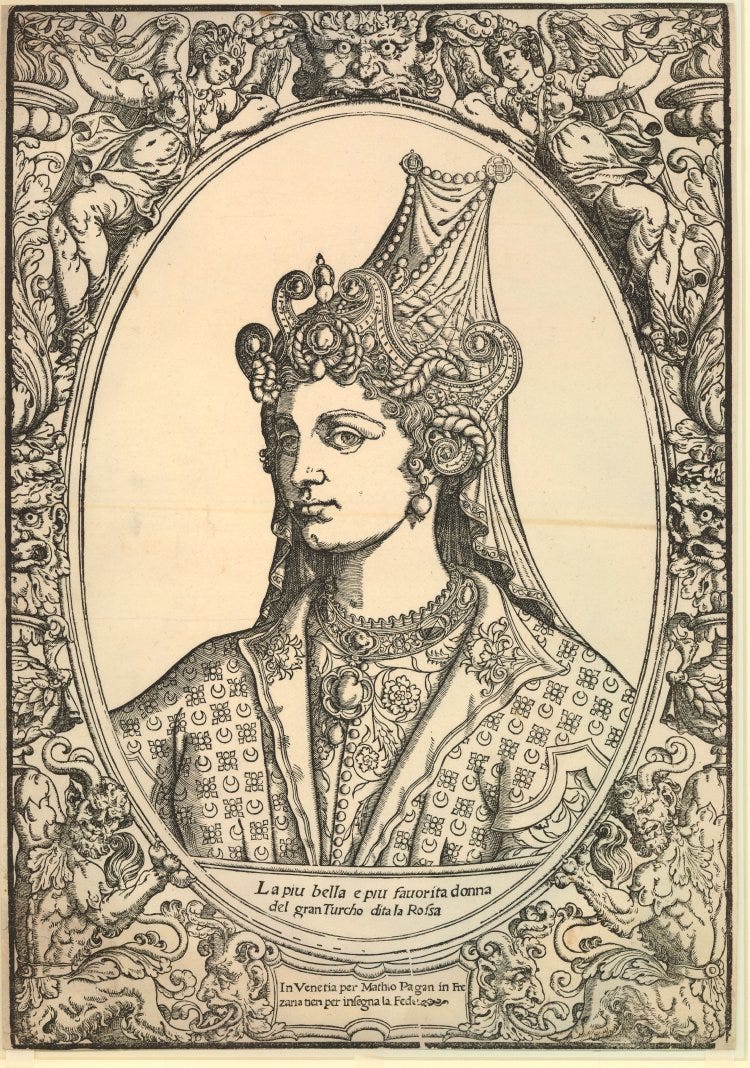
Portrait of Roxelana, c. 1540–50. Matteo Pagani. Public domain.
There she entered the imperial harem, was given the name Hürrem, and within a few years had become the favourite of Sultan Suleiman the Magnificent. He eventually married her, breaking centuries of Ottoman tradition. She bore him six children, including the future sultan Selim II, making her the ancestor of every subsequent Ottoman ruler. She shaped the foreign policy of an empire, corresponded with European kings, commissioned some of the greatest works of the imperial architect Sinan, and became known across Europe as Roxelana: the Ruthenian one.
She is remembered today in Ukraine as Roksolana. There is a monument to her in Rohatyn. In 2019, an inscription near her tomb in Istanbul that described her as Russian was removed at the formal request of the Ukrainian Embassy in Turkey.
Even in death, four and a half centuries later, the same argument was still being fought. She was not Russian. She was Ukrainian. She was taken from Ukraine through Crimea. And she ended up ruling the world.
The scale of it is difficult to absorb. Historians estimate that between 1441 and 1774, the Crimean slave trade was comparable in size to the entire transatlantic slave trade of the same period. The northern Black Sea steppe was depopulated across generations. The “Wild Fields” that stretched between the Khanate and Moscow were left largely empty not because they were uninhabited but because the inhabitants had been taken.
And Moscow, for most of this period, paid tribute to the Crimean Khan rather than the other way around. The idea of Crimea as Russian is not just historically recent. For most of the period of Tatar dominance, it was the opposite: Russia was, in a meaningful sense, subordinate to Crimea.
THE WORLD RUSSIA DESTROYED
When Catherine the Great’s armies finally annexed the Crimean Khanate in 1783, they were not reclaiming Russian land. They were conquering a foreign state with its own language, its own laws, its own ancient capital at Bakhchysarai, and its own people who had lived there for centuries.
Before annexation, Tatars made up roughly 90 percent of Crimea’s population. Catherine issued settlement manifestos offering free land and tax exemptions to Orthodox Slavic settlers from Russia and Ukraine, as well as foreign colonists from Germany, Bulgaria, Greece and Armenia. Between 1783 and 1800, somewhere between 100,000 and 200,000 Tatars fled or were driven out, their share of the population collapsing within a generation.
Russia then spent the next two centuries systematically erasing the world it had conquered. Tatar place names were replaced with Greek-sounding Russian ones. Sevastopol, Simferopol, Feodosia: Russian colonial names stamped over centuries of Tatar geography. The magnificent Khan’s Palace at Bakhchysarai, one of the great architectural monuments of the Islamic world, was partially preserved as a curiosity for Russian tourists. The rest was allowed to decay.
The Crimean Tatars were not gone. They endured, diminished and dispossessed, through the tsarist period, through the Crimean War, through the revolution. They held on to their language, their faith, their memory of what had been taken from them.
And then in May 1944, Stalin finished what Catherine had started.
That is the next chapter.
For now, remember this: when Russia says Crimea has always been Russian, it is asking you to ignore three thousand years of history. The Cimmerians. The Scythians. The Greeks. The Romans. The Goths. The Byzantines. The Genoese. The Tatars. The Ottomans. The children carried in chains to Constantinople.
All of that existed before Russia arrived. All of it was erased, or nearly erased, after Russia arrived.
The theft of Crimea did not begin in 2014. It began in 1783. And the story of what was stolen goes back much further than that.
Next in the series: Part 1, Catherine the Great and the First Theft, 1783