Holy War, Burning Church
Russia calls this a holy war. Last night it burned the oldest church in Eastern Europe.
JUN 16, 2026
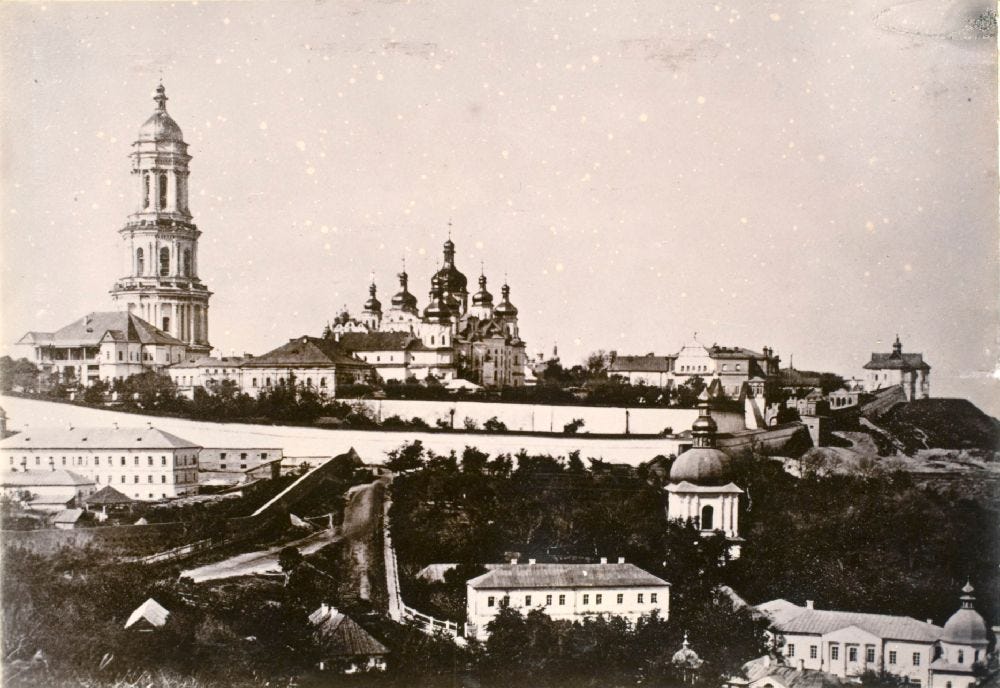
Kyiv Pechersk Lavra, c. late 19th century. Public domain
Russia bombed a monastery last night. Not a military base. Not an arms depot. A monastery. One that has stood for nearly a thousand years, that predates Moscow itself, that has survived Mongol raids, Tatar sackings, Nazi occupation and Soviet demolition. The Kyiv Pechersk Lavra, the Monastery of the Caves, the spiritual heart of Eastern Orthodox Christianity, was struck by Russian ballistic missiles in the early hours of Monday morning. Its roof burned while priests ran through fire hose cables trying to save crosses and icons from the flames.
Russia calls this a holy war.
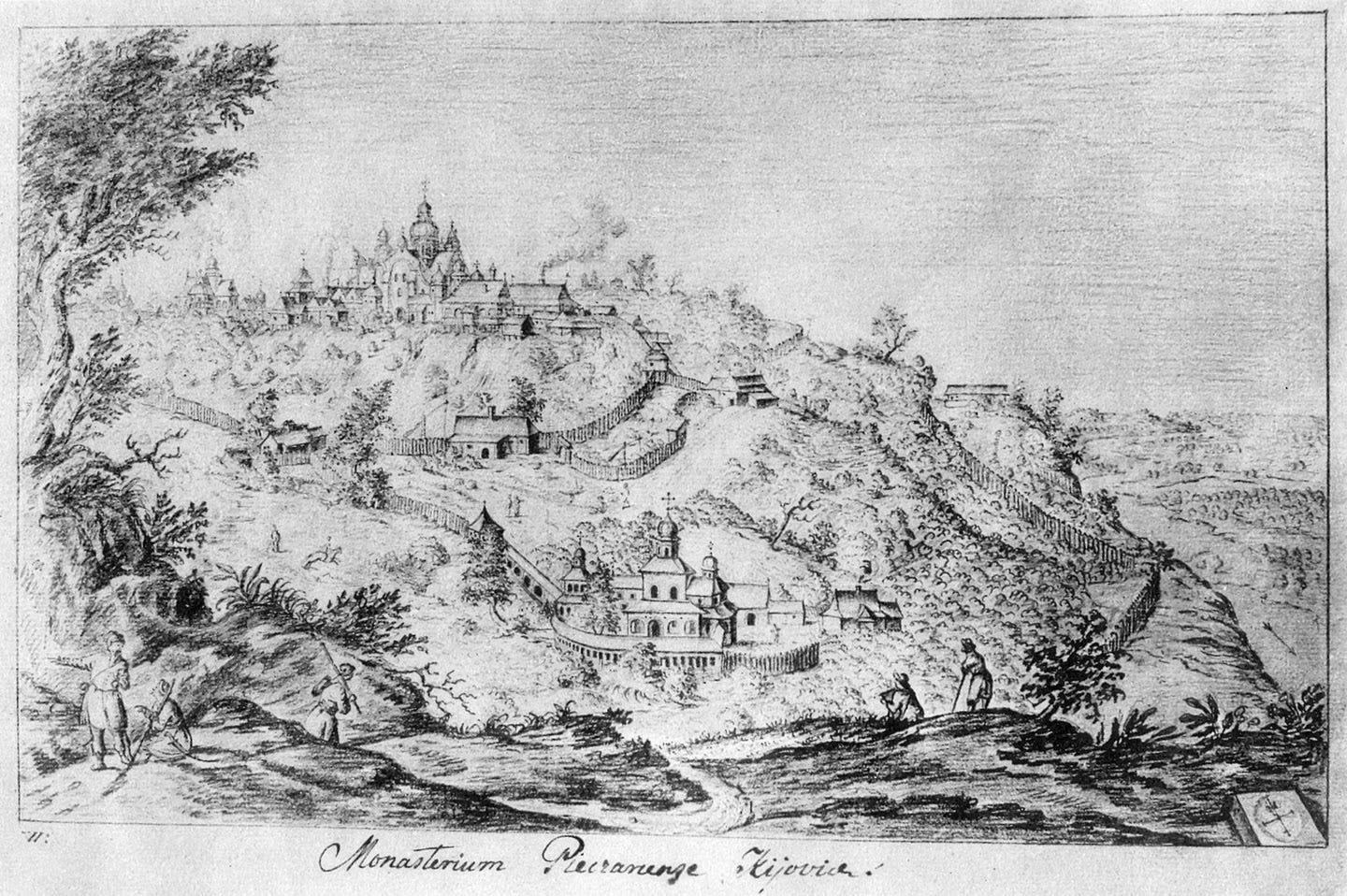
17th century engraving of the Kyiv Pechersk Lavra (Monasterium Peccerense Kijoviæ). Public domain.
WHAT THE LAVRA IS
Most of the world knows this story as a news event. A building was hit. A UNESCO site was damaged. Firefighters responded. But to understand why this matters beyond the wire report, you have to understand what the Lavra actually is, and how old, and what it has meant to the people Russia is trying to destroy.
The Kyiv Pechersk Lavra was founded in 1051 by a monk named Anthony, who had returned from Mount Athos and chosen to live alone in a cave on the steep wooded slopes above the Dnipro River. Other monks joined him. A community formed around those caves. Within decades it had become one of the great spiritual and intellectual centres of medieval Europe, home to chroniclers who wrote the earliest histories of the Rus peoples, to icon painters whose work shaped the visual language of Orthodox Christianity, to physicians, educators and theologians.
The Dormition Cathedral, the great golden-domed church at the heart of the complex, was begun in 1073. It was consecrated in 1089.
Consider what that means in terms of the world it was built into. The Lavra is older than St Mark’s Basilica in Venice by a decade. It is older than Notre Dame de Paris by three centuries. It predates the Cathedral of Santa Maria del Fiore in Florence by four centuries, and St Peter’s Basilica in Rome by five hundred years. And it predates the first historical written mention of Moscow, in 1147, by nearly a century.
The civilisation that built the Lavra existed before Moscow was a clearing in a forest.
This matters because Russia’s entire ideological justification for this war is built on the claim that Ukraine and Russia share an inseparable historical and spiritual identity, that Kyivan Rus is the cradle of Russian civilisation, that defending Ukraine means defending the Orthodox faith. Putin said as much in his pre-war address: “Ukraine is an inalienable part of our own history, culture and spiritual space.” Patriarch Kirill of Moscow, who formally declared the invasion a holy war in 2024, has spent years preaching that Russia is the guardian of Orthodox Christian civilisation against a depraved and godless West.
If any of that means anything at all, the Lavra is its most sacred monument. It is older than Russia. It is the source, not the branch.
Last night, Russia set it on fire.
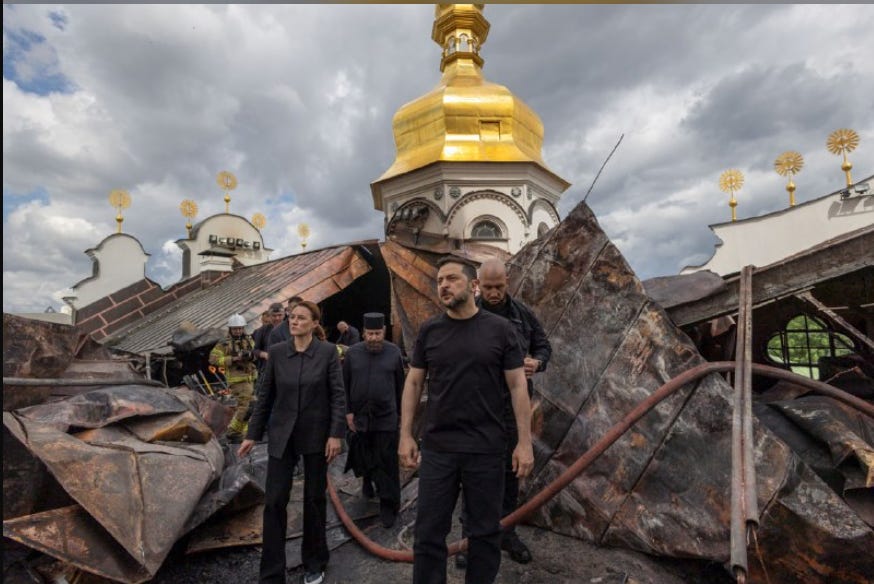
Ukrainian Presidential Press Service / Reuters handout.
THE SCALE OF THE ATTACK
This was not a stray missile. Ukraine’s air force reported that Russia launched 70 missiles and 611 drones into the country overnight, one of the largest single barrages of the entire war. The Lavra was among the targets, along with the Mystetskyi Arsenal cultural complex next door and the Dovzhenko National Film Studio, where Ukraine’s oldest and largest film costume collection was destroyed. Residential buildings across Kyiv were also struck. At least five people were killed in the capital, including a pregnant woman. Two children, aged five and six, were among the injured.
Bishop Avraamiy, the Lavra’s abbot, confirmed that monks and rescue workers managed to carry out ancient icons, antimensia and liturgical items of national and universal value before the flames took hold. Our correspondent Caolan Robertson was outside the complex as it happened, and watched priests running through the dark trying to save crosses from the burning building.
Metropolitan Epifaniy, head of the Orthodox Church of Ukraine, wrote from the scene: “The roof of one of the holiest places in the Christian world is burning. Another Russian crime against humanity, against history, against Christianity.”
Zelenskyy called it “one of the biggest Russian crimes against Christian culture to date.”
THE CONTRADICTION
Russia declared this a holy war. In March 2024, the World Russian People’s Council, chaired by Patriarch Kirill, published a formal decree describing the invasion as a spiritual crusade to preserve “Holy Rus” against Western encroachment. Kirill had been building toward this for years. In a sermon delivered on 6 March 2022, just days after the full-scale invasion began, he told Russian congregations that soldiers dying in Ukraine would have their sins forgiven and go immediately to heaven, a doctrine with no foundation in Orthodox theology. Academics who have studied his wartime preaching describe him plainly as blessing tanks and bombs in the name of God.
And then Russia bombed the holiest Orthodox site in Europe.
The contradiction is not subtle. Russia used the Lavra as a tool of political control for thirty years before it used missiles. After Ukrainian independence, the Lavra remained in the hands of the Ukrainian Orthodox Church of the Moscow Patriarchate, the Russian-affiliated branch loyal to Kirill. When Ukrainian security services raided the complex in 2022 they found pro-Russian literature, roubles and Russian passports inside the monastery walls. When priests were filmed singing songs praising the “Russian world” in the Lavra’s own churches, Moscow accused Ukraine of persecuting believers.
When Ukraine finally moved to evict the Moscow-aligned church from the Lavra in 2023, and later passed legislation banning Russian-affiliated religious organisations altogether, Patriarch Kirill appealed to the Pope, to global faith leaders, to international human rights bodies. Every step toward Ukrainian spiritual independence was reframed by Russia as persecution, as further evidence of the godlessness the holy war was meant to defeat.
And then, once Ukraine had reclaimed its own cathedral and given it to the independent Orthodox Church of Ukraine, Russia sent missiles.
The logic is not complicated. What could not be controlled was to be destroyed.
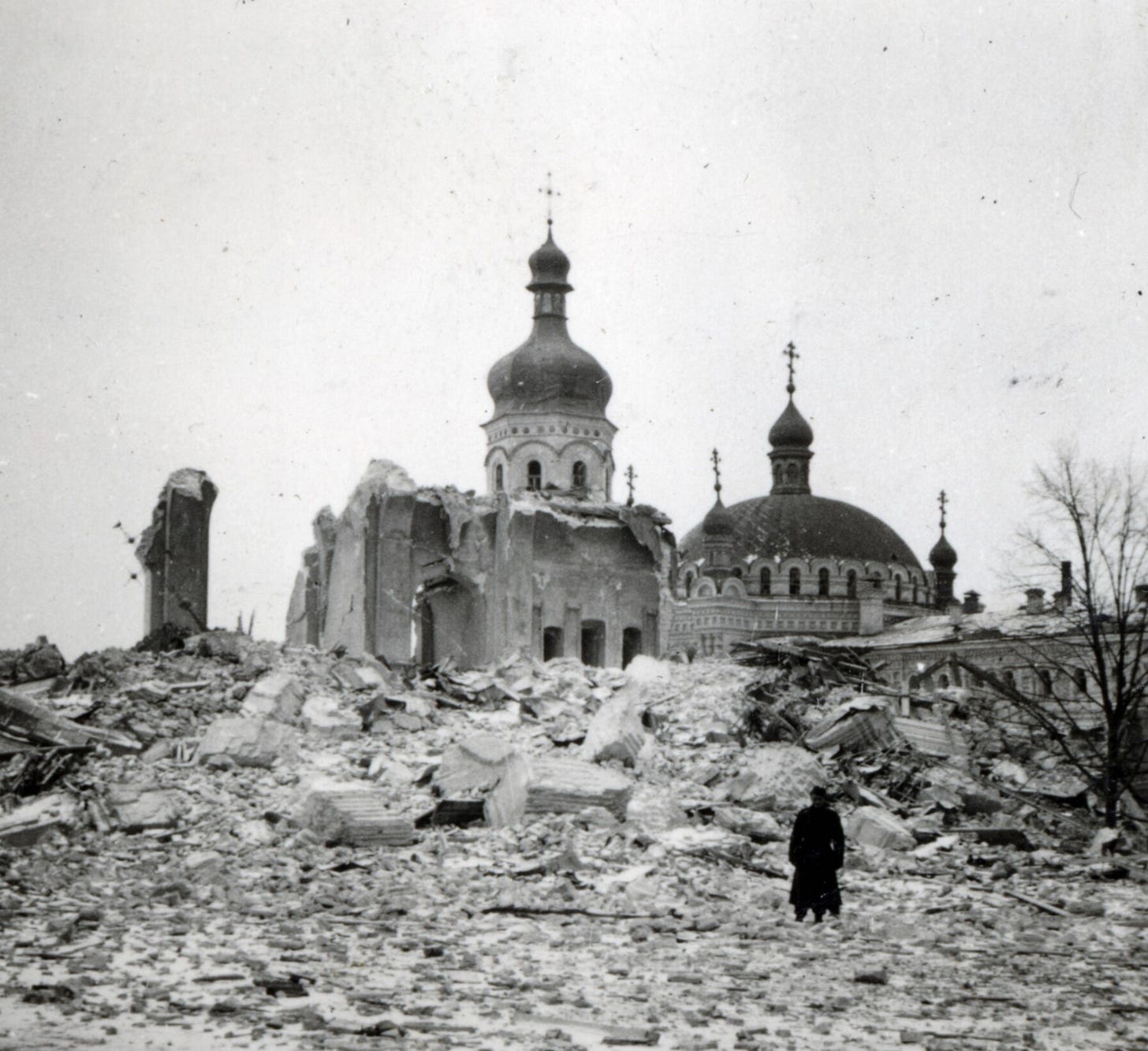
Credit as: Radio Free Europe/Radio Liberty.
A PATTERN OLDER THAN THIS WAR
This fits a pattern that readers of this series will recognise.
We have written before about the Executed Renaissance, the Soviet campaign of the 1930s to eliminate an entire generation of Ukrainian writers, poets, intellectuals and artists. We have written about the librarians of Bakhmach who cycled through the war zone preserving books from destroyed communities, carrying on a tradition of cultural resistance that has never fully stopped. The Lavra itself is part of that story. It survived the Mongol sack of Kyiv in 1240. It survived repeated Tatar raids. It survived the religious persecutions of the Polish-Lithuanian Commonwealth and the repressions of the Russian Empire. It survived Nazi occupation, though not without cost: on 3 November 1941, the Dormition Cathedral was destroyed by Soviet NKVD mines planted before the Red Army’s retreat, detonated while German forces occupied the city. Both sides blamed each other for decades. Independent Ukraine rebuilt the cathedral by 2000. Now Russia has set it on fire again.
Every century, a different power has attempted to erase what Ukraine is. The instruments change. The impulse does not.
What Russia understands, and what its sustained targeting of churches, monasteries, libraries, archives, museums, theatres and film studios confirms, is that cultural memory is itself a form of resistance. A people who know what they are and where they come from are harder to conquer and harder to absorb. Burn the Lavra and you do not merely damage a building. You reach back across a thousand years and try to sever a living people from the continuity that makes them who they are.
This is not collateral damage. It is the point.
THE G7 TIMING
Russia chose today specifically.
The G7 is in session. The world’s most powerful democratic governments are gathered at a summit. Zelenskyy addressed this directly in the early hours of this morning, calling on the G7 to respond decisively: more pressure on the aggressor, more support for Ukraine.
Whether that call produces meaningful action, or is absorbed into the usual communique language about grave concern and continued monitoring, is the open question this week will answer. Russia burned a thousand-year-old cathedral on the day the West was assembled and watching.
The message was plain: we will not stop, and we do not believe you will make us.
CLOSING
By morning, Bishop Avraamiy confirmed the treasures had been saved. The icons, the relics, the antimension cloths, all carried out by hand through smoke and darkness. The cathedral roof burned and the rain came and the firefighters worked through it and the shrines survived.
This is what Ukraine does. It has always been what Ukraine does. It carries the irreplaceable things out through the fire because it has learned, across centuries of occupation and erasure, that no one else is coming to carry them.
The Lavra will be repaired. The icons will go back. It has survived worse than this, and it will survive Russia too. What none of us should allow to become normal is a world in which a country wages a holy war by burning holy sites, and the men who blessed the bombs are never called to account for it.
Patriarch Kirill declared this a crusade. Last night, his crusade set fire to the oldest church in Eastern Europe.
Remember that the next time someone tells you this war is complicated.