One Night in May
The Deportation of the Crimean Tatars, 1944
AUG 15, 2026
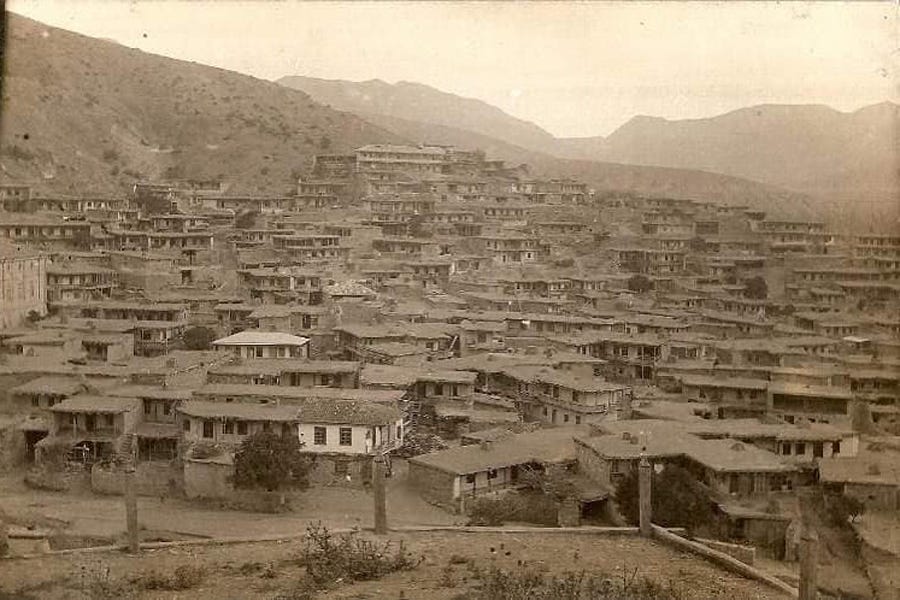
The village of Uskut, Crimea, 1945. Photographed after the deportation of its entire Crimean Tatar population. Every house still standing. Nobody left to live in them. Wikipedia. Public domain.
This photograph was taken in 1945. Look at it carefully. Every house is still standing. The streets are still there. The hills behind the village are the same hills they have always been. Nothing has been bombed. Nothing has burned.
The people are simply gone.
That is what the deportation of the Crimean Tatars looked like from the outside. A village with no village in it. Multiply that by every Tatar settlement on the peninsula, and you begin to understand what happened in Crimea between 18 and 20 May 1944.
In seventy two hours, an entire people vanished from their homeland.
THEY WERE STILL THERE
Part 2 ended with Russia humiliated. The Treaty of Paris in 1856 had stripped it of its Black Sea Fleet. Within fifteen years Russia had torn up that treaty. Within a century it had rebuilt the fleet, retaken the strategic dominance, and had absolute control of Crimea.
The Crimean Tatars were still there.
They had outlasted Catherine. They had outlasted the Crimean War. They had watched their population shrink from nine in ten Crimeans to a fraction of that, their place names erased, their Khan’s Palace turned into a tourist attraction. They had survived the chaos of the Russian Revolution, the brief years in the early 1920s when Crimea was designated an autonomous republic and there was a fragile, fleeting sense that things might be different under Soviet rule.
They had survived the collectivisation of the 1930s, which stripped Tatar farmers of their land and produced a famine that killed tens of thousands. They had survived Stalin’s purges, which removed most of their political and intellectual leadership.
They were still there.
Stalin decided that was the problem.
THE PRETEXT
The pretext, by now familiar, was collaboration.
When Nazi Germany occupied Crimea in 1941, some Crimean Tatars did collaborate with the German occupiers.
Hitler had explicitly ordered in July 1941 that Crimean Tatars were to be protected from expulsion, partly as a diplomatic signal to Turkey. German commanders offered the Tatar population things Stalin had spent a decade taking away: land reform, freedom of religious practice, improved food supply. After the Soviet collectivisation of the 1930s had killed tens of thousands of their people, some Tatars saw the Germans as the lesser of two brutal powers. Others fought with the Red Army until the last day of the war. Stalin chose not to distinguish between the two. So did some members of every occupied Soviet population, Russians, Ukrainians, Belarusians and Georgians. The vast majority of Nazi collaborators across the entire Soviet Union came from those core Slavic nationalities. None of them faced collective punishment.
What Stalin chose to do with the Crimean Tatars was different.
The Soviet accusation claimed 20,000 Tatar soldiers had deserted from the Red Army. The actual documented figure of deserters verified by the NKVD’s own records across all nationalities in Crimea for the entire war was 479. The 20,000 figure was not based on any investigation. Beria’s deputies Serov and Kobulov simply took the total number of Crimean Tatars conscripted into the Red Army and retroactively declared every single one of them a deserter. They provided no evidence because there was none.
The man whose racist reports formed the original basis for the treason charges was the Soviet partisan commander Mokrousov, who had banned Crimean Tatars from serving in his partisan units, ordered attacks on Tatar villages, and whose movement had collapsed from 3,000 members to 150 under his leadership. Official Soviet reports described him as too drunk to carry out basic military duties. The justification for deporting 200,000 people originated with an incompetent alcoholic whose reports were fabricated.
Over 80 percent of the deportees were women and children. The men were still fighting in the war, many of them in the Red Army fighting the same Germans they were being accused of collaborating with. When the war ended, 8,927 Crimean Tatar soldiers were demobilised from the Soviet military and sent directly to the special settlements rather than home. They had fought for the Soviet Union until the final day of the war. Their reward was exile.
On 11 May 1944, Stalin signed Order No. 5859. It described the Crimean Tatars as collectively guilty of treason. It ordered their total removal from Crimea. Every man, woman and child. The entire population of an indigenous people, to be loaded onto trains and transported to Central Asia.
Beria requested and received 32,000 NKVD troops for the task. He told Stalin it could be completed in three days.
He was right.
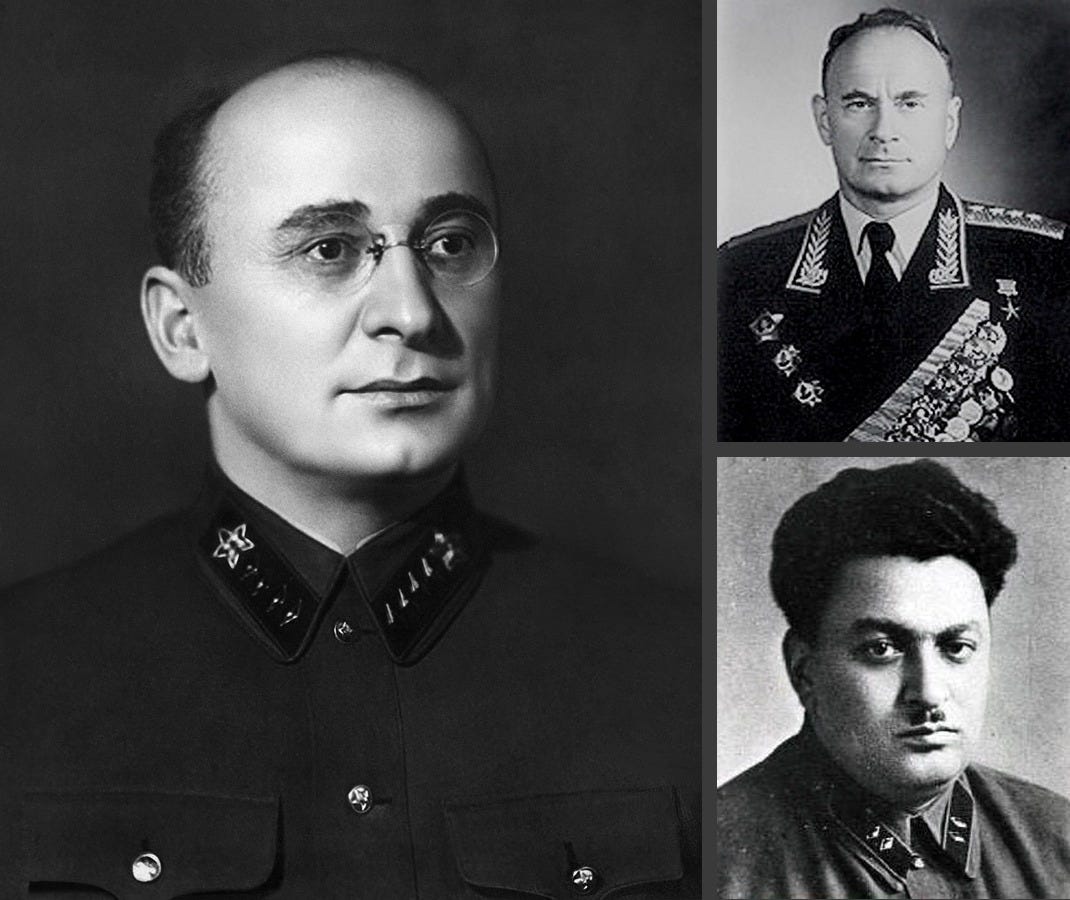
Left: Lavrentiy Beria, head of the NKVD, who proposed the deportation to Stalin and oversaw its execution. Top right: Ivan Serov, Deputy Head of the NKVD, who co-authored the fabricated treason charges claiming 20,000 Tatar deserters. Bottom right: Bogdan Kobulov, Deputy Head of the NKVD, who reported Crimea “cleansed of Tatars” and ordered the Arabat Spit killings when he discovered the operation was incomplete. All three were decorated for their role in the deportation. Wikimedia Commons. Public domain.
ONE NIGHT IN MAY
Nobody told the soldiers what the operation was until they were already in position.
In the early hours of 18 May 1944, 32,000 NKVD troops moved into place around every Tatar village and town in Crimea simultaneously. Their officers revealed the purpose of the mission only once the men were surrounding the houses. The Tatars had no warning.
Dilaver Ennanov, who was a boy in Simferopol that night, later described what happened:
“On the evening of May 17, numerous trucks appeared in Simferopol. Many, many soldiers appeared in the city. Suddenly, in the middle of the night, there was a loud knock on the door. I woke up to see an officer angrily reading something from a paper to my mother. Two soldiers stood before her. They hurried us, saying we had 10 minutes to gather our belongings. We were led out into the yard, where our neighbours, also Crimean Tatars, sat with their belongings in the rain, surrounded by internal troops. Cars arrived, and we were taken to the railway station. Amid tears, moans, and screams, the train began to move. As we crossed the border of Crimea, everyone on the train sang a song. They sang and wept, looking back.”
Usniye Cholpan remembered the same morning from a different village:
“In the early morning, Soviet soldiers burst into our house: Get ready. You traitors are being evicted. Where? Why? Confused and frightened, not understanding what was happening, the young children cried. First, I grabbed the Quran, then the frying pan and the coffee pot.”
She grabbed the Quran first. Then something to cook with. The things you reach for when you know you are not coming back.
Many grabbed only the Quran. They thought they were going to be shot, the way Jews were being shot by Germans across occupied Europe. Some did not even have time for that.
The vehicles that drove families from their homes to the railway stations were American trucks. Studebakers and Fords, supplied to the Soviet Union under the Lend-Lease programme as part of the Allied war effort against Nazi Germany. The same alliance fighting to liberate Europe was providing the transport for this.
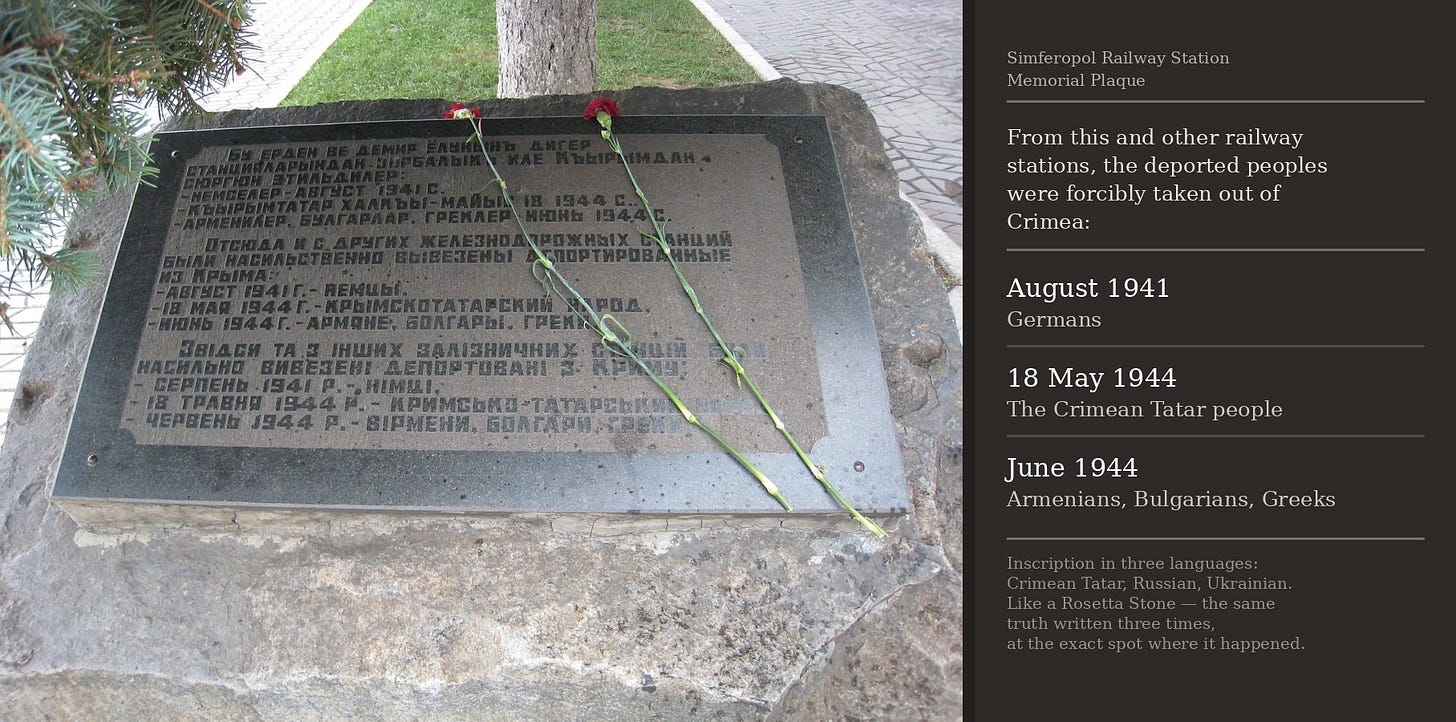
Memorial plaque at Simferopol railway station, marking the site from which the Crimean Tatar people were forcibly deported on 18 May 1944, along with Germans in 1941 and Armenians, Bulgarians and Greeks in June 1944. Two carnations left by visitors. Wikimedia Commons. Public domain.
The trains were cattle wagons. Sealed. No windows. No sanitation. In some wagons there was no room to lie down. The journey to Central Asia took between two weeks and a month. Food and water were provided intermittently, sometimes not at all. People died on the trains. The elderly died first, then children. Bodies were removed at stops, or left inside until the next one. Survivors described the smell. They described the sound. They described arriving and not knowing, for days, who among their family was still alive.
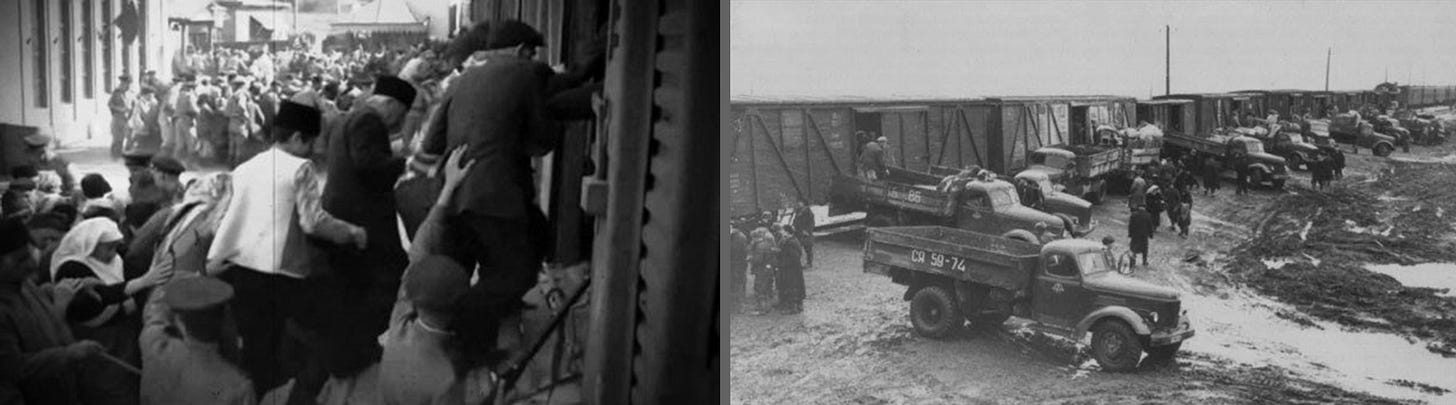
Left: Crimean Tatars being forced onto freight wagons at departure, Crimea, May 1944. The overwhelming majority of those loaded onto these trains were women and children. The men were still fighting in the Red Army. Right: Deportees arriving at their destination in Central Asia after a journey of up to 2,000 miles in sealed cattle wagons with little food, water or medical care. Many did not survive the journey. Public domain.
By the evening of 20 May 1944, Beria’s deputy reported to Moscow that the operation was complete. 173,287 people loaded onto 67 trains. 63 trains already on their way. The remaining four departing that day.
Then came his final line to Stalin:
“During the conduct of the resettlement operation, no incidents occurred.”
An entire people removed from their homeland in seventy two hours.
No incidents.
THE ARABAT BARGE
There was one problem the planners had not anticipated.
A small group of Crimean Tatars had been missed. Fishermen and salt miners living on the Arabat Spit, a narrow strip of land running along Crimea’s northeastern coast, separating the Sivash lagoon from the Azov Sea. Remote enough that the operation had passed them by. Most of the men were at the front. The people left in those villages were women, children and the elderly.
When Kobulov reported to Beria that Crimea had been cleansed of Tatars, they were at a ceremony awarding medals to the participants in the operation. Someone mentioned the forgotten villages. Kobulov’s response was immediate: if a single Tatar remained alive in two hours, heads would roll.
There was no time for trains. There was no plan.
A local official found a solution. The remaining Tatars were rounded up at a marina and locked in the hold of an old barge. The barge was towed out to the deepest part of the Azov Sea. The kingston valves, the valves in the hull designed to let water in, were opened. The upper hatches were sealed. The barge sank slowly to the bottom. Convoy boats patrolled the surface for hours afterward to make sure no one escaped.
It was not a military operation. It was not a state decree. It was an inconvenience, solved in an afternoon, at a moment when the people responsible were otherwise occupied celebrating.
That is what this state does when it meets an obstacle it did not plan for. It was true in 1944. Anyone watching what Russia does today when its plans meet unexpected resistance will recognise the instinct immediately.
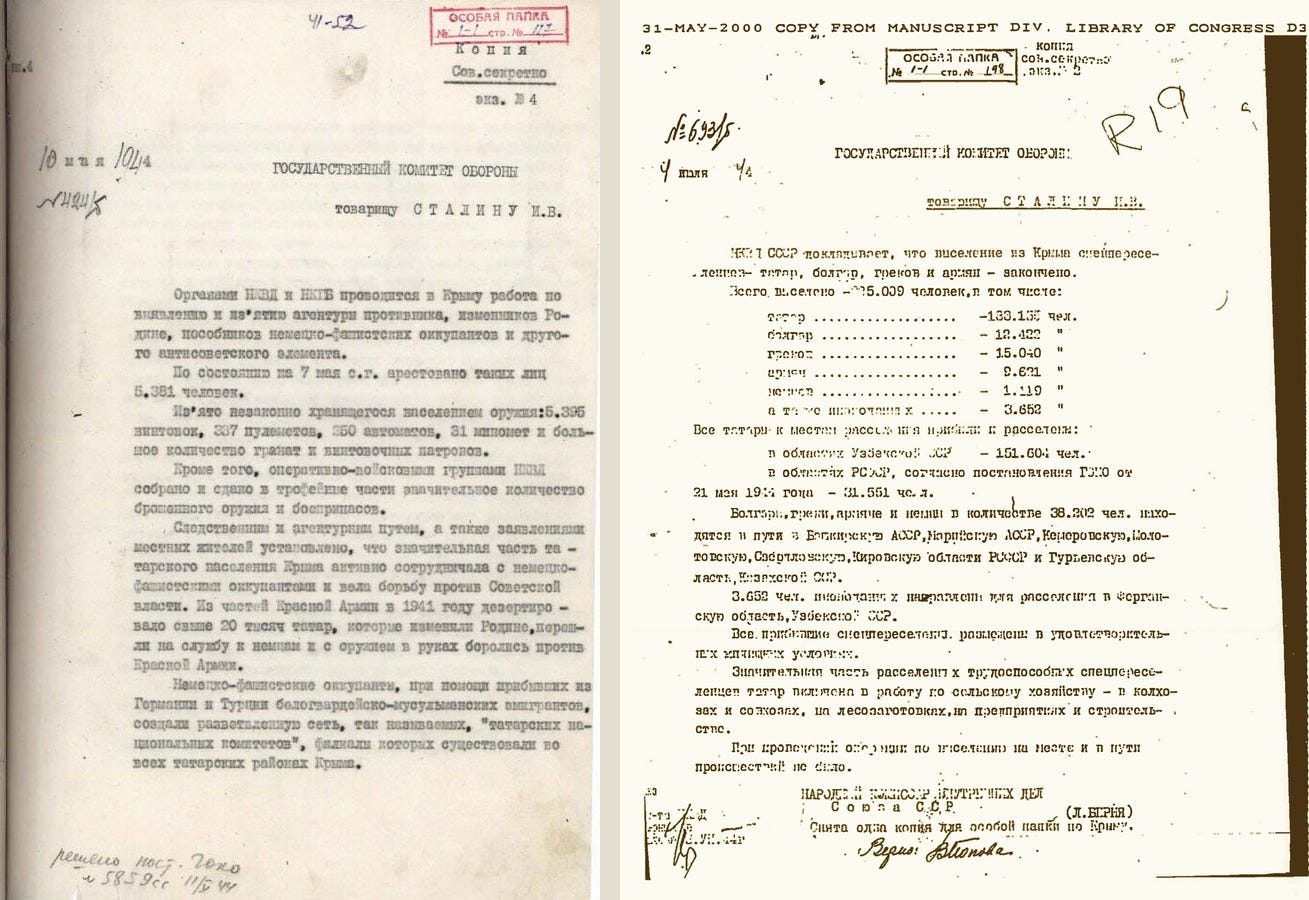
Left: Beria’s top secret memo to Stalin dated 10 May 1944, requesting permission to deport the entire Crimean Tatar population. Stamped “Special Folder. Top Secret.” Addressed to “Comrade Stalin I.V.” Right: The completion report signed by Beria, dated 4 July 1944. It lists the final numbers: 133,135 Tatars deported, along with 12,422 Bulgarians, 15,040 Greeks, 9,621 Armenians and others removed from Crimea. The final line reads: “During the conduct of the resettlement operation, no incidents occurred.” Copy from the Manuscript Division, Library of Congress. Public domain.
THE DEATH TOLL
Nobody knows exactly how many died.
The Soviet Union did not keep those records honestly. What is known comes from three sources: partial Soviet archives, Tatar community surveys, and survivor testimony.
The NKVD’s own internal report from October 1944 acknowledged that conditions in the places of exile were catastrophic. Huts unfinished. Bread rations of 150 grams per person per day. No shoes. No wages paid since July. Infectious diseases spreading through the camps.
One hundred and fifty grams of bread. That is the weight of a small apple. Per person. Per day. Recorded in the NKVD’s own documents.
When the deportees arrived in Uzbekistan, the locals had been primed by Soviet propaganda to receive them as traitors and enemies of the people. In some places they were met with stones. The imam in one village called them collaborators from the pulpit. Over 80 percent of the arriving deportees were women and children. That is who the stones were thrown at.
Official Soviet figures acknowledge that 44,887 special settlers from Crimea died in 1944 and 1945 alone, roughly 20 percent of those deported. That figure does not include those who died on the trains. Tatar community surveys from the 1960s, conducted by Crimean Tatar activists including Mustafa Dzhemilev, put the total death toll at 109,956, around 46 percent of all deportees, dead within the first eighteen months. Independent historians place the figure at somewhere between 18 and 30 percent.
Take the most conservative figure. Eighteen percent of 200,000 people is 36,000 dead. In under two years. Not on a battlefield. In camps, in huts, in a landscape nothing like the one they had come from, with 150 grams of bread and no shoes.
This happened while the world’s attention was on Normandy. The Allied landings in France began on 6 June 1944, eighteen days after the last Tatar was removed from Crimea. History was looking elsewhere.
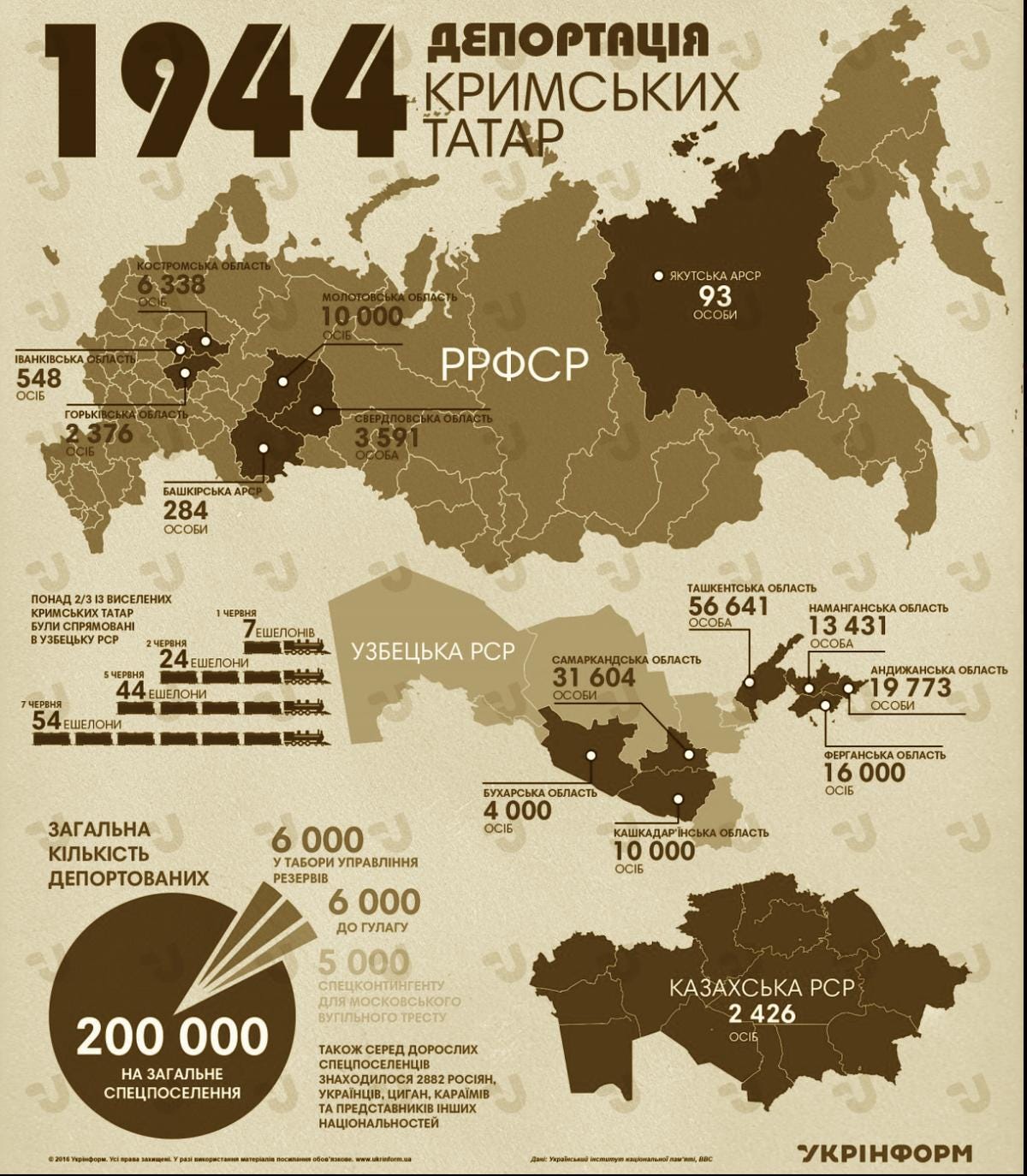
Where 200,000 people were sent. The overwhelming majority, around 151,000, were transported to Uzbekistan. The remainder were scattered across Siberia, Kazakhstan, the Urals and other remote regions of the USSR. The number of trains dispatched tells its own story: 7 on 1 June, 24 by 2 June, 44 by 5 June, 54 by 7 June. Source: Ukrinform / Ukrainian Institute of National Memory.
THE ERASURE
Within weeks of the deportation, the Soviet state began erasing the evidence that the Crimean Tatars had ever been there.
Tatar place names were wiped from maps for the second time in Crimean history. Catherine had done it in 1783. Now it happened again, faster and more completely. Over 80 percent of Crimean place names with Tatar origins were changed between 1944 and 1948. Villages renamed. Streets renamed. The Tatar language removed from schools, from publications, from public life. Books pulled from library shelves.
In some places, Crimean Tatar gravestones were pulled up and used as building material for roads. The dead were not permitted to mark the ground either.
The word Sürgün, which in the Crimean Tatar language means both expulsion and exile, became the name the Tatars gave to what had happened to them. It was a word they were forbidden to use publicly for decades.
Crimean Tatar homes were redistributed to new settlers. Soviet authorities seized 80,350 houses, 34,000 plots of land, around 50,000 head of cattle, vineyards, orchards, equipment and vehicles. All of it handed to migrants from the Russian interior.
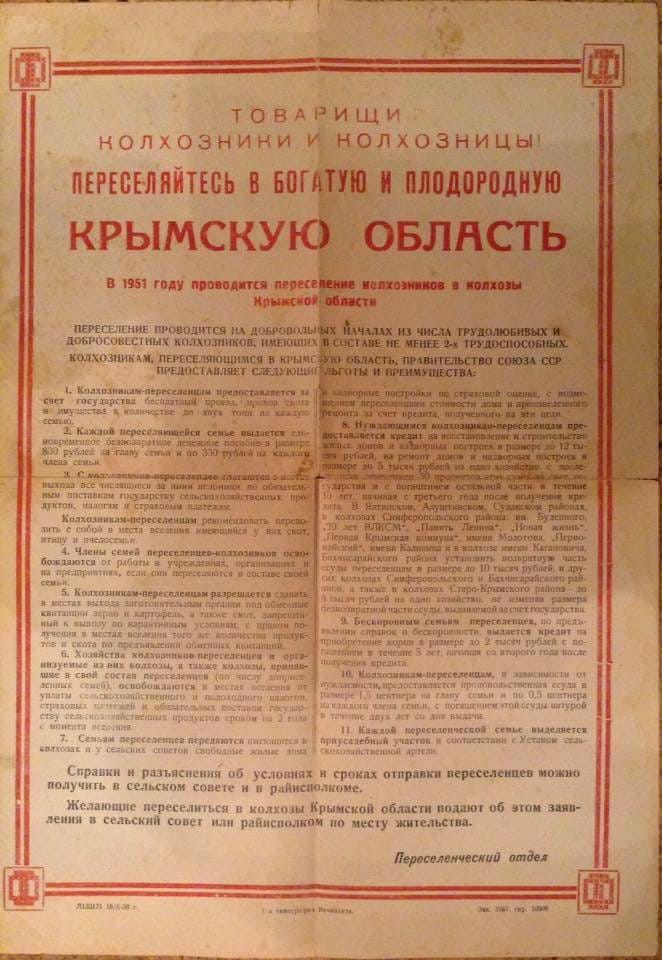
Soviet propaganda leaflet, 1951. “Comrades, resettle to the rich and fertile Crimean region.” Seven years after the deportation of the Crimean Tatars, the Soviet state was actively recruiting Russian settlers to take over the emptied peninsula, offering free transport, housing, loans and tax exemptions. Wikimedia Commons. Public domain.
The Khan’s Palace at Bakhchysarai was kept, as it had been kept under the Tsars, as a museum. As a curiosity. Stripped of the living culture that had built and maintained it for centuries.
A monument without a people.
THE RETURN THAT WASN’T
Stalin died in 1953. Khrushchev’s de-Stalinisation in the late 1950s rehabilitated many of the deported peoples, allowing them to return to their homelands.
The Crimean Tatars were specifically excluded.
Khrushchev publicly named the peoples who had suffered deportation. The Crimean Tatars appeared in his speech as “and others.” Two words. After everything that had been done to them, they were “and others.”
The official reason for their exclusion from rehabilitation was that Crimea had already been resettled and there was no room. The real reason was that return would mean acknowledging what had been done, and restitution of land that now belonged to someone else.
And if any Tatar tried to return anyway, a Soviet decree of November 1948 had already made the consequences clear. Escape from a place of compulsory settlement was punishable by twenty years of hard labour.
They remained in exile. In Uzbekistan. In Siberia. In Kazakhstan. Keeping their language alive in communities that had no country. Passing down the memory of villages they had been taken from as children to children who had never seen Crimea. Meeting in each other’s homes, speaking Crimean Tatar, talking always about the same thing.
“We all talked about Crimea,” Mustafa Dzhemilev later recalled. “ Deportation was one of the central topics. We remembered who was deported and how, who died on the road and who survived. Many people had only the Quran with them. They thought they would be shot, just as Jews were shot by Germans.”
The right to return came slowly and was never fully honoured. From 1989, during Perestroika, Tatars began coming back. When Ukraine became independent in 1991 they came in larger numbers. They came back to bureaucratic obstacles at every turn, to land disputes they almost always lost, to a Crimean government dominated by ethnic Russians who did not want them there. If a Tatar family managed to buy a house and settle, the house could be bulldozed and the family expelled from Crimea by force.
They came back anyway.
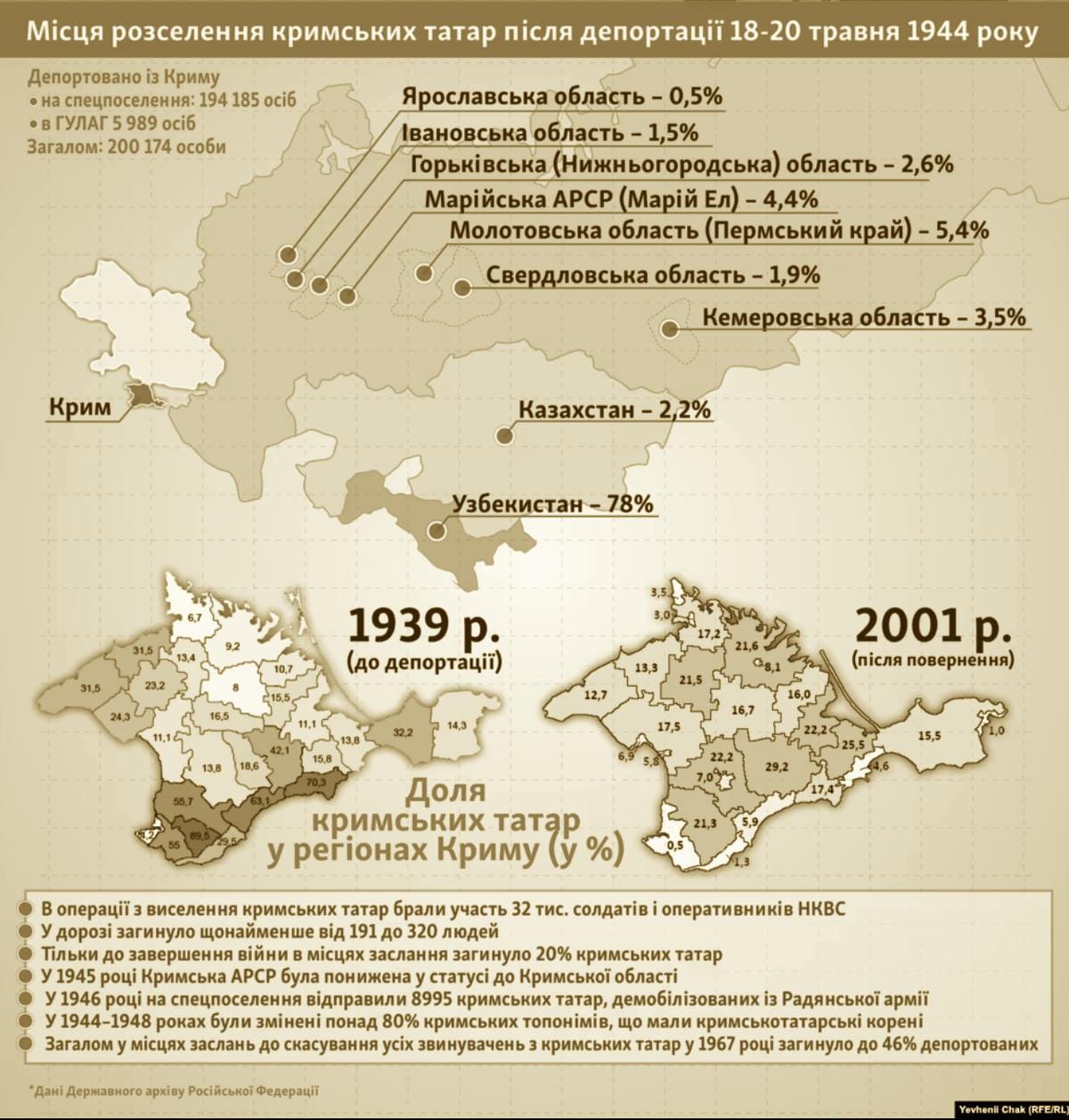
Two maps of Crimea tell the full story. Left: Crimea in 1939, before the deportation. The percentages show Tatar population by region. In the south and southwest, Tatars made up between 55 and 89 percent of the population. Right: Crimea in 2001, after the partial return. Those same regions now show Tatar populations in the low single figures. The deportation and the decades of exile did not just remove people. It unmade a presence that had existed for over five hundred years. Source: Radio Free Europe / Radio Liberty. Ukrainian State Archives.
THE THIRD TIME
When Russian forces took Crimea in February 2014, the Crimean Tatars were among the first to understand what it meant.
Their Mejlis, the representative assembly that functions as their parliament, was banned by Russian authorities in 2016 and designated an extremist organisation. Their leaders were arrested, expelled from Crimea, or disappeared. Their media outlets were shut down. Tatar language broadcasting was taken off air. Young Tatar men began disappearing, taken by Russian security services, some never found.
Under occupation, if three Crimean Tatars gathered together it was considered an unauthorised assembly. They found ways around it. Weddings. Birthday celebrations. Prayers at home. The same instinct for survival that had kept the culture alive in Uzbekistan for forty years.
The pattern is not new. It is not subtle. It is the same pattern applied to this people three times now, across two and a half centuries.
Take the land. Remove the people. Erase the evidence. Call anyone who objects an extremist.
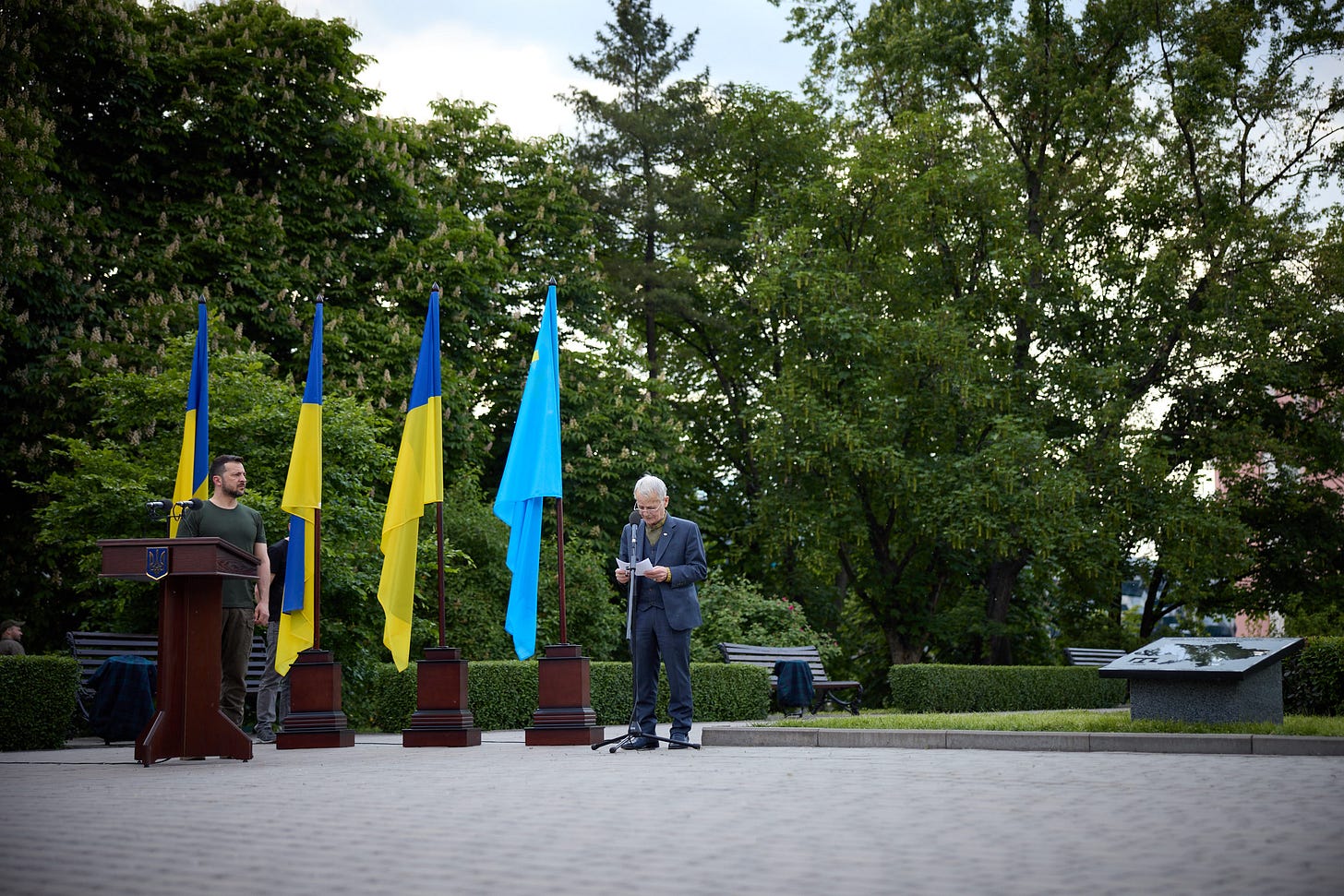
President Zelenskyy and Mustafa Dzhemilev at the commemoration of the 80th anniversary of the Crimean Tatar deportation, 18 May 2024, Kyiv. The Ukrainian and Crimean Tatar flags side by side. Office of the President of Ukraine. Public domain.
Mustafa Dzhemilev spent fifteen years in Soviet prisons for refusing to renounce his people’s right to their homeland. He staged hunger strikes that lasted months. He survived. He came back to Crimea. He was elected head of the Mejlis. He served in the Ukrainian parliament. He spent his entire adult life fighting to be allowed to exist in the place he was born.
In 2014, Russian authorities banned him from entering Crimea.
He was seventy years old.
He was born in Crimea on 13 November 1943. His family was deported on 18 May 1944.
He was six months old.
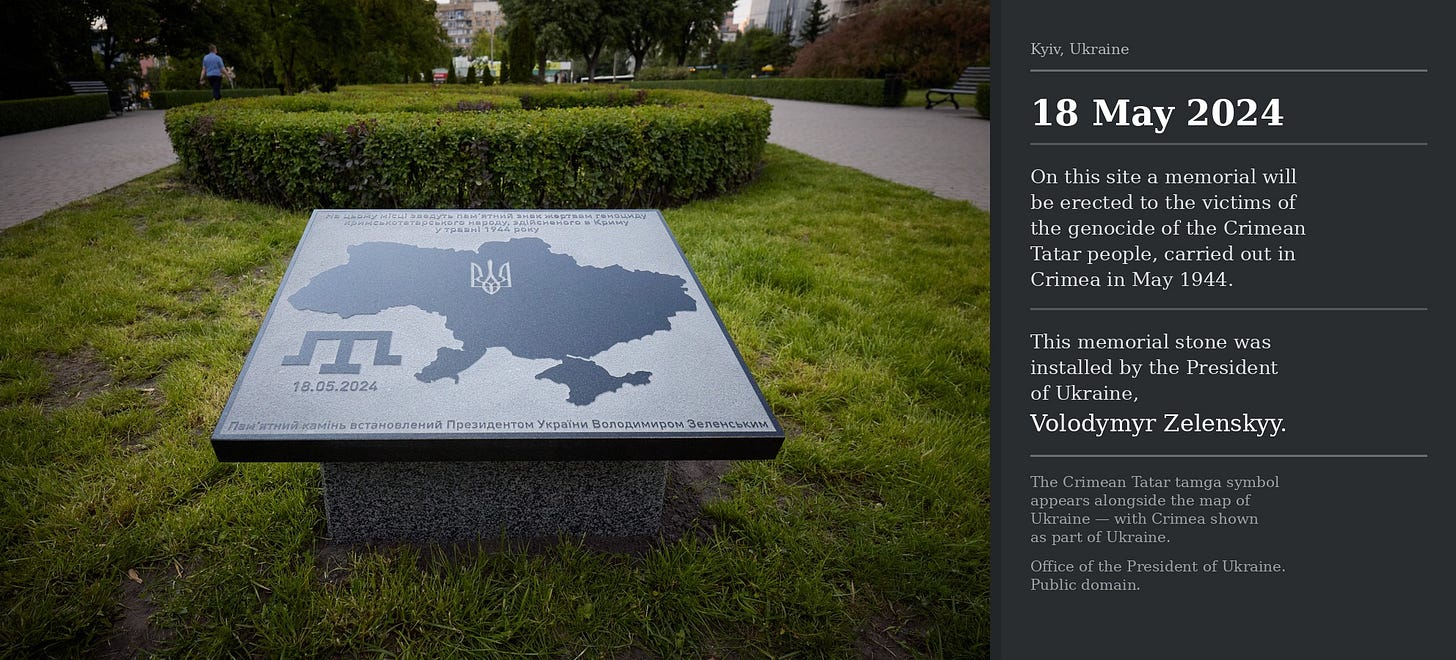
A commemorative stone laid by President Zelenskyy on 18 May 2024, the eightieth anniversary of the deportation, marking the site of a future memorial to the victims of the Crimean Tatar genocide. The Crimean Tatar tamga symbol and the map of Ukraine with Crimea shown as part of it. Kyiv, Ukraine. Office of the President of Ukraine. Public domain.
NEXT
Three times Russia has taken Crimea. Three times it has used the same tools. A pretext. A promise of protection. And then erasure.
Catherine renamed the streets. Stalin emptied them. Putin locked the doors.
What none of them has managed, across two hundred and forty years of trying, is to erase the memory of the people who were there first.
Part 4 is the story of how Russia took Crimea for the third time, and what it has done there since.
Sources: NKVD Order No. 5859, 11 May 1944; Beria report to Stalin, 4 July 1944, Library of Congress Manuscript Division; J. Otto Pohl, “The False Charges of Treason against the Crimean Tatars,” International Committee for Crimea, 2010; Aurélie Campana, “Sürgün: The Crimean Tatars’ Deportation and Exile,” Sciences Po, 2008; Mubeyyin Batu Altan, “The Arabat Tragedy,” International Committee for Crimea; Ukraïner, “Genocide of the Crimean Tatars,” 2026; Euromaidan Press, “Sürgünlik: Remembering Stalin’s Deportation of the Crimean Tatars,” 2020; Survivor testimony of Dilaver Ennanov and Usniye Cholpan, Ukrainian Institute of National Memory; Vladyslav Havrylov, “Deportation of Crimean Tatars in 1944,” Ukraïner; Slavinska Iryna and Pavlov Danylo, “Stop Asking, Start Demanding: Portrait of Mustafa Dzhemilev,” The Ukrainians, 2023; Human Rights Watch, “Crimea: Tatar Community Under Pressure,” 2014; Ukrinform deportation infographic, 2016; Radio Free Europe / Radio Liberty, Crimean Tatar deportation data.